18V vs 24V vs 40V Battery Systems for Cordless Equipment
Cordless equipment has expanded far beyond drills and impact drivers. Today, the same battery-platform decisions affect saws, vacuums, string trimmers, blowers, chainsaws, lawn mowers, and heavier commercial equipment.
In practical terms, 18V systems favor portability and ecosystem breadth, 24V systems offer a useful middle ground, and 40V-class systems are better suited to sustained high-load applications. The right choice still depends on power demand, runtime, pack weight, charger and tool compatibility, and the equipment you plan to operate.
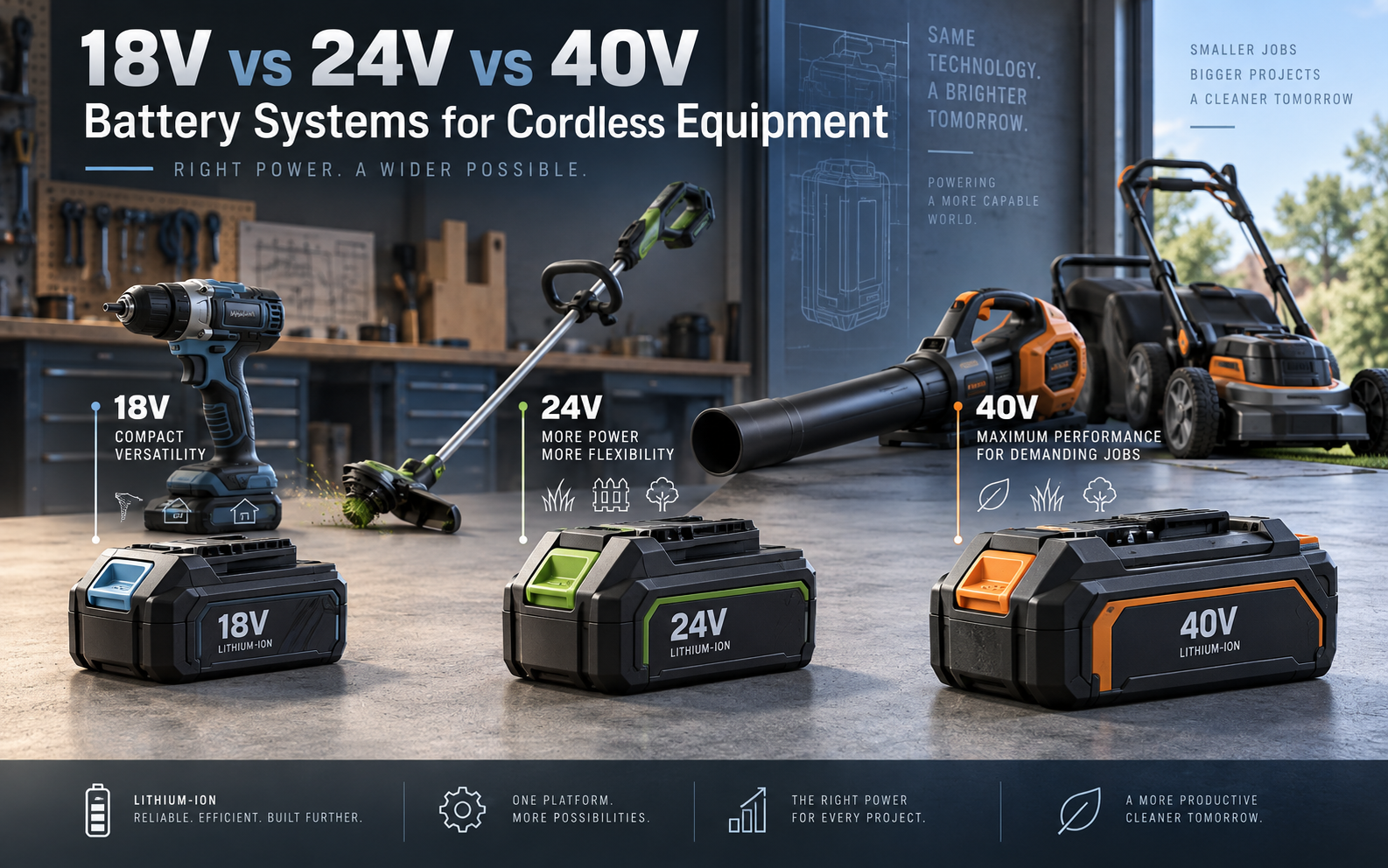
18V vs 24V vs 40V Battery Systems: Quick Comparison
For most buyers, the fastest way to compare cordless equipment battery voltage is to look at the whole system instead of the number printed on the pack.
| Factor | 18V / 20V Max | 24V-Class | 40V-Class |
|---|---|---|---|
| Typical positioning | General-purpose cordless tools | Mid-range power and portability | Sustained high-load equipment |
| Portability | High | Medium to high | Lower |
| Battery weight | Usually lower | Moderate | Usually higher |
| Ecosystem breadth | Extensive | More limited | More specialized |
| Power potential | General to high | More output headroom | Strong sustained-load potential |
| Typical applications | Drills, drivers, compact saws, maintenance tools | Handheld tools, trimmers, outdoor equipment | Mowers, blowers, chainsaws, heavy equipment |
| Main advantage | Versatility | Balance | High-load performance |
| Main trade-off | Lower voltage ceiling | Smaller ecosystem | Weight, size and system cost |
An 18V battery system is usually the most practical starting point for general construction, repair, and maintenance work. Mature 18V ecosystems cover a very broad range of equipment, and buyers can choose from many power tool replacement batteries for established cordless platforms.
A 24V battery system occupies a narrower position. It offers additional voltage without moving directly into the larger packs commonly associated with 40V-class equipment.
A 40V system makes more sense when the application requires sustained power for larger motors or heavier continuous loads. Lawn care equipment is one of the clearest examples.
There is no universal winner. A drill and a commercial mower place very different demands on a battery pack.
What Do 18V, 24V and 40V Actually Mean?
Battery voltage describes the electrical potential of the pack. In lithium-ion cordless equipment, manufacturers build a required voltage by connecting multiple cells in series.
The label on the battery, however, does not always represent voltage in exactly the same way.
Nominal Voltage vs Maximum Voltage
Nominal voltage is the approximate operating voltage used to describe a battery system during normal discharge. Maximum voltage refers to a higher voltage near the top of the charge range.
That distinction explains why seemingly different battery labels can describe similar electrical platforms.
A common 18V lithium-ion pack uses five series-connected cells. With each cell around 3.6V nominal, the pack is approximately 18V nominal. Some manufacturers market this class as 20V Max.
Likewise, some battery systems marketed around 40V are electrically closer to a 36V nominal architecture.
For engineering comparisons, nominal voltage is usually the cleaner reference point. If you are evaluating a replacement battery for an existing tool platform, it is useful to first understand how to match battery voltage with your power tool platform.
Typical Lithium-Ion Cell Configurations
| Marketed Platform | Typical Series Configuration | Approx. Nominal Voltage |
|---|---|---|
| 18V / 20V Max class | 5S | 18V |
| 24V class | 6S | 21.6V |
| 40V Max class | 10S | 36V |
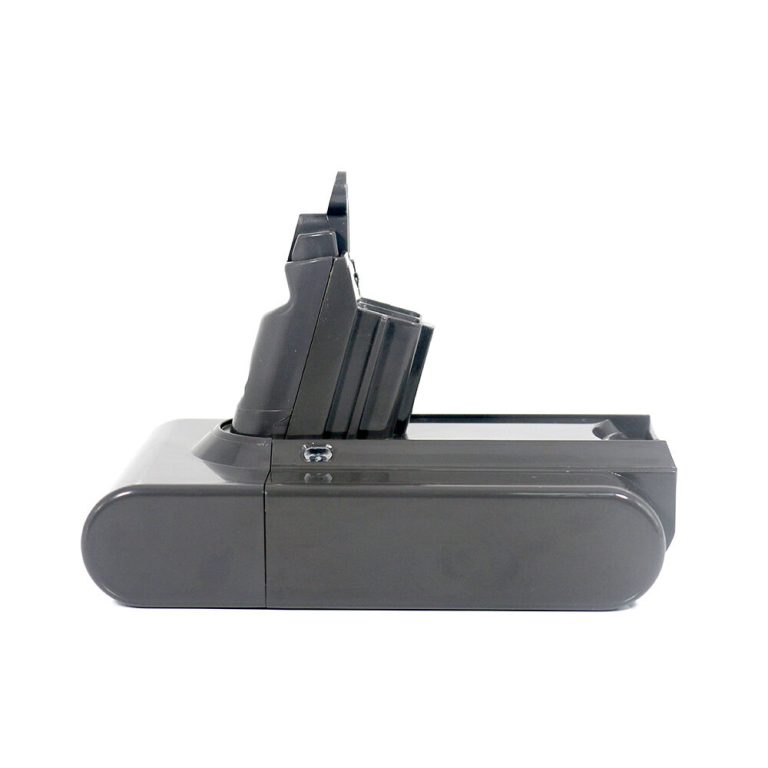
A typical 6S lithium-ion pack may reach about 25.2V when fully charged, which helps explain the use of a 24V-class label. A practical example is a 21.6V 6S lithium battery pack used in cordless equipment outside the traditional power tool category.
These voltage classes describe electrical architecture. They do not imply battery interchangeability. Two batteries can have similar nominal voltage and still use completely different housings, terminals, communication systems, and charger requirements.
Does Higher Voltage Mean More Power or Longer Runtime?
Voltage affects how a cordless system can deliver power, but the battery pack still has to provide enough current and energy for the job.
Two simple relationships explain most of the difference.
Voltage, Current and Power
Electrical power can be approximated as:
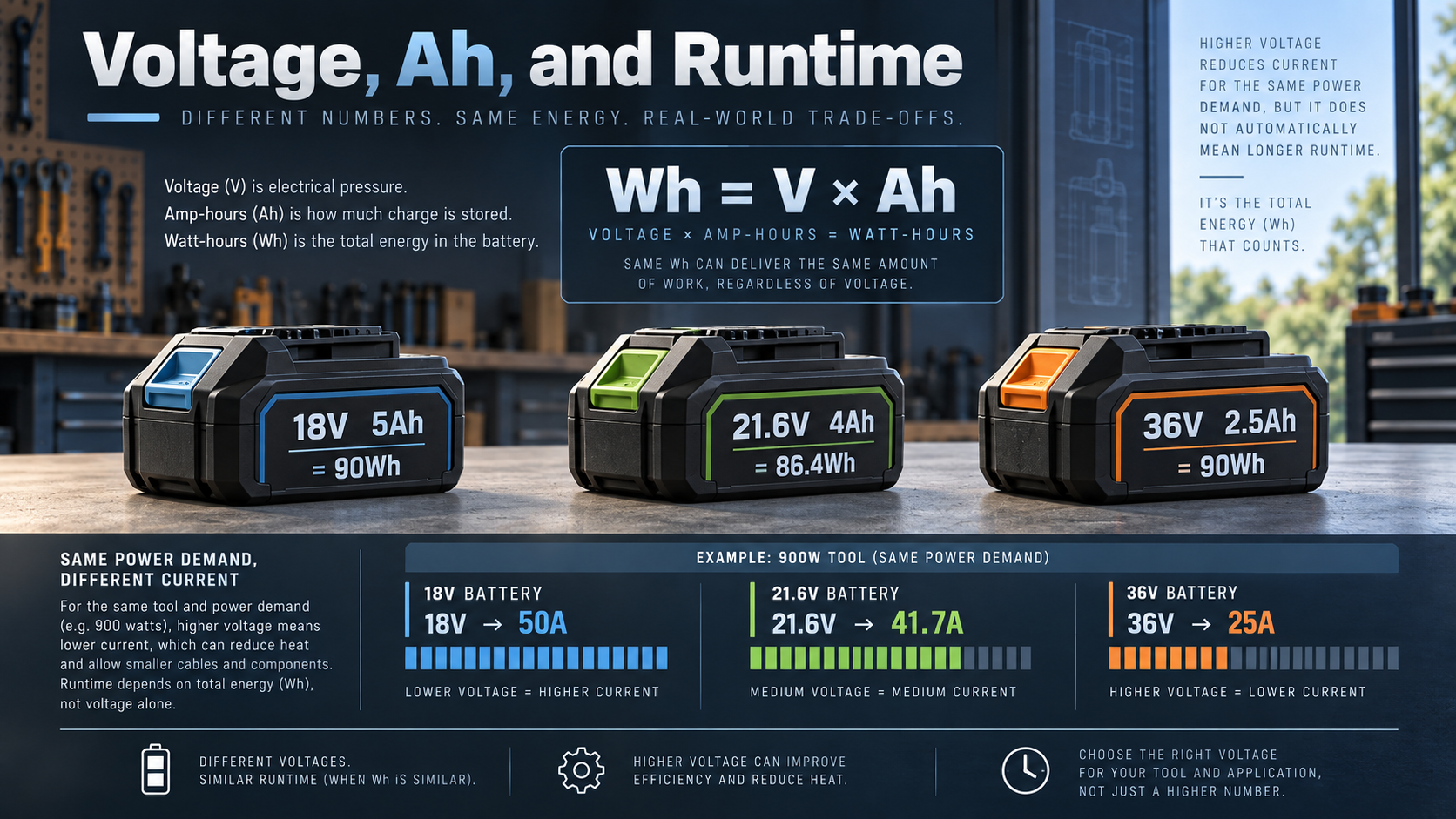
Power = Voltage × Current
For the same power requirement, increasing system voltage reduces the current required.
Consider an illustrative 900W electrical load:
| Nominal System Voltage | Approx. Current at 900W |
|---|---|
| 18V | 50A |
| 21.6V | 41.7A |
| 36V | 25A |
This is one reason higher-voltage battery systems become attractive for demanding cordless equipment. Lower current for the same power can reduce resistive losses through conductors, contacts, and other parts of the electrical path.
The calculation does not predict actual tool output by itself. Real performance still depends on cell discharge capability, pack resistance, BMS limits, voltage sag, motor and controller efficiency, and thermal management.
That is also why two 18V packs with the same Ah rating can behave very differently in a high-load tool.
Voltage, Ah and Watt-Hours
Amp-hours, or Ah, describe electrical charge capacity. For comparing stored battery energy across different voltage systems, watt-hours, or Wh, are more useful.
Wh = V × Ah
For example:
| Battery Example | Theoretical Stored Energy |
|---|---|
| 18V 5Ah | 90Wh |
| 21.6V 4Ah | 86.4Wh |
| 36V 2.5Ah | 90Wh |
The 18V 5Ah and 36V 2.5Ah examples both contain about 90Wh of theoretical energy.
So a higher-voltage battery does not automatically provide longer runtime.
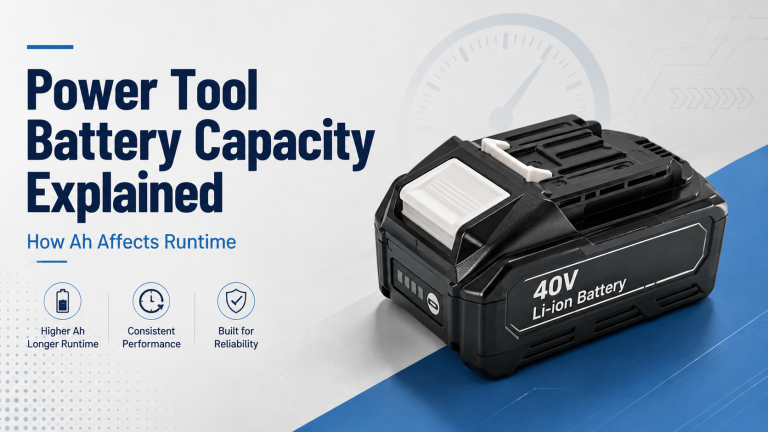
Actual runtime also depends on how quickly the equipment consumes that stored energy. A high-CFM blower operating continuously can drain a large pack much faster than an intermittently used drill. For a deeper look at this relationship, see our guide to power tool battery capacity and runtime.
Multi-voltage systems illustrate the same principle. A configuration that provides 36V at 4Ah or 18V at 8Ah stores about 144Wh theoretically in either case.
18V vs 24V vs 40V: Strengths and Trade-Offs of Each System
The three voltage classes become easier to understand when viewed through the equipment they are designed to support.
18V / 20V Max: Portability and a Broad Tool Ecosystem
The 18V class remains the general-purpose workhorse of cordless equipment.
It is well suited to equipment that combines moderate-to-high intermittent power demand with frequent handling. Drilling, fastening, finish carpentry, sanding, HVAC service, and compact cutting are natural applications.
Typical examples include:
- drills and impact drivers
- compact circular and reciprocating saws
- sanders and polishers
- installation and maintenance tools
- light-to-medium-duty cutting equipment
Weight matters here. A smaller 18V battery is easier to use overhead, on ladders, or in confined spaces. Larger-capacity packs can then be fitted when runtime or output becomes more important.
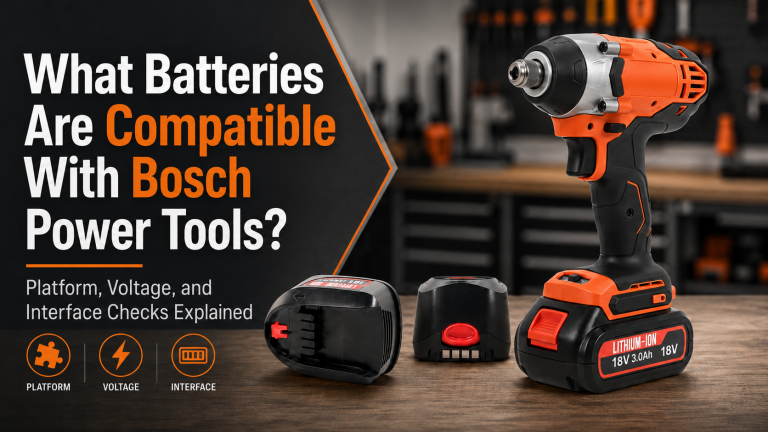
The other major advantage is ecosystem maturity. Platforms such as Makita LXT, Bosch 18V, and DeWalt 20V Max demonstrate how much equipment can be built around this voltage class. GeB Power, for example, offers an 18V replacement battery system with multiple capacity options for compatible cordless tools.
That breadth often matters more in day-to-day work than gaining a modest voltage increase.
24V: The Middle Ground
A 24V-class system gives designers more voltage headroom while remaining practical for handheld equipment.
That makes the platform interesting for applications such as higher-load handheld tools, large drilling or cutting tasks, hedge trimmers, string trimmers, selected outdoor power equipment, and light commercial equipment.
For a fixed power demand, the higher voltage can reduce current compared with an 18V system. The pack may therefore deliver demanding loads without pushing cell current as aggressively.
The main limitation is platform breadth. The 24V ecosystem is smaller than the mature 18V market, and the availability of tools, chargers, and replacement batteries varies considerably by manufacturer.
For that reason, 24V works best when the available equipment matches the intended application. The voltage advantage has little value if the platform lacks the tools needed later.
40V-Class: Designed Around Sustained High Loads
A 40V-class battery platform is especially useful when the equipment demands continuous power rather than short bursts.
Typical applications include:
- lawn mowers
- high-output leaf blowers
- string trimmers
- chainsaws
- commercial landscaping equipment
- heavy cutting equipment
- selected concrete and construction equipment
These products often use larger motors and run under load for longer periods. Higher voltage can make that power easier to deliver without requiring extremely high current throughout the system.
The trade-off is physical. Higher-voltage packs generally contain more series-connected cells, so battery size, weight, and cost tend to increase.
A 40V 10S high-power lithium battery pack is a good example of how higher-voltage architectures are used for more demanding power requirements.
Makita’s 18V LXT and 40V Max XGT platforms illustrate a useful industry approach. The higher-voltage platform serves demanding applications while the established 18V platform continues to cover routine work efficiently.
That is a good way to think about 40V: an extension for workloads that justify it, rather than a universal replacement for lower-voltage equipment.
Which Battery Voltage Is Best for Different Cordless Equipment?
Voltage selection becomes much clearer when matched to workload.
| Equipment / Workload | 18V | 24V | 40V-Class |
|---|---|---|---|
| Drill / impact driver | Excellent | Good | Usually unnecessary |
| Compact saw | Excellent | Excellent | Application-specific |
| HVAC / maintenance | Excellent | Good | Usually unnecessary |
| String trimmer | Suitable | Very suitable | Very suitable |
| Leaf blower | Light to moderate use | Suitable | Strong fit |
| Chainsaw | Light-duty options | Suitable | Strong fit |
| Lawn mower | Application-specific | Possible | Strong fit |
| Commercial landscaping | Limited by workload | Suitable | Strong fit |
| Heavy continuous cutting | Application-specific | Application-specific | Strong fit |
The key distinction is often peak power versus continuous power.
A drill may produce brief high-current events followed by periods of lighter load. A mower or blower can demand substantial power continuously for many minutes. Battery voltage, current capability, and thermal design become increasingly important as continuous load rises.
For lawn care equipment, pack selection therefore has to account for duty cycle, discharge current, thermal behavior, and usable energy. Our guide to battery pack requirements for cordless lawn and garden equipment covers these factors in more detail.
Leaf blowers are another useful example because they can place sustained electrical demand on the battery. If this is your application, see how to choose a battery for a cordless leaf blower.
For long-duration handheld work, weight can move the decision in the other direction. More available power is useful only when the operator can comfortably manage the equipment.
Why Battery Platform and Compatibility Matter More Than the Voltage Label
A replacement battery must match the electrical and mechanical requirements of the equipment.
Voltage is one compatibility factor. It does not define the complete interface.
Battery platform compatibility can also depend on:
- original battery reference
- mounting rails and locking geometry
- terminal position and electrical contacts
- connector design
- battery-to-tool communication
- discharge-current requirements
- charger model and charging logic
- enclosure dimensions
This matters even within the same voltage class. Two 18V batteries from unrelated platforms may both be based on five series lithium-ion cells and still be completely incompatible.
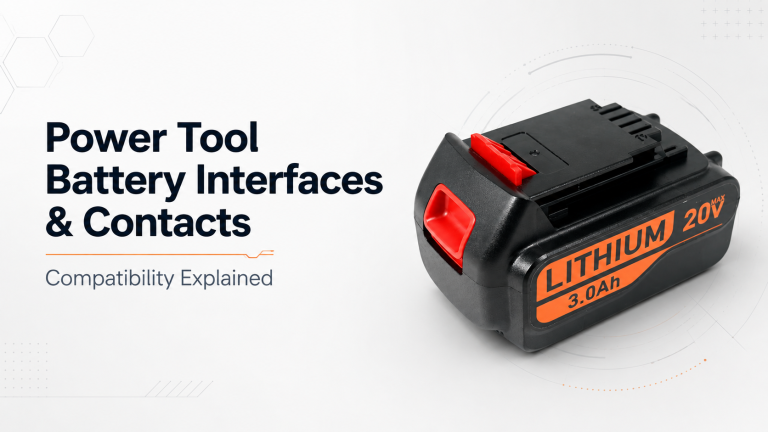
For buyers working across multiple brands or tool generations, our guide on whether power tool batteries are interchangeable explains why voltage matching is only the first step. Mechanical fit and contact design are equally important, which is why power tool battery interfaces and contacts should be checked before approving a replacement model.
Multi-voltage products make the platform issue even clearer. DeWalt FlexVolt and Metabo HPT MultiVolt use battery architectures designed to serve different voltage requirements within defined tool ecosystems. Their capability comes from the complete system design, not from a voltage label by itself.
For replacement battery projects, compatibility should therefore be verified against the actual battery, tool, and charger models before samples or production are approved.
How to Choose Between 18V, 24V and 40V
A useful decision starts with the equipment workload, then works back to the battery.
If You Already Own a Cordless Platform
Existing batteries and chargers have economic value. If an established 18V platform already handles most work, replacing the entire system to gain more power for one or two applications rarely improves overall efficiency.
A dual-platform strategy can make more sense.
For example, a contractor may retain 18V equipment for drilling, fastening, maintenance, and routine cutting, then add a 40V-class platform for concrete work, heavy cutting, or landscaping.
Before adding another voltage system, review:
- which existing tools share batteries
- how many batteries and chargers are already in service
- which workloads currently create performance limits
- whether those loads are occasional or continuous
- what future equipment is available on the new platform
This keeps the decision focused on operating value instead of specification sheets.
If You Are Selecting a Battery System for OEM/ODM Equipment
OEM and ODM battery projects need a broader engineering review.
The voltage decision should be made together with:
- application and duty cycle
- peak and continuous load
- required discharge current
- target runtime and watt-hours
- cell configuration
- BMS and protection requirements
- thermal path
- enclosure volume and weight target
- connector and interface design
- charger requirements
- sample validation criteria
For a battery-powered blower, mower, industrial tool, or other cordless equipment, these variables influence each other. Increasing voltage changes pack architecture. Increasing runtime usually means adding energy capacity, which affects pack size and weight. Higher current changes the requirements for cells, conductors, contacts, protection, and thermal management.
That engineering review is more useful than selecting a voltage first and forcing the rest of the equipment around it.
GeB Power supports this type of work through battery engineering services, compatibility review, OEM/ODM development, and sample validation.
FAQ: 18V vs 24V vs 40V Battery Systems
Is 40V Always Better Than 18V?
No. A 40V-class platform is well suited to sustained high-load equipment, while an 18V platform usually provides better portability and a much broader selection of general-purpose tools.
For drills, drivers, maintenance equipment, and many cutting applications, 18V remains highly practical.
Does Higher Voltage Mean Longer Runtime?
No direct relationship exists without considering battery capacity and equipment load.
Compare stored energy in watt-hours:
Wh = nominal voltage × Ah
Then consider how much power the equipment consumes during actual operation.
Is 24V More Powerful Than 18V?
A 24V-class system provides more voltage and can reduce the current required to deliver a given amount of power.
Actual tool output still depends on the battery cells, BMS current limits, motor, controller, and thermal design. Voltage creates design headroom; the complete system determines performance.
Can I Use a 24V Battery on an 18V Tool?
Only if the equipment platform was specifically designed to support that battery configuration.
A matching connector shape is not sufficient evidence of compatibility. Tool voltage, terminals, communication requirements, and charger design all need to match.
Are All 18V or 40V Batteries Interchangeable?
No.
Batteries with the same advertised voltage can use different housings, mounting rails, electrical contacts, communication protocols, and charging requirements. Compatibility should be confirmed against the original battery, equipment, and charger references.
What Matters More, Volts or Amp-Hours?
They describe different properties.
Voltage affects the electrical architecture and how power can be delivered. Amp-hours describe charge capacity. For comparing stored energy across battery systems, watt-hours are usually more useful.
An 18V 5Ah battery stores about 90Wh theoretically. A 36V 2.5Ah pack also stores about 90Wh.
Choosing the Right Battery System
For general cordless tools, 18V remains the strongest all-around platform because of portability and ecosystem breadth. A 24V system can offer a useful balance where the equipment range supports it, while 40V-class platforms are better suited to sustained high-load cordless equipment. Power demand, watt-hours, weight, and platform compatibility should all be reviewed before committing to a system.
GeB Power supplies compatible replacement power tool batteries and supports OEM/ODM battery projects through compatibility verification, pack engineering, sample validation, and structured production handoff. If you are evaluating an 18V, 24V, or 40V-class battery solution for a specific cordless equipment project, contact us with the application, load, voltage, target runtime, interface, charger, and expected quantity so the project can be reviewed on the right technical basis.