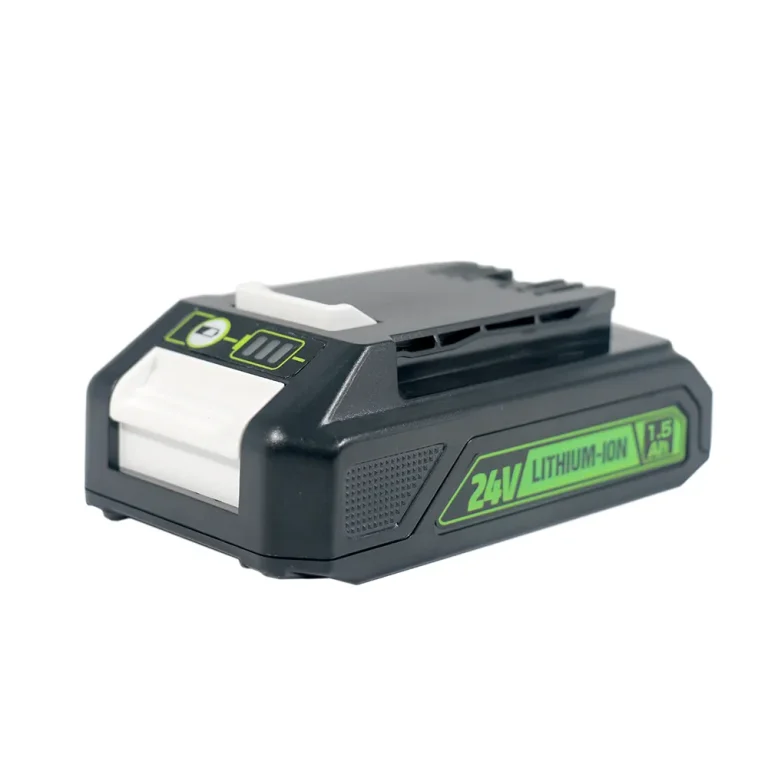
Battery Pack Considerations for Cordless Polishers: Runtime, Heat and Weight
Cordless polishers occupy a demanding niche in the power-tool landscape. Unlike drills or impact drivers that deliver power in short bursts, a polisher runs continuously at high RPM for minutes on end, pushing a buffing pad against curved paintwork with constant friction. The cordless polisher battery pack behind it must sustain high discharge currents, shed heat generated deep inside the cell stack, and keep the tool’s centre of gravity low enough that an operator can hold it steady for an hour or more.
For distributors, brand owners and engineering teams sourcing replacement power tool batteries or custom battery packs, three parameters dominate every specification conversation: runtime, heat and weight. Get any one of them wrong and the end user feels it immediately — either through a dead pack mid-job, a swollen cell after a summer of detailing, or wrist fatigue that sends them back to a corded tool.
A cordless polisher places sustained high-load demands on its battery pack — runtime, thermal behaviour and weight all interact.

Runtime: Capacity Alone Does Not Tell the Whole Story
When buyers ask “how long does this pack last on a polisher,” the reflex answer is a capacity figure in ampere-hours (Ah). That number is a starting point, not a conclusion. Real-world cordless polisher battery runtime depends on the interaction of capacity, cell chemistry, continuous discharge capability, and the polisher’s own current draw profile.
A typical cordless polisher draws somewhere in the range of 15 to 25 amps under load, depending on pad size, speed setting and whether it is a rotary or random-orbital type. A 4.0 Ah pack built with quality 18650 or 21700 cells and a 20A continuous discharge rating can deliver roughly 15 to 25 minutes of active polishing before voltage sag triggers the tool’s low-battery cut-off. Move to a 5.0 Ah pack with the same cell platform and that window extends to around 20 to 30 minutes.
These are working estimates — actual figures vary with pad pressure, compound viscosity and ambient temperature — but they frame the conversation around what an operator can achieve between swaps.
20–30 min — Typical active polishing window, 5.0 Ah pack
Several engineering details separate a pack that delivers its rated capacity from one that falls short. Cell grouping and matching matter: cells with mismatched internal resistance cause the weakest cell to hit cut-off voltage first, leaving usable energy stranded in the rest of the pack.
A well-engineered BMS (battery management system) balances cells during charge and protects against over-discharge during use, but it cannot compensate for cells that were poorly sorted at the pack-assembly stage. For OEM/ODM battery pack engineering projects, this is why cell grading and matching protocols should appear on the factory’s QC checklist — not just the advertised Ah number on the spec sheet.
Heat: The Silent Factor That Determines Pack Lifespan
Thermal management inside the pack — cell spacing, venting paths and BMS sensor placement — directly affects cycle life.
Polishers are unforgiving on battery thermals. The sustained current draw heats the cells from within through I²R losses, while the motor and gearbox transfer radiant heat back into the pack cavity.
If that heat cannot escape from the lithium-ion battery pack, cell temperatures climb past the zone where lithium-ion chemistry stays stable — generally accepted as below 60°C for sustained operation. Battery performance at elevated temperatures becomes an important consideration because every degree above that threshold accelerates degradation: electrolyte breakdown, internal resistance rise, and in extreme cases, cell swelling that physically deforms the pack housing.
For B2B buyers evaluating replacement or custom packs, the thermal design questions to ask are concrete:
1. Cell Spacing & Air Channels
Are cells arranged with gaps or interleaved venting paths, or packed tight with no airflow? Tight packs run hotter and die younger.
2. NTC Sensor Placement
Does the BMS use a single NTC thermistor on one end cell, or multiple sensors distributed across the stack? A single sensor can miss hotspots in larger packs.
3. Thermal Cut-off Thresholds
At what temperature does the BMS throttle or shut down? A pack that lets cells run to 70°C before intervening will show good runtime on day one — and poor cycle life by month three.
4. Housing Material & Venting
Does the housing incorporate vent slots or a thermally conductive shell? A sealed plastic box traps heat; engineered venting lets convective airflow do its job.
A pack that runs cool on the bench but swells after three months of summer detailing was never truly validated for the polisher’s duty cycle — it was validated for a spec sheet.
For GeB Power OEM/ODM projects, review starts with the application, load, voltage, target capacity and operating environment, then moves through battery pack engineering, sample validation and production handoff.
The engineering review can cover cell configuration, protection requirements, electrical contacts and battery interfaces, connectors, enclosure, thermal paths and assembly requirements.
For a cordless polisher battery pack, project-specific validation items can be defined around sustained-load behaviour, temperature response, runtime and acceptance criteria before production is discussed. These are the data points worth requesting from any battery supplier — not just the headline capacity and voltage.
Weight: The Ergonomic Variable That Drives End-User Satisfaction
Pack weight and its position along the tool’s longitudinal axis directly affect operator fatigue and finish quality.
Cordless polisher battery weight is the factor most often under-specified in battery procurement — and the one end users complain about loudest. A polisher is held at arm’s length, often overhead or at awkward angles, for extended periods.
Every additional 100 grams on the battery shifts the tool’s balance point and increases the torque the operator’s wrist must counteract. Over a full detailing session, that translates directly into operator fatigue and ergonomic strain, inconsistent pad pressure, and ultimately a poorer finish.
The trade-off is unavoidable: higher capacity means more cells, and more cells mean more mass. A 2.0 Ah pack might weigh around 400 to 450 grams; a 5.0 Ah pack on the same platform can reach 650 to 750 grams.
The engineering question is not whether to accept that weight, but where to place it and how to minimise it without sacrificing the runtime or thermal headroom discussed above.
| Capacity (Ah) | Typical Pack Weight | Estimated Runtime | Best Use Case |
|---|---|---|---|
| 2.0 | ~400–450 g | ~8–12 min | Quick spot correction, edging |
| 4.0 | ~550–600 g | ~15–25 min | Standard detailing sessions |
| 5.0 | ~650–750 g | ~20–30 min | Full-vehicle polishing, pro use |
Figures are working estimates based on common 18650/21700 cell platforms; actual values vary by cell manufacturer, BMS design and housing material.
Three design levers help manage weight without gutting performance.
First, cell selection: moving from 18650 to 21700 cells typically yields 15 to 20 percent better energy density per cell at a similar or slightly lower per-cell weight, meaning fewer cells are needed for the same capacity. Buyers evaluating this type of configuration can also review a 20V 21700 lithium battery for cordless power tools as a practical reference.
Second, pack geometry: positioning cells along the tool’s longitudinal axis rather than in a wide block keeps the centre of gravity close to the grip, reducing the lever arm on the operator’s wrist.
Third, housing material: a glass-fibre-reinforced polymer shell can shave 30 to 50 grams compared to a standard ABS housing while improving impact resistance — a meaningful saving on a tool held for hours.

Bringing the Three Together: A Sourcing Checklist for B2B Buyers
Runtime, heat and weight are not independent variables — they are a triangle, and moving one corner moves the others. More capacity buys runtime but adds weight and thermal mass. Aggressive thermal management adds BMS complexity and cost. Lighter cells may have lower discharge ratings.
The job of a battery pack engineering partner is to find the right balance for each tool platform and market segment.
For distributors and brand teams evaluating replacement or OEM/ODM battery suppliers, the following checklist distils the engineering conversation into actionable questions:
1. Cell Platform & Grading
Which cell manufacturer and model? What is the cell-grading and internal-resistance matching protocol? Are cells from a single production lot?
2. Continuous & Peak Discharge
What is the rated continuous discharge current, and has it been validated under a polisher-relevant duty cycle — not just a short-burst test?
3. Thermal Validation Data
Can the supplier provide thermal soak test results showing cell-skin temperatures and internal gradients under sustained load? What are the BMS thermal cut-off thresholds?
4. Pack Weight & Geometry
What is the total pack weight, and how are cells oriented relative to the tool’s grip axis? Is the housing material optimised for weight and impact resistance?
5. Cycle Life Expectancy
What is the rated cycle life at the polisher’s typical discharge depth, and under what temperature conditions was it tested?
6. Certifications & Safety
Which model-specific certificates, test reports and shipping documents are available for the intended market and transport route, for example UN38.3 where applicable? Is there over-current, short-circuit and over-temperature protection at the pack level?

Conclusion
The cordless polisher market rewards cordless polisher battery packs that are engineered for the tool’s real-world duty cycle — not packs that simply maximise one number on a spec sheet.
A 5.0 Ah pack that overheats after one season, or a lightweight pack that sags under load and cuts out mid-panel, is a worse investment than a 4.0 Ah pack with proper thermal management, well-matched cells and a geometry that keeps the tool balanced in the hand.
GeB Power is a Shenzhen-based B2B manufacturer of compatible replacement power tool batteries and an cordless polisher OEM/ODM battery project partner and solutions, supporting global distributors, brand teams, procurement teams and engineering teams with compatibility verification, pack engineering, sample validation and structured production handoff.
If you are sourcing or developing a cordless polisher battery pack, contact GeB Power to discuss the tool platform, runtime target, thermal requirements, weight limits and project-specific documentation needs.
FAQ
How long does a cordless polisher battery pack typically run?
Runtime depends on capacity, cell chemistry, continuous discharge capability, pad size, speed setting, pressure and ambient temperature. Using the working estimates in this article, a 4.0 Ah pack may provide roughly 15 to 25 minutes of active polishing, while a 5.0 Ah pack may extend that to around 20 to 30 minutes under comparable conditions.
Is a higher-Ah battery always better for a cordless polisher?
No. Higher capacity can extend runtime, but it usually adds pack mass and can affect tool balance and operator fatigue. The better choice is the battery pack that meets the required runtime while staying within acceptable thermal and weight limits for the intended polishing duty cycle.
Why does a cordless polisher battery get hot during use?
A polisher can place a sustained discharge load on the battery. Current flowing through cell internal resistance generates heat, while heat from the motor and gearbox can also influence the pack environment. Cell selection, pack layout, thermal paths, sensor placement and protection settings all matter when managing battery temperature.
What information should a B2B buyer provide for a custom cordless polisher battery pack?
Provide the tool and charger models, voltage platform, application and load profile, target capacity and runtime, discharge requirements, interface or connector details, enclosure constraints, expected quantity, destination market and any required documents.
These inputs help determine whether a catalog-compatible product or an OEM/ODM battery pack development path is more appropriate.