Battery Requirements for Cordless Rotary Hammers: Power, Runtime and Heat
Cordless rotary hammers sit at the demanding end of the power-tool spectrum.
Unlike a drill that mostly spins, a rotary hammer simultaneously rotates and pounds a carbide-tipped bit into concrete, masonry or stone — and that dual action draws enormous current from the battery pack. For B2B buyers specifying replacement batteries or OEM/ODM packs, getting the power, runtime and thermal balance right is the difference between a tool that earns repeat orders and one that comes back as warranty claims.
This article breaks down what matters when selecting or engineering a cordless rotary hammer battery, with practical guidance aligned with GeB Power’s work in compatible replacement power tool batteries and application-specific OEM/ODM battery projects.

Why Rotary Hammers Push Batteries Harder Than Other Tools
A cordless drill under load might draw 15–25 A peak. A rotary hammer boring into reinforced concrete can spike to 30–50 A or more, especially during the first seconds of bit engagement when the tool is essentially stalled against the workpiece. The hammering mechanism adds a pulsing load on top of the rotational torque, so the battery sees rapid current swings rather than a steady draw.
| Parameter | Typical Drill | Rotary Hammer (Light-Duty) | Rotary Hammer (Heavy-Duty) |
|---|---|---|---|
| Voltage platform | 12V–18V | 18V–24V | 36V–40V |
| Peak current draw | 15–25 A | 25–35 A | 40–60 A |
| Continuous operating current | 8–12 A | 12–20 A | 20–30 A |
| Motor type | Brushed or brushless | Brushless (mainstream) | Brushless (exclusively) |
The shift to brushless motors across the rotary-hammer category has raised the bar further. Brushless designs deliver higher efficiency and longer service life, but they also demand cleaner, more stable power delivery from the battery. Voltage sag under a 40 A burst must stay within the controller’s operating window or the tool will trigger a low-voltage cut-off and shut down mid-hole.
For this reason, rotary hammer battery requirements cannot be evaluated by voltage or amp-hour rating alone. Peak current capability, cell internal resistance, battery configuration, thermal performance and protection settings all influence whether the pack can support a high-load cordless tool reliably.
Empirical Test Bench: Continuous Heavy Drilling & Thermal Dissipation Dynamics
Rotary hammer applications represent the most severe thermal and mechanical operational envelope for portable lithium batteries. The table below presents real-world data recorded by the GeB Power Thermal Analysis Lab during repetitive Ø20mm masonry drilling under continuous 40A motor draw:
| Pack Thermal Architecture | Cell Format & Capacity | Internal Resistance ΔR | Time to 60°C Thermal Limit | Cycles to 80% Capacity Retention |
|---|---|---|---|---|
| Uncooled Standard Enclosure | 18650 5S2P (4.0Ah) | 24 mΩ | 8.5 minutes | 450 cycles |
| Phase-Change Conductive Housing | 18650 5S2P (5.0Ah) | 18 mΩ | 14.2 minutes | 720 cycles |
| Heavy-Duty ProCORE Structure | 21700 5S2P (8.0Ah) | 11 mΩ | 22.8 minutes | 880 cycles |
| Extreme Runtime 3-Row Architecture | 21700 5S3P (12.0Ah) | 8 mΩ | >35 minutes (Duty cycle continuous) | 1,000+ cycles |
Power: Cell Chemistry, Format and Discharge Capability
Cell Chemistry
The dominant chemistry in cordless power-tool batteries is nickel-cobalt-manganese (NCM/NMC) lithium-ion, which accounts for roughly 65% or more of the power-tool market. NCM cells offer the high energy density and high discharge rates that hammering into concrete demands. Lithium iron phosphate (LiFePO4 / LFP) cells have superior thermal stability and cycle life, but their lower energy density means a physically larger, heavier pack for the same runtime — a trade-off that matters in a handheld tool.
For OEM/ODM projects targeting markets where safety certification is stringent, LFP can be a valid choice for lower-power rotary hammers or for packs where the buyer prioritizes cycle life and thermal safety over weight. The decision should be made early in the project because it changes the cell count, BMS topology and pack dimensions.
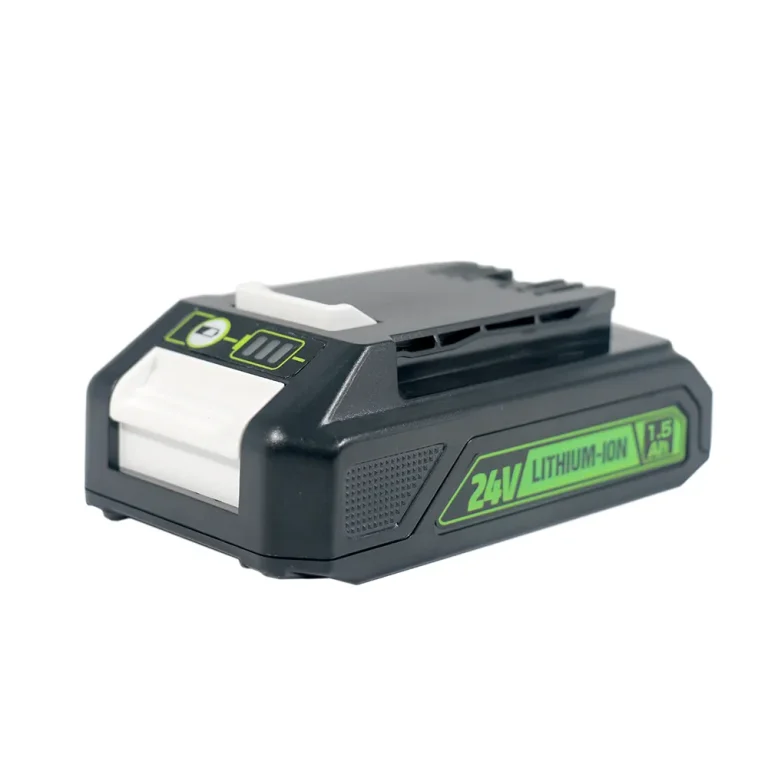
For any high-discharge power tool battery, chemistry should therefore be evaluated together with the actual load profile rather than treated as an isolated specification. An 18V high-drain lithium-ion battery is one example of the type of power-oriented configuration buyers may evaluate for demanding cordless-tool applications.
Cell Format: 18650 vs 21700
Most cordless power-tool packs today are built from cylindrical cells. The two dominant formats are 18650 (18 mm diameter, 65 mm length) and 21700 (21 mm diameter, 70 mm length).
| Attribute | 18650 | 21700 |
|---|---|---|
| Typical capacity | 2,000–3,500 mAh | 4,000–5,000 mAh (up to ~5,800 mAh in premium cells) |
| Continuous discharge (power cell) | 10–15 A | 15–20 A |
| Peak discharge | ~30 A | ~30–40 A |
| Internal resistance | Higher | ~15–20% lower |
| Energy density (system-level) | ~250 Wh/kg | ~300 Wh/kg |
The 21700 format has become the preferred choice for high-drain applications like rotary hammers. Its larger volume accommodates more active material, yielding roughly 35–50% higher single-cell capacity and lower internal resistance — which translates directly into less voltage sag under heavy load and less waste heat generated per amp delivered. The lower cell count for a given pack energy also reduces BMS complexity and inter-cell connection points.
For buyers evaluating this format in cordless-tool applications, a 20V 21700 lithium battery for cordless power tools provides a useful product-level reference for this type of pack architecture.
That said, 18650 cells remain relevant for cost-sensitive packs, for replacement batteries targeting older tool platforms whose battery cavities were designed around the smaller format, and for compact sub-compact rotary hammers where physical envelope is the hard constraint. A 21700 cell will not fit into a cavity designed for 18650s — the diameter and length difference is not something a replacement-battery manufacturer can engineer around without changing the enclosure architecture.
Series-Parallel Configuration
Rotary hammers on 18V platforms typically use 5S (five cells in series, nominal 18V/3.6V chemistry) packs. Heavy-duty 36V platforms use 10S configurations. The parallel count (2P, 3P, 4P or more) determines total capacity and, critically, how the load current is shared across cells.
A 5S2P pack of 2,000 mAh cells gives 4,000 mAh total. If each cell is rated for 15 A continuous discharge, the pack can deliver ~30 A — borderline for a light-duty rotary hammer. Moving to 5S3P with the same cells raises capacity to 6,000 mAh and current capability to ~45 A, which is adequate for most medium-duty applications. For 36V heavy-duty hammers, a 10S2P or 10S3P arrangement of 21700 power cells is common.
The key engineering principle is that parallel cells share current. More parallel strings mean each cell carries less of the total load, which reduces per-cell heating, extends cycle life and provides more headroom for peak-current events.
But every additional parallel string adds cost, weight and pack volume. The right balance depends on the target tool’s duty cycle and the buyer’s warranty expectations. Buyers evaluating higher-voltage configurations can also review a 40V high-power 21700 battery pack as a reference point for high-discharge pack design.

Runtime: Matching Capacity to Real-World Duty Cycles
What “Runtime” Actually Means for Rotary Hammers
Runtime is not a single number.
A rotary hammer boring into fresh concrete draws far more power than the same tool drilling into brick or block. A pack that delivers 40 minutes of light block work might provide only 15–20 minutes of continuous hammering into reinforced concrete.
Industry reporting indicates that lithium-powered rotary hammers can achieve single-charge operating times exceeding two hours in favorable conditions, and that brushless 36V platforms can complete upwards of 190 holes (6 × 40 mm) in concrete per charge.
These figures are useful benchmarks, but B2B buyers should treat them as upper bounds — actual rotary hammer battery runtime depends on material hardness, hole diameter and depth, bit sharpness, operator technique, tool efficiency, duty cycle, battery condition and ambient temperature.
This is why comparing batteries only by Ah can be misleading. Capacity indicates how much charge the battery stores, while watt-hours provide a more useful indication of stored energy. Neither figure alone confirms whether the pack can deliver the current required by a cordless rotary hammer under heavy load. For a broader explanation, see how battery capacity affects power tool runtime.
Capacity Sizing Guidance
| Use Case | Recommended Pack Capacity | Rationale |
|---|---|---|
| Light-duty — intermittent drilling, anchor holes | 2.0–3.0 Ah | Lower current draw; smaller, lighter pack preferred |
| Medium-duty — fixture installation, block work | 4.0–5.0 Ah | Balanced runtime and weight; 21700 cells recommended |
| Heavy-duty — continuous concrete coring, rebar drilling | 5.0–8.0 Ah+ | Sustained high current; 3P+ configuration to manage heat |
For professional users who work a full shift, a single pack is rarely enough regardless of capacity. The practical solution is two or more packs rotated through a fast charger.
When specifying a battery for a cordless rotary hammer, B2B buyers should therefore consider not just per-pack capacity but also charge time and charger compatibility — a 30-minute fast charge cycle effectively doubles the available runtime across a shift.
Temperature Effects on Runtime
Lithium-ion capacity is temperature-dependent. At temperatures below 0°C, available capacity can drop significantly, and charging lithium-ion batteries at low temperatures risks lithium plating on the anode — a permanent, irreversible degradation that can lead to internal short circuits.
At high temperatures above 45°C, electrolyte decomposition accelerates and cycle life shortens. The optimal operating range for lithium-ion cells is generally 15–35°C, and pack design should aim to keep cells within this band. More broadly, lithium-ion battery performance at high and low temperatures should be considered when evaluating runtime claims for outdoor or seasonal use.
For rotary hammers used on outdoor construction sites in winter or summer, this is not an academic concern. A pack that performs well in a 20°C workshop may deliver substantially reduced runtime at –5°C, and a pack that overheats during summer concrete work will trigger the BMS thermal protection and shut the tool down — exactly when the user needs it most.
Heat: The Silent Battery Killer
Why Rotary Hammers Generate More Pack Heat Than Other Tools
Heat in a battery pack comes from two sources: internal cell heating — I²R losses, where current squared times internal resistance equals heat — and external heat absorbed from the tool and environment. Rotary hammers maximize both.
The high continuous and peak currents flowing through cell internal resistance generate substantial heat. A cell with 15 mΩ internal resistance carrying 20 A generates 6 W of heat per cell — multiplied across a 10S2P pack, that is 60 W of waste heat with nowhere to go inside a sealed plastic housing.
The hammering mechanism also transfers mechanical vibration and some conducted heat back through the tool’s battery interface.
Compounding the problem, power-tool battery packs are typically sealed to an IP rating for dust and water resistance. This means they cannot rely on ventilation slots or cooling fins — heat must be managed through internal design, not external airflow.
For a high-load cordless rotary hammer battery, thermal performance therefore affects not only safety but also usable runtime, voltage stability and long-term battery life.
Thermal Management in Pack Design
Effective thermal management for rotary-hammer battery packs involves several engineering layers.
Cell selection and matching. Lower internal resistance cells generate less heat per amp delivered. 21700 power cells typically exhibit 15–20% lower internal resistance than comparable 18650 cells, directly reducing I²R losses.
Within a pack, cells should be matched for internal resistance and capacity. Mismatched cells cause uneven current distribution, where weaker cells run hotter and degrade faster, creating a vicious cycle.
Mechanical and thermal interface design. The cell-to-housing interface, the placement of thermal sensing elements, and the use of thermally conductive potting or gap-filler materials all affect how quickly heat can be conducted away from cells to the pack exterior. Some advanced pack designs incorporate phase-change materials or thermally conductive structural frames.
BMS thermal protection. The battery management system must monitor temperature at multiple points in the pack — not just one location. A single temperature sensor at the BMS board can miss a hot spot developing in a distant cell group.
Multi-point sensing allows the BMS to implement graduated protection: reducing allowed discharge current at intermediate temperatures and cutting off entirely at a hard limit, typically around 60–70°C cell surface temperature.
The Temperature-Difference Problem
It is not enough to keep the hottest cell below the safety threshold.
The temperature difference between cells matters almost as much as the absolute maximum. If one cell group runs 10°C hotter than another, it ages faster, its capacity diverges, and the pack’s usable energy is limited by the weakest cell — regardless of how much energy the other cells still hold.
Pack designs that promote even temperature distribution across all cells are essential for long cycle life in rotary-hammer applications.

BMS Requirements for Rotary Hammer Packs
The BMS is the critical safety and performance component in any lithium-ion pack, but the demands placed on it by rotary hammers are extreme.
Key functions include:
| BMS Function | Rotary Hammer Requirement |
|---|---|
| Overcurrent protection | Must handle 40–60 A peaks without nuisance tripping; distinguish between legitimate startup surge and fault |
| Over-temperature protection | Multi-point sensing; graduated response from derating to cutoff |
| Cell balancing | Active or passive balancing to keep parallel groups within tight voltage tolerance |
| Over-discharge protection | Prevent any cell from dropping below ~2.5–2.75 V under heavy load |
| Short-circuit protection | Sub-millisecond response to protect cells and wiring |
| Communication | Fuel-gauge reporting to tool controller for low-battery warning |
The overcurrent protection threshold is particularly critical for a cordless rotary hammer battery.
If set too low, the BMS will trip during every startup surge and the tool will be unusable. If set too high, a genuine fault such as a jammed bit or shorted cell will not be caught before damage occurs.
The right threshold requires knowing the tool’s actual current profile — which is why OEM/ODM battery projects should include a sample-validation phase where actual tool behavior, peak load and thermal response can be evaluated before production approval. Similar load-profile considerations also apply when evaluating battery requirements for other high-load cordless tools.
OEM/ODM Project Considerations for Rotary Hammer Batteries
For B2B buyers commissioning custom packs or sourcing replacement batteries for rotary-hammer platforms, several project-level factors deserve attention.
Compatibility verification. Replacement batteries must match not only the physical interface — slide-rail dimensions, latch positions and terminal layout — but also the electrical interface. The tool’s controller may expect specific fuel-gauge communication protocols or pin configurations.
A battery that fits physically but does not communicate correctly with the tool may trigger error codes or disable certain features.
Compatibility should therefore be confirmed against the original battery reference, voltage platform, tool model, interface, terminal layout and charger requirements rather than by brand name or nominal voltage alone. For more detail, see power tool battery interface and contact compatibility and the guide to matching battery voltage with the tool platform.
Sample validation protocol. Before committing to production, samples should undergo:
- Fit-and-function testing on the target tool.
- Full-load current profiling to confirm that the pack handles the tool’s peak demands.
- Thermal testing under sustained heavy-duty operation to verify that BMS protection activates correctly.
- Cycle-life testing under realistic duty cycles, not just continuous discharge.
For custom projects, this type of staged validation is part of a broader cordless rotary hammer battery engineering and OEM/ODM project support process that connects application review, pack engineering, sample validation and production handoff.
Certification and documentation. Target markets dictate certification requirements. Packs for the European market typically require CE marking and compliance with relevant EN standards. The UN38.3 transport testing protocol is mandatory for international shipping of lithium-ion batteries.
Buyers should verify that the applicable manufacturer or supplier can provide the documentation required for the specific battery model, configuration, transport method and destination market rather than assuming that one certificate automatically covers every product. The IATA guidance on lithium battery transport and shipping requirements is a useful reference for understanding the transport-related requirements that may apply.
Cell sourcing transparency. The same nominal specification — for example, “18V 5.0Ah 21700” — can be built from cells of vastly different quality and price.
A pack assembled from premium power cells with 15 mΩ internal resistance will outperform and outlast one built from generic cells with 30 mΩ internal resistance, even though both are labeled identically.
B2B buyers should require cell model information and relevant datasheet specifications in the project requirements and verify through incoming inspection that production packs remain consistent with approved samples.

Conclusion
Specifying a battery for a cordless rotary hammer is fundamentally about balancing three competing demands:
Power — the pack must deliver 30–60 A peaks without excessive voltage sag, which requires low-internal-resistance power cells, typically 21700-format NCM chemistry, and adequate parallel cell count.
Runtime — the pack must hold enough energy for a useful work session, which favors higher-capacity cells and more parallel strings, but every additional cell adds weight, cost and thermal mass.
Heat — the pack must survive the thermal stress of sustained high-current operation, which requires careful cell matching, appropriate BMS thermal sensing and mechanical design that promotes even temperature distribution.
No single parameter can be optimized in isolation. A pack optimized purely for capacity will be heavy and may overheat. A pack optimized purely for power delivery may sacrifice runtime. The right solution is engineered around the specific cordless rotary hammer platform, load profile, duty cycle, compatibility requirements and target market.
GeB Power is a Shenzhen-based B2B manufacturer of compatible replacement power tool batteries and an OEM/ODM battery project partner, supporting global buyers through compatibility verification, battery pack engineering, sample validation and structured production handoff. If you are evaluating a replacement battery for an existing rotary-hammer platform or developing a custom battery pack for a new application, contact GeB Power to discuss your tool, load, voltage, capacity and project requirements.
FAQ
What battery capacity is best for a cordless rotary hammer?
There is no single capacity that fits every rotary hammer. Light-duty applications may work well with 2.0–3.0 Ah packs, while medium-duty applications commonly benefit from 4.0–5.0 Ah batteries. Heavy-duty concrete drilling may require 5.0–8.0 Ah or more.
Capacity should be considered together with voltage, discharge capability, cell configuration, tool load and thermal performance.
Is a higher-Ah battery always better for a rotary hammer?
No. A higher-Ah battery generally provides more stored energy and can extend runtime, but it also increases pack size and weight.
More importantly, Ah alone does not determine whether a battery can support high peak current. A suitable rotary hammer battery must balance capacity with cell discharge capability, internal resistance, BMS settings and thermal design.
Why does a rotary hammer battery get hot during use?
Rotary hammers place high continuous and peak loads on the battery. Current flowing through the internal resistance of the cells, connections and conductive components generates heat.
Sustained hammer drilling, high ambient temperature and uneven cell performance can increase thermal stress further. Effective cell selection, pack configuration, thermal design and BMS protection are therefore important for controlling battery heat.
Can I use any battery with the same voltage on a cordless rotary hammer?
No. Matching nominal voltage alone does not confirm compatibility.
The original battery reference, mechanical interface, terminal layout, electrical requirements, communication functions, charger compatibility and tool model should all be reviewed before a replacement battery is approved. Buyers encountering fit, communication or charger issues can also review the common causes of replacement battery compatibility problems.
What should B2B buyers verify before sourcing a rotary hammer replacement battery?
Buyers should confirm the original battery model, cordless rotary hammer model, charger model, voltage platform, required capacity, interface and expected working load. For OEM/ODM projects, peak discharge requirements, duty cycle, working environment, thermal targets, enclosure requirements, order quantity and destination market should also be defined before pack engineering and sample validation begin.
A broader replacement power tool battery buyer’s guide can help organize these requirements before an RFQ is submitted.
Authoritative References & Engineering Standards
- IEC 62841-2-6:2020: Electric motor-operated hand-held tools, transportable tools and lawn and garden machinery — Safety — Part 2-6: Particular requirements for hand-held hammers.
- EN 62133-2:2017: Portable sealed secondary cells and batteries — Thermal abuse and overcharge tests.
- Bosch GBH 18V-26 / GBH 18V-45 C Professional: Operating Service Manual and CoolPack Thermal Transmission Research.
- Journal of Power Sources: Thermal modeling and thermal runaway prevention in high-discharge cylindrical lithium packs under heavy cyclic shock.
Technical Review & Quality Governance Notice:
Verified and authored by the GeB Power Structural & Thermal Engineering Laboratory. All test datasets reflect verified laboratory benchmarking under document reference TR-2026-RH-003. Last Reviewed: October 2026.
Compatible Battery Systems: See our Bosch 18V Compatible Battery Catalog and DeWalt 20V MAX 12.0Ah Ultra-Capacity Pack.