Battery Selection for Cordless Edge Trimmers: Runtime, Weight and Outdoor Use
Cordless edge trimmers have become a staple in professional landscaping and property maintenance. As outdoor equipment continues to shift from petrol and corded electric systems toward battery-powered platforms, the battery used in a cordless edge trimmer becomes a critical part of tool performance.
A cordless edge trimmer battery affects how long the operator can work before swapping packs, how heavy and balanced the tool feels during extended use, and how reliably the battery performs when exposed to heat, dust, grass clippings, moisture, vibration, and changing outdoor temperatures.
This article examines the three factors that matter most when selecting a replacement or OEM battery for cordless edge trimmers: runtime, weight, and outdoor durability. Whether you are sourcing a replacement battery for an existing cordless tool platform or specifying a custom battery pack for a new outdoor power equipment product, these factors should be evaluated together rather than in isolation. For a broader view of outdoor applications, see these battery pack requirements for cordless lawn and garden equipment.

How Battery Choice Affects Cordless Edge Trimmer Performance
An edge trimmer draws a specific load profile: intermittent high-current bursts when the blade encounters dense grass or soil edges, combined with lighter running between passes. Unlike a drill that may operate under load for only a few seconds at a time, a cordless edge trimmer can sustain several minutes of continuous draw before the operator pauses to reposition.
That load profile places demands on the battery pack.
The pack must deliver sustained discharge current without excessive voltage sag, manage heat buildup during extended operation, and recover effectively between working cycles. A battery designed around short-duty-cycle applications may overheat or experience unacceptable voltage drop when used continuously in outdoor trimming equipment.
For this reason, cordless edge trimmer battery selection should start with the application and workload, rather than simply choosing the highest available amp-hour rating.
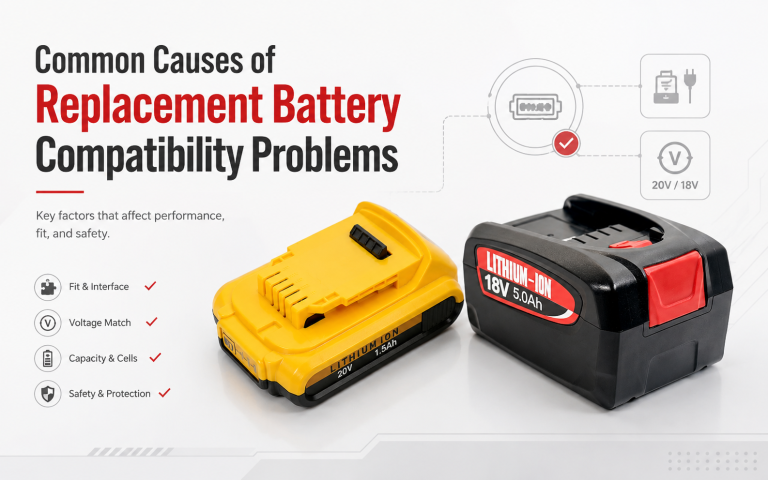
A practical battery compatibility review should also consider the original battery reference, nominal voltage, battery interface, terminal layout, tool model, charger requirements, expected discharge load, and operating environment. Matching the voltage alone is not enough to establish compatibility. Buyers unfamiliar with this process can refer to this guide on power tool battery interfaces and compatibility.
How Battery Capacity Affects Edge Trimmer Runtime
Capacity and Real-World Runtime
Runtime is usually the first question a buyer asks, and the answer starts with battery capacity, measured in ampere-hours (Ah), but it does not end there.
A 2.0 Ah pack on an 18 V platform stores roughly 36 Wh of energy; a 4.0 Ah pack doubles that to about 72 Wh; and a 5.0 Ah pack reaches roughly 90 Wh.
In practice, a 4.0 Ah battery on a typical 18–20 V cordless edge trimmer delivers approximately 30–45 minutes of active cutting under moderate load, while a 2.0 Ah pack may exhaust in 15–20 minutes of similar use.
| Capacity | Nominal Energy (Wh, 18 V platform) | Approx. Active Cutting Time | Typical Use Case |
|---|---|---|---|
| 2.0 Ah | ~36 Wh | 15–20 min | Light residential, quick touch-ups |
| 4.0 Ah | ~72 Wh | 30–45 min | Standard residential / light commercial |
| 5.0 Ah | ~90 Wh | 40–60 min | Professional, larger properties |
| 6.0+ Ah | ~108+ Wh | 50–75 min | Full-day commercial use with battery rotation |
These figures are indicative ranges, not guarantees.
Actual edge trimmer battery runtime depends on cutting load, blade condition, motor efficiency, ambient temperature, duty cycle, and the electrical characteristics of the battery pack. Dense grass and soil edges require more current than light turf, while a dull blade or one covered with sap and soil debris can increase current draw by 20–30% or more, shortening runtime proportionally.
For additional background on the relationship between amp-hour ratings and working time, see how battery capacity affects runtime.
This is why capacity should be selected against the actual trimming duty cycle rather than treated as an isolated specification. Buyers comparing common cordless-tool configurations can also review an 18V 3.0Ah–6.0Ah replacement battery for cordless power tools as an example of the capacity ranges available within one voltage class.
Cell Chemistry and Discharge Rate
Not all amp-hours are created equal. The same 4.0 Ah rating can produce very different field performance depending on the cells and pack architecture used inside the battery.
Two cylindrical cell formats dominate many cordless power tool battery applications:
| Cell Format | Typical Capacity per Cell | Max Continuous Discharge | Common Use |
|---|---|---|---|
| 18650 | 2,000–3,500 mAh | 10–20 A | Standard tool packs, cost-sensitive applications |
| 21700 | 3,000–5,000 mAh | 15–30 A+ | High-performance packs, premium tools |
The 21700 cell, adopted widely in higher-performance battery packs, offers roughly 30–50% more capacity per cell than a comparable 18650 and generally supports higher sustained discharge currents.
For an edge trimmer that may pull 15–25 A under heavy load, a pack built on 21700 cells can maintain voltage stability more effectively, which translates into more usable runtime before the tool’s low-voltage cutoff is triggered.
When comparing two batteries with the same Ah rating, buyers should therefore ask what cell format is inside the pack and what sustained discharge performance the configuration supports.
A 4.0 Ah pack built on 21700 cells will typically outperform a 4.0 Ah pack built on 18650 cells in sustained-load applications such as trimming because the larger cells tend to experience less voltage sag and run cooler. A 20V 21700 lithium battery for cordless power tools provides one example of how this cell format can be applied within a cordless-tool platform.
The Duty-Cycle Factor
Runtime on paper often assumes continuous cutting. Actual landscaping work is different.
Operators pause to move to the next section, clear debris, adjust cutting depth, or reposition the tool. These pauses allow the battery to cool before the next load cycle.
A pack that overheats and throttles after 20 minutes of continuous operation may deliver 35–40 minutes of real-world working time when natural pauses are included. Conversely, a battery rated for 60 minutes of continuous cutting can still shut down early if the operator works without breaks in high ambient temperatures.
When reviewing cordless edge trimmer battery runtime, three questions matter:
- Under what electrical load was the runtime measured?
- At what ambient temperature?
- What duty cycle was used?
For B2B sourcing or an OEM/ODM battery project, a runtime claim is more useful when it can be linked to defined discharge conditions rather than presented only as a marketing figure.
How Battery Weight Affects Tool Balance and Operator Fatigue
Why Battery Weight Matters
An edge trimmer is operated in a posture that can become tiring over extended periods. The cutting head must be guided accurately along lawn edges, paths, garden beds, and other borders, while the operator continuously controls the angle and position of the tool.
Battery weight affects both total tool weight and center of gravity.
A pack that adds 300–400 g to the rear of the tool changes the balance point and increases the lever arm the operator must control. Over an hour of edging, that difference can translate into measurable fatigue. Fatigue can then affect handling consistency and cutting accuracy.
Battery weight should therefore be treated as an application parameter, not simply a specification-sheet number.
Weight by Capacity and Cell Format
The following figures show approximate battery pack weights for common configurations. Actual weights vary according to enclosure material, BMS board, internal busbar design, connectors, and mechanical structure.
| Pack Configuration | Cell Count & Format | Approx. Pack Weight | Nominal Energy |
|---|---|---|---|
| 18 V / 2.0 Ah | 5S1P, 18650 | 350–450 g | ~36 Wh |
| 18 V / 4.0 Ah | 5S2P, 18650 | 650–800 g | ~72 Wh |
| 18 V / 5.0 Ah | 5S1P, 21700 | 500–600 g | ~90 Wh |
| 20 V / 4.0 Ah | 5S2P, 18650 | 650–800 g | ~72 Wh |
| 20 V / 5.0 Ah | 5S1P, 21700 | 500–600 g | ~90 Wh |
| 36 V / 4.0 Ah | 10S2P, 18650 | 1,300–1,600 g | ~144 Wh |
| 40 V / 5.0 Ah | 10S2P, 21700 | 1,200–1,500 g | ~180 Wh |
A notable pattern emerges: a 5.0 Ah pack built on 21700 cells in a 1-parallel configuration can weigh less than a 4.0 Ah pack built on 18650 cells in a 2-parallel configuration while delivering 25% more energy.
This is one of the advantages of the 21700 format for some outdoor power equipment battery designs: more energy per gram, fewer cells to assemble, and lower internal resistance.
Balancing Runtime and Battery Weight
More battery capacity generally means more stored energy, and in many configurations that also means additional weight.
The real question is not simply, “What is the largest battery available?” but:
How much additional runtime is worth the additional pack weight for this specific tool and working session?
For residential and light-commercial edge trimming, a 4.0 Ah pack on an 18–20 V platform represents a reasonable balance: enough runtime for a typical residential property at approximately 30–45 minutes of cutting, with a battery weight of roughly 650–800 g.
Moving to 5.0 Ah can add approximately 15–25 minutes of runtime, but it can also change the balance of the tool. If the cordless edge trimmer was not designed around the larger battery configuration, ergonomics may suffer.
Professional users working throughout the day often use two or three mid-capacity batteries rather than one very large pack. A 4.0 Ah battery weighing about 700 g can be swapped when depleted, keeping the tool relatively light while another battery charges.
With a fast charger recovering a pack in approximately 30–60 minutes, a two-pack rotation can support near-continuous work.
The practical lesson for buyers is simple: do not default to the highest-capacity cordless edge trimmer battery available. Match capacity to the tool’s weight balance, expected session length, discharge requirement, and charging strategy.
For an OEM/ODM project, a two-pack bundle with an appropriate charger may in some cases provide a better user experience than one oversized battery pack.

What to Check When Using Edge Trimmer Batteries Outdoors
Temperature and Battery Performance
Lithium-ion batteries are chemical systems, and their performance is temperature-dependent.
The commonly cited operating range for lithium-ion cells is approximately -20°C to 60°C for discharge and 0°C to 45°C for charging. Outside these ranges, battery performance can deteriorate and safety risks can increase.
For cordless edge trimmers, several outdoor conditions deserve particular attention:
| Condition | Risk to Battery | Mitigation |
|---|---|---|
| Hot day (35°C+), heavy load | Cell temperature exceeds 60°C; BMS throttles or shuts down | Use a higher-capacity pack to reduce C-rate per cell and schedule breaks |
| Cold morning below 0°C | Reduced capacity of 20–40%; higher internal resistance | Keep spare pack warm until use and allow gradual warm-up |
| Charging below 0°C | Lithium plating on the anode and irreversible damage | Do not charge below 0°C; BMS should block cold charging |
| Direct sunlight on parked pack | Higher case temperature and accelerated cell degradation | Store packs in shade or an insulated bag |
A common field complaint is that a fully charged battery appears to run for only a short period. In many situations, temperature rather than nominal capacity is the real cause.
On a 35°C summer morning with heavy grass, a 4.0 Ah pack that would deliver around 40 minutes at 20°C may throttle to 15–20 minutes as the BMS reduces current to protect the cells from excessive temperature and the risk of lithium-ion battery thermal runaway.
A well-engineered outdoor power equipment battery should therefore consider:
- Temperature sensors positioned to monitor cell temperature.
- BMS thermal protection appropriate for the cell chemistry.
- Housing and thermal paths capable of managing transient heat during heavy cutting.
- Actual application load and expected outdoor operating temperature.
For a custom battery pack, working environment should be reviewed at the same stage as voltage, target capacity, discharge current, protection requirements, enclosure design, and thermal path rather than being added only after the electrical design has been finalized.
Dust, Water and Ingress Protection
Edge trimmers operate close to the ground in dust, grass clippings, morning dew, and occasionally rain. The battery pack is exposed to many of the same environmental conditions as the tool.
An IP rating describes resistance to solid-particle and moisture ingress.
| IP Rating | Protection | Suitability for Edge Trimmers |
|---|---|---|
| IP54 | Dust-protected, splashing water | Minimum acceptable target for outdoor use |
| IP65 | Dust-tight, water jets | Recommended target for professional outdoor tools |
| IP67 | Dust-tight, immersion for 30 min at 1 m | Premium target for applications exposed to heavy rain or washing |
For many cordless edge trimmer applications, IP54 can serve as a useful minimum design target for resistance to ordinary dust and light splashing. It does not mean the battery is intended for continuous rain exposure or immersion.
For more demanding professional outdoor equipment, IP65 or higher may be considered where the application and product specification require it.
Higher IP ratings, however, are not automatically better in every engineering dimension.
A fully sealed IP67 battery pack must manage heat mainly through conduction and radiation because there are no open ventilation paths for convective cooling. That means thermal design becomes more demanding.
A poorly designed highly sealed pack may run hotter than a less tightly sealed pack of the same capacity.
Ingress protection and thermal management should therefore be evaluated together rather than as independent specifications.
Actual IP claims should always be confirmed for the specific battery design and tested configuration rather than assumed from appearance or intended outdoor use.
Vibration and Mechanical Durability
Cordless edge trimmers generate vibration as the cutting blade or head encounters soil, roots, dense vegetation, and other resistance. Those forces are transmitted through the tool and into the battery interface.
Over long-term use, vibration can loosen cell connections, fatigue solder joints, and wear the battery-to-tool latch mechanism.
A battery intended for outdoor tool service should consider:
- Mechanical cell retention: cells should be held securely in individual sleeves or a precision-molded carrier rather than relying solely on electrical tabs for mechanical stability.
- Strain relief on internal wiring: BMS-to-cell connections should tolerate repeated vibration without work-hardening and fracturing.
- Reinforced latch and contact interface: the battery interface should withstand repeated insertion and removal while maintaining stable electrical contact.
This is one reason mechanical compatibility matters alongside electrical compatibility when evaluating a replacement battery.
Battery size, mounting interface, structural fit, contact position, and enclosure geometry all influence whether a replacement pack can operate reliably with the intended edge trimmer.
UV and Chemical Exposure
Battery housings are commonly manufactured from materials such as ABS or polycarbonate. Prolonged UV exposure can embrittle these materials, while contact with fertilizers, herbicides, pool chemicals, and other substances may cause surface degradation.
For outdoor-rated battery packs, UV-stabilized materials and suitable surface treatment can extend enclosure service life.
These details are easily overlooked when reviewing a battery specification, but they can contribute to cracked housings and warranty returns after prolonged field use.
BMS Protection Requirements for Cordless Edge Trimmer Batteries
A Battery Management System, or BMS, is central to the safe operation of a modern lithium-ion battery pack.
For cordless edge trimmers and other outdoor power equipment, the BMS helps protect the pack against over-discharge, overheating, excessive current, and short-circuit conditions.
Typical protection functions include:
| Protection Function | What It Prevents | Typical Threshold |
|---|---|---|
| Over-charge | Cell voltage exceeds safe maximum, gas generation, thermal risk | Per-cell cutoff ~4.25–4.35 V |
| Over-discharge | Cell voltage drops below safe floor, irreversible capacity loss | Per-cell cutoff ~2.5–2.75 V |
| Over-current | Excessive discharge damages cells and contacts | 25–35 A, tool-dependent |
| Short-circuit | Catastrophic failure and fire risk | Millisecond-level cutoff |
| Over-temperature | Thermal runaway | 60–65°C cell temperature |
| Cell balancing | Capacity divergence between cells over repeated cycles | Passive balancing at ~4.2 V |
For outdoor tool applications, over-temperature protection and cell balancing deserve particular attention.
A pack that is repeatedly used under hot conditions without effective thermal protection will degrade more rapidly. Cell internal resistance rises and available capacity falls. Within 100–200 cycles, the pack may deliver only 60–70% of its original runtime.
A BMS with active or passive balancing can prevent the weakest cell from disproportionately limiting the usable capacity of the battery pack, extending useful service life by 20–30% or more over hundreds of cycles.
IEC 62133-2, the lithium-system portion of IEC 62133 revised in 2017, is a widely referenced safety standard for portable sealed lithium-ion battery systems. It includes testing for conditions such as over-charge, external short-circuit, thermal abuse, and mechanical abuse.
For replacement or OEM/ODM battery sourcing, the applicable certificates and test reports should be confirmed against the specific battery model, product configuration, destination market, and project requirements. International orders may also be subject to specific lithium battery transport and safety requirements depending on configuration, quantity, transport mode, carrier, and destination.
A document should not be assumed to cover a battery simply because it exists for another product in the same general product family.

A Practical Cordless Edge Trimmer Battery Selection Checklist
The three core factors—runtime, battery weight, and outdoor durability—can be brought together in a practical sourcing checklist.
| Dimension | Key Questions | Red Flags |
|---|---|---|
| Runtime | What cell format is used? What sustained discharge current can the battery support? Is discharge data available at a trimmer-relevant load? | Same Ah rating but little supporting discharge information; vague “long runtime” claims |
| Weight | What is the total pack weight? How does it compare with the battery it replaces? Does the tool remain balanced? | Pack significantly heavier for the same capacity; no weight specification |
| Outdoor use | What ingress-protection target applies? How is temperature monitored? Is the enclosure designed for outdoor exposure? | No environmental specification; little information about thermal monitoring or enclosure design |
| BMS / safety | What protection functions and thresholds are used? Is balancing included? What relevant test documentation is available? | No BMS specification; unclear protection strategy; documentation scope cannot be matched to the product |
| Mechanical | How are cells retained? How is the latch designed? What contact materials and structural features are used? | Weak cell retention; poorly defined latch design; exposed or inadequate contact structure |
| Compatibility | Does the battery match the original model reference, voltage platform, interface, terminal layout, tool, and charger? | Selection based only on brand name or voltage |
For B2B buyers, this checklist should normally be followed by sample validation with the intended tool and charger before a volume order is approved.
For an OEM/ODM battery project, the same logic can be extended into a structured development process: first review the application and load, then define pack engineering requirements, validate samples, and finally hand the approved specification into production. GeB Power’s battery engineering and OEM/ODM project support follows this type of requirements-first approach.
That approach helps turn requirements such as target runtime, maximum pack weight, discharge current, enclosure, protection, charger compatibility, and outdoor operating conditions into a battery specification that can actually be reviewed and tested.
Buyers should also verify the voltage platform rather than relying on nominal voltage labels alone. This guide explains how to match battery voltage with your power tool platform.
Conclusion
Selecting the right cordless edge trimmer battery is a balance between runtime, weight, electrical load, battery compatibility, and outdoor operating conditions.
The best battery is not automatically the pack with the highest capacity, the lowest weight, or the highest IP rating in isolation. It is the battery that matches the tool platform, delivers the required runtime without creating unnecessary weight, supports the actual discharge load, and remains suitable for the intended working environment.
For buyers sourcing power tool replacement batteries, the selection process should begin with the original battery and tool platform, followed by confirmation of voltage, interface, charger, load, required capacity, and use environment.
For OEM and ODM projects, the process begins with a clear specification covering target runtime, maximum battery weight, voltage, discharge requirements, interface, charger, operating environment, enclosure, protection requirements, and applicable testing or documentation. Sample validation should then confirm how the battery behaves with the intended tool before production is finalized.
GeB Power is a Shenzhen-based B2B manufacturer of compatible replacement power tool batteries and an OEM/ODM battery project partner. We support global buyers and engineering teams with model and platform verification, electrical and mechanical compatibility review, battery pack engineering, sample validation, and structured production handoff.
If you are evaluating a replacement battery for a cordless edge trimmer or developing a custom battery pack for outdoor power equipment, contact GeB Power to discuss the tool platform, application load, runtime target, interface, operating environment, quantity, and project requirements.
FAQ
What Ah battery is best for a cordless edge trimmer?
There is no single Ah rating that is best for every cordless edge trimmer. A 4.0 Ah battery on an 18–20 V platform can provide a practical balance between runtime and weight for many residential and light-commercial applications, but the correct capacity depends on tool load, expected cutting time, battery weight, discharge requirements, and the intended working environment.
The highest available Ah rating is not automatically the best choice.
Can I use a higher-Ah battery in my cordless edge trimmer?
A higher-capacity battery may provide longer runtime, but it should only be used if it is compatible with the tool platform.
Check the original battery reference, voltage, mechanical interface, terminal arrangement, tool model, charger compatibility, battery dimensions, and supported discharge load. A higher-Ah pack can also change the weight and balance of the tool.
Is a battery compatible if the voltage is the same?
Not necessarily.
The same nominal voltage does not prove battery compatibility. A replacement battery must also match the battery interface, contact or terminal layout, mechanical fit, tool requirements, charger requirements, and applicable electrical protection strategy.
For this reason, battery compatibility should be verified by model and platform rather than voltage alone.
What should I look for in a battery for outdoor edge trimmer use?
Important factors include operating temperature, thermal protection, dust and moisture exposure, enclosure design, vibration resistance, mechanical retention, BMS protection, and the battery’s ability to deliver the required discharge current.
Where an IP rating is specified, it should be confirmed for the actual battery configuration rather than assumed from the product’s intended outdoor use. Buyers evaluating other cordless landscaping tools can also review this guide on how to choose a battery for cordless outdoor equipment.
Should B2B buyers test an edge trimmer battery before placing a volume order?
Yes. A sample should ideally be evaluated with the intended edge trimmer and charger under representative operating conditions before a production order is approved.
Testing can help verify compatibility, runtime, thermal behavior, weight balance, charging performance, mechanical fit, and the suitability of the battery for the intended duty cycle.