Compact vs High-Capacity Batteries for Cordless Oscillating Multi-Tools
Cordless oscillating multi-tools are sensitive to battery size because the pack sits at the rear of a short, hand-guided tool. A compact battery keeps weight and balance under control. A high-capacity battery extends runtime and reduces battery changes. The right choice depends on task duration, workload, ergonomics, and compatibility—not simply on the largest Ah rating available.

Compact vs High-Capacity Batteries: What’s the Practical Difference?
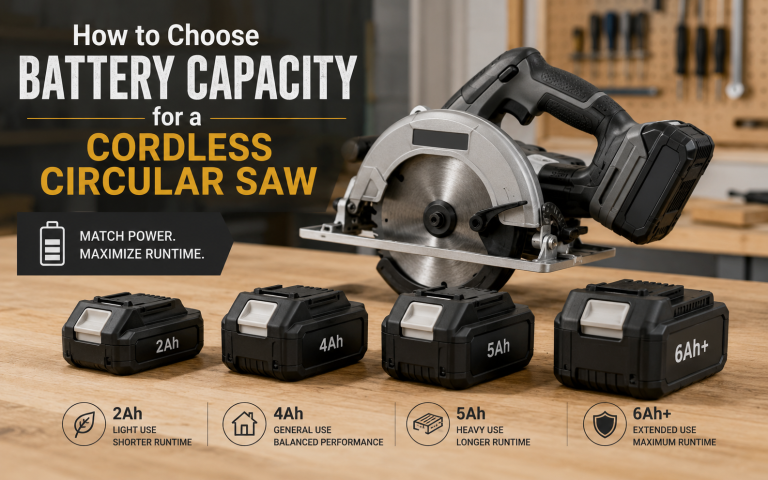
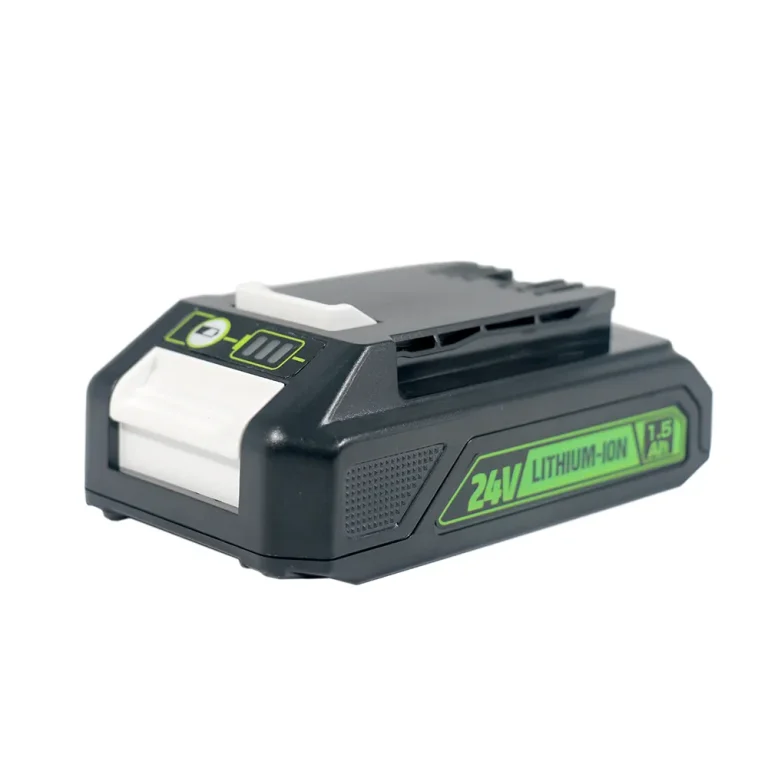
A compact power tool battery is a smaller, lighter battery pack designed to reduce tool weight and improve handling. On many 18V/20V-class cordless platforms, compact batteries are commonly around 1.5–2.0Ah.
A high-capacity battery stores more energy and normally uses a larger or more energy-dense pack design. Capacities around 4.0–6.0Ah are common, while some platforms extend well beyond that range.
| Factor | Compact Battery | High-Capacity Battery |
|---|---|---|
| Typical capacity | About 1.5–2.0Ah | Often 4.0–6.0Ah+ |
| Runtime | Shorter | Longer |
| Weight | Lower | Higher |
| Pack size | Slimmer, lower-profile | Usually taller or bulkier |
| Tool balance | Easier to maneuver | More rear weight |
| Battery changes | More frequent | Less frequent |
| Typical use | Short, precise, mobile work | Long, continuous work |
These are practical categories rather than universal standards. Cell type, enclosure design, electronics, and battery architecture vary between manufacturers. A 4.0Ah pack from one platform may differ substantially in size and weight from a 4.0Ah pack on another.
Oscillating multi-tools make those physical differences easy to notice. They are frequently used one-handed, against walls, above shoulder height, or inside restricted spaces. A battery size that feels acceptable on a larger two-handed tool can make a multi-tool noticeably less agile.
For buyers comparing available configurations, GeB Power offers 18V replacement batteries for Bosch cordless oscillating tools in multiple capacity options that illustrate how one tool platform can support different runtime requirements.
The basic trade-off is straightforward: compact packs favor control; high-capacity packs favor runtime.

Does a Higher Ah Battery Make an Oscillating Multi-Tool More Powerful?
Amp-hours, or Ah, describe battery charge capacity. They do not directly measure motor power.
For packs operating at the same nominal voltage, watt-hours provide a clearer picture of total stored energy:
Wh = V × Ah
A 5.0Ah battery therefore has 2.5 times the rated charge capacity of a 2.0Ah battery at the same voltage. In simplified energy terms, it can store roughly 2.5 times as much energy.
That mainly affects runtime.
A larger Ah number does not automatically mean the oscillating tool will cut faster or develop more useful output under load. For a deeper explanation of this relationship, see our guide to power tool battery capacity and runtime.
What Ah does not show is how effectively a battery can supply current.
Two packs at the same nominal voltage can behave differently because of:
- cell chemistry and cell size
- internal resistance
- parallel cell count
- protection electronics
- thermal design
- discharge capability
Some larger packs use additional parallel cell groups. Sharing current across more cells can reduce the load on each individual cell and help maintain voltage during sustained cutting, scraping, or sanding.
This is where high capacity and high output can overlap, but they are not the same specification.
A larger battery may perform better under heavy load if its cells and internal architecture support stronger current delivery. The improvement comes from the battery design, not from the Ah label by itself. A well-designed compact high-output pack can outperform a larger but lower-output pack under certain demanding conditions.
For battery selection, treat Ah primarily as a runtime indicator and treat sustained current capability as a separate engineering consideration.
Why Compact Batteries Work So Well on Oscillating Multi-Tools
Oscillating multi-tools depend heavily on hand control. The accessory moves through a small oscillating arc, but the operator still controls the cut line, angle, contact pressure, and position.
Battery weight therefore affects more than comfort.
It changes the balance of the tool.
A heavier battery moves the center of gravity toward the rear. Because a multi-tool has a relatively short body, that shift is easy to feel at the wrist. During plunge cuts, trimming, detail sanding, or overhead work, extra rear weight can make accurate positioning more tiring.
Compact batteries are particularly well suited to:
- precision plunge cuts
- door-jamb and trim work
- outlet-box cutouts
- detail sanding
- overhead work
- cabinet and interior work
- short jobs in confined spaces
Pack dimensions also matter. A physically larger battery can restrict movement inside a cabinet, between framing members, close to a wall, or underneath an installed surface. Electrical compatibility with a platform does not automatically mean every battery size is equally practical in every work position.
Compact packs do have a clear limitation: less stored energy means more frequent battery changes during continuous use. That is normally acceptable during intermittent work, where the tool runs for short periods and is repeatedly repositioned between cuts.
For precision-heavy applications, reducing unnecessary tool weight can be more useful than carrying extra capacity that never gets used.
When High-Capacity Batteries Make More Sense
A high-capacity oscillating multi-tool battery becomes more useful when stopping to change packs interrupts the job.
Extended sanding, adhesive scraping, grout removal, repetitive plunge cutting, and long remodeling sessions can keep an oscillating tool running much longer than occasional trim or repair work. In those situations, the main advantage of a larger battery is not necessarily faster cutting.
It is longer uninterrupted operation.
Typical high-capacity applications include:
- prolonged sanding
- repeated cuts across a large project
- scraping adhesive or coatings
- extended grout or material removal
- dense hardwood cutting
- metal cutting
- continuous drywall or baseboard trimming
A larger pack may also handle sustained load more effectively when its design uses additional parallel cells or high-output cells. This can reduce voltage sag and distribute current across more cells.
Thermal behavior also becomes more important as duty cycle increases. Continuous heavy cutting or sanding creates more cell and pack heat than short intermittent cuts. Cell selection, discharge capability, protection settings, and thermal design therefore matter alongside rated capacity.
For applications where long runtime is the priority, a high-capacity 18V battery for Bosch cordless oscillating tools provides an example of the larger-capacity direction available for extended operation.
The trade-off remains physical. Additional weight and bulk sit directly behind the grip. During overhead work or careful positioning, operator fatigue can become noticeable well before a large battery is discharged.
High-capacity batteries make the most sense when runtime and uninterrupted operation are the dominant requirements.
Which Battery Is Better for Different Oscillating Multi-Tool Jobs?
The most useful way to choose an oscillating multi-tool battery is by task rather than by the Ah label alone.
| Oscillating Multi-Tool Job | Better Starting Point | Main Reason |
|---|---|---|
| Outlet-box cutouts | Compact | Short cuts and high control requirement |
| Door-jamb trimming | Compact | Precision and maneuverability |
| Overhead trimming | Compact | Lower wrist and arm load |
| Detail sanding | Compact or mid-capacity | Depends on session length |
| Long sanding sessions | High-capacity | Fewer battery changes |
| Adhesive scraping | High-capacity | Longer continuous runtime |
| Repetitive hardwood cuts | Mid/high-capacity | Runtime plus sustained-load demand |
| Metal cutting | Mid/high-capacity | Load can be high; pack output matters |
| Mixed repair work | Mid-capacity | Balance of runtime and handling |
Short Precision Cuts and Tight-Space Work
Compact batteries are usually the better fit when the tool operates in short bursts. Door-jamb adjustments, outlet-box cutouts, small plunge cuts, and cabinet work all benefit from lower weight and a compact rear profile.
In these jobs, carrying unused energy provides little benefit. Better balance can improve placement and reduce wrist fatigue.
Overhead Work and Detail Sanding
Overhead work places battery weight at a mechanical disadvantage because the operator must support the tool and rear-mounted battery away from the body. A compact pack reduces that load.
Detail sanding depends more on duration. Short finishing work favors a compact battery. Longer sanding may justify a mid-capacity pack to reduce battery changes without moving to the largest available option.
Long Sanding, Scraping, and Repetitive Cutting
High-capacity batteries have their clearest advantage here.
Sanding a larger area, scraping adhesive, removing material, or making repeated cuts throughout a remodeling job can consume much more energy than occasional trimming. Longer battery runtime reduces interruptions and keeps the workflow moving.
For 20V-class applications, GeB Power also provides 20V cordless oscillating tool replacement batteries across several capacity options.
Dense Wood or Metal Cutting
Capacity is only part of the decision when cutting demanding materials.
Cell quality, discharge capability, battery architecture, internal resistance, and thermal protection also affect performance. A larger battery may be appropriate, but the strongest choice is not automatically the pack with the highest Ah rating.
The battery must be able to sustain the required current without excessive voltage drop or heat.

Is a Mid-Capacity Battery the Better Compromise?
For mixed work, a mid-capacity battery can be the most practical option. A pack around 4.0Ah provides substantially more runtime than a compact battery without reaching the size and weight of very large extended-capacity packs.
That makes it useful when cutting, sanding, scraping, and repair work all occur during the same day.
One Mid-Capacity Battery
A single mid-capacity pack simplifies battery management. It can handle short precision tasks without feeling as oversized as the largest batteries while providing more stored energy for moderate sanding or repetitive cutting.
For users who want one battery size to cover several applications, this approach avoids both extremes.
The same relationship between runtime and handling appears across other cordless tools. Our article on how battery capacity affects runtime and handling discusses this trade-off from another handheld-tool perspective.
Two-Battery Strategy
Another approach is to carry two battery sizes:
- a compact battery for precision, overhead, and confined-space work
- a high-capacity battery for long sanding, scraping, or repetitive cutting
This keeps the multi-tool light when control matters and adds runtime only when the task requires it. It also creates a practical battery rotation while one pack is charging.
For professional kits and larger cordless tool fleets, task-based battery selection is often more flexible than fitting every tool with the largest available pack.
Check Compatibility Before Choosing Battery Capacity
Battery capacity only matters after compatibility is confirmed.
For a replacement power tool battery, compatibility includes electrical, mechanical, and charging requirements. Matching a brand name or nominal voltage alone is not sufficient.
Before selecting a 2.0Ah, 4.0Ah, 5.0Ah, or 6.0Ah battery, check:
- original battery model
- nominal voltage platform
- tool model
- battery interface and rail geometry
- terminal layout
- charger model
- battery dimensions and available clearance
- intended workload
Start by confirming the correct electrical platform. Our guide to matching battery voltage with the power tool platform explains why nominal voltage is one of the first compatibility checks, but not the only one.
Mechanical fit also deserves separate attention. Rail shape, contact arrangement, terminal position, and enclosure clearance can prevent a battery from working correctly even when the voltage appears suitable. For more detail, see power tool battery interface and contact compatibility.
This applies to both OEM batteries and compatible replacement batteries. A pack can belong to the correct voltage family yet use a different physical interface, communication method, terminal layout, or charger requirement.
A physically larger battery can also be electrically compatible but ergonomically inconvenient on a compact multi-tool.
For B2B sourcing, an RFQ should therefore contain more than the requested Ah rating. Useful project information includes:
- original battery reference
- tool and charger models
- voltage
- required capacity
- order quantity
- destination
- label, packaging, inspection, or documentation requirements
Teams comparing different replacement options can also refer to our buyer’s guide to choosing the right replacement power tool battery before moving into model-specific verification.
Capacity is a selection variable. Compatibility is a prerequisite.

Conclusion
For cordless oscillating multi-tools, compact and high-capacity batteries solve different problems. Compact batteries reduce weight and improve handling. High-capacity batteries extend runtime and reduce interruptions. Mid-capacity packs sit between those priorities and work well for mixed applications.
The selection process should remain straightforward: confirm compatibility, define the task, estimate runtime, consider ergonomics, evaluate sustained-load requirements, and then choose capacity.
GeB Power supplies power tool replacement batteries and supports compatibility review, battery engineering, sample validation, and OEM/ODM development through its battery project and supply solutions. If you are evaluating battery capacities for a cordless oscillating multi-tool platform, contact GeB Power with the original battery model, tool and charger models, voltage, required capacity, quantity, and destination so the appropriate product or project path can be reviewed.
FAQ
Does a Higher Ah Battery Make an Oscillating Multi-Tool More Powerful?
Not by itself. Higher Ah mainly means more stored capacity and longer potential runtime. Actual output under load depends on cell capability, internal resistance, pack architecture, protection electronics, temperature, and tool demand.
Will a 5Ah Battery Run Twice as Long as a 2Ah Battery?
At the same nominal voltage, a 5Ah battery has 2.5 times the rated charge capacity of a 2Ah battery. Real-world runtime may not increase by exactly 2.5 times because material, accessory type, oscillation speed, pressure, temperature, battery condition, and tool efficiency all affect energy use.
Is a 2Ah Battery Enough for an Oscillating Multi-Tool?
For short cuts, detail sanding, overhead work, and other intermittent tasks, a 2Ah-class compact battery can be a practical choice.
Continuous sanding, scraping, or heavy cutting will normally require more frequent battery changes.
Is a Bigger Battery Always Better?
No. A larger battery improves runtime but also increases weight and bulk. Depending on charger output and battery design, replenishing the additional stored energy may also require more charging time.
On a precision-oriented handheld tool, those disadvantages can outweigh capacity the user does not need.
What Battery Size Is the Best All-Around Option?
For mixed use, a mid-capacity battery can provide a practical balance between runtime and handling.
Users who regularly alternate between short precision work and long continuous tasks may benefit more from separate compact and high-capacity batteries than from trying to make one very large pack handle every application.