Cordless Lawn Mower Battery Guide: Voltage, Capacity and Runtime
The shift from petrol to battery-powered lawn equipment is no longer a trend — it is the new baseline. Municipal noise ordinances, emissions regulations, and the convenience of pull-start-free mowing have pushed cordless lawn mowers from novelty to mainstream. At the heart of every cordless mower sits one component that determines whether the job gets done in a single charge or stalls halfway across the lawn: the battery pack.
For procurement teams, engineering groups, and brand owners specifying or sourcing a cordless lawn mower battery, three parameters dominate the conversation: voltage, capacity, and runtime. Understanding how these three interact — and where the trade-offs lie — is the difference between a battery that performs and one that disappoints.
But voltage and Ah ratings alone are not enough when evaluating a replacement lawn mower battery. The battery also has to match the mower’s electrical platform, interface, terminals, charger requirements, discharge load, and protection strategy.
This guide explains lawn mower battery voltage, capacity, runtime, cell configuration, charging, and compatibility, with practical guidance for evaluating replacement batteries and custom battery packs.

How Cordless Lawn Mower Battery Voltage Affects Power and Compatibility
Voltage is the electrical “pressure” that drives current through the mower’s motor. In practical terms, higher voltage allows a motor system to deliver more power and torque without relying on equally high current, which can help control heat buildup and resistive losses.
However, battery voltage should first be treated as a platform-matching parameter, not simply as a performance ranking. A higher-voltage battery is not automatically an upgrade if the mower was not designed for that voltage platform.
1.Common Voltage Platforms
Most cordless lawn mowers on the market today fall into several voltage tiers:
| Voltage Platform | Typical Use Case | Power Range |
|---|---|---|
| 20V–24V | Small lawns, trimmers, light-duty mowers | 250–600 W |
| 36V–40V | Medium residential lawns (200–500 m²) | 600–1200 W |
| 48V–56V | Large lawns, thick grass, commercial entry | 1000–2000 W |
| 60V–82V | Professional landscaping, heavy-duty commercial | 1500–3000+ W |
A 20V platform is perfectly adequate for a small urban yard with soft, regularly maintained grass. But when the grass is tall, wet, or dense, a 20V mower may bog down, stall, and drain its battery rapidly. A 40V or higher platform can maintain blade speed more effectively under heavier load, producing a cleaner cut and potentially finishing the job in fewer passes.
The important point when sourcing a replacement lawn mower battery is that the required voltage platform is determined by the mower design. Changing voltage without confirming electrical compatibility can affect the motor controller, protection system, charger, and battery interface. For a deeper explanation of platform selection, see this guide on how to match battery voltage with a cordless tool platform.
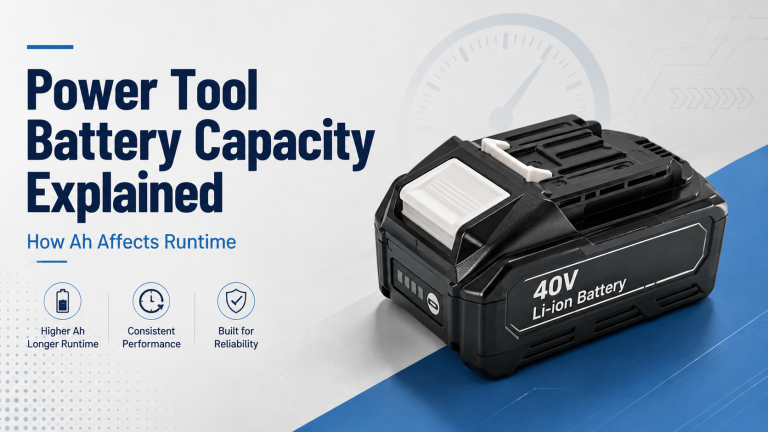
For buyers evaluating an established 40V application, a 40V replacement lithium-ion battery can illustrate how voltage, physical interface, and platform compatibility need to be considered together rather than treating voltage as a standalone specification.
2.The Cell-Level Story: Series Configuration
A lithium-ion cell has a nominal voltage of approximately 3.6–3.7 V and a fully charged voltage of about 4.2 V. To reach higher pack voltages, cells are wired in series (S), with each series group adding its voltage to the total.
| Target Pack Voltage | Cells in Series (S) | Nominal Pack Voltage |
|---|---|---|
| 20V | 5S | 18.5 V |
| 36V–40V | 10S | 37 V |
| 48V | 13S | 48.1 V |
| 60V | 16S | 59.2 V |
| 80V–82V | 22S | 81.4 V |
This is why a “40V” battery pack is not simply a bigger version of a “20V” pack. It has a fundamentally different internal architecture, BMS design, and discharge profile. The BMS must manage the corresponding series groups, while protection thresholds for over-voltage, under-voltage, and over-current are defined around the pack configuration.
For buyers, this creates an important distinction: matching the voltage label does not by itself confirm lawn mower battery compatibility.
3.Why Same-Voltage Batteries May Not Be Compatible
A common question from buyers is whether one 40V battery will work in another 40V mower platform.
The answer is generally no unless compatibility has been specifically confirmed.
Even when nominal voltage matches, the physical interface, terminal arrangement, battery identification method, communication requirements, charger design, thermal sensing, and mechanical fit may differ. A mismatched battery may fail to operate, trigger protection shutdowns, or create electrical and mechanical risks.
That is why a compatibility review should go beyond the voltage printed on the housing. A practical replacement-battery check should include:
- Original battery model or reference
- Voltage platform
- Mower or tool model
- Battery interface and mechanical fit
- Terminal and contact layout
- Charger compatibility
- Discharge load and protection requirements
For B2B replacement battery sourcing, brand name or voltage alone should not be used as confirmation of fit. The role of battery interfaces and contact compatibility is especially important when evaluating aftermarket replacement packs.
How Lawn Mower Battery Capacity (Ah) Affects Stored Energy
If voltage determines the electrical platform, capacity — measured in ampere-hours (Ah) — indicates how much charge the battery can deliver.
A 4.0 Ah battery can theoretically deliver 4 amps for one hour or 8 amps for 30 minutes before depletion.
For a cordless mower, however, the Ah figure should not be viewed in isolation. The energy available to perform work depends on both voltage and capacity.
1.Ah vs. Wh: Compare Stored Energy More Accurately
Ampere-hours alone can be misleading when comparing batteries across different voltage platforms.
A 4.0 Ah battery at 20V stores approximately 80 watt-hours (Wh) of energy, while a 4.0 Ah battery at 40V stores approximately 160 Wh — twice the energy despite having the same Ah rating.
The conversion is straightforward:
Wh = V × Ah
Watt-hours therefore provide a more useful basis for comparing the stored energy of batteries from different voltage platforms.
When evaluating a cordless mower battery capacity, replacement battery, or custom battery pack, check Wh alongside Ah rather than assuming that two batteries with the same Ah rating will provide similar runtime. For more detail on this relationship, see how battery capacity affects runtime.
2.Cell Selection: 18650 vs. 21700
The capacity of a battery pack is ultimately determined by the cells inside it. Two cylindrical cell formats are widely used in power-tool and outdoor-equipment battery packs:
| Parameter | 18650 | 21700 |
|---|---|---|
| Dimensions | Ø18 × 65 mm | Ø21 × 70 mm |
| Typical Capacity | 2,000–3,500 mAh | 3,500–5,000 mAh |
| Volume vs. 18650 | — | ~47% larger |
| Energy Density Gain | — | ~30–50% higher |
| Typical Application | Standard tool packs | High-capacity packs, newer platforms |
The 21700 format has become a common option for higher-capacity battery packs. A 5S2P configuration using 21700 cells rated at 4.0 Ah each yields an 8.0 Ah pack at 18.5 V, or approximately 148 Wh.
An equivalent build based on lower-capacity cells may require more parallel cells to reach the same battery pack capacity, increasing pack size, weight, assembly complexity, and cost.
Cell format alone, however, does not determine whether a pack is suitable for a lawn mower. Cell capacity, discharge capability, internal resistance, thermal behavior, pack architecture, and the mower’s workload must be considered together. Products such as a 20V 21700 lithium battery pack demonstrate how larger-format cells can be applied within a defined voltage platform.
3.Parallel Configuration: Adding Capacity
To increase Ah without changing voltage, cells are wired in parallel (P). Parallel groups operate at the same voltage while their capacities add together.
For example:
- A 5S2P pack using 3.0 Ah cells delivers 6.0 Ah at 18.5 V.
- A 10S2P pack using 4.0 Ah 21700 cells delivers 8.0 Ah at 37 V, or approximately 296 Wh.
For lawn mower applications, parallel counts are typically selected to balance capacity, discharge capability, pack dimensions, weight, and thermal management.
More parallel cells can provide additional energy and current capability, but they also increase mass. Battery capacity therefore should not be maximized without considering the complete mower design and intended duty cycle.

How to Estimate Cordless Lawn Mower Battery Runtime
Lawn mower battery runtime is where voltage, capacity, and actual mower load come together.
A basic planning calculation is:
Runtime (hours) ≈ Pack Energy (Wh) ÷ Motor Power (W)
The formula is useful for comparing battery configurations, but it should not be treated as a guaranteed mowing time because a lawn mower does not operate at a perfectly constant load.
1.Practical Runtime Estimates
Using the formula with real-world motor power figures gives the following planning ranges:
| Battery Configuration | Pack Energy | Motor Power | Estimated Runtime |
|---|---|---|---|
| 20V 4.0 Ah (5S2P, 18650) | 74 Wh | 500 W | ~9 min |
| 40V 4.0 Ah (10S2P, 18650) | 148 Wh | 800 W | ~11 min |
| 40V 6.0 Ah (10S3P, 21700) | 222 Wh | 1000 W | ~13 min |
| 56V 7.5 Ah (15S2P, 21700) | 420 Wh | 1500 W | ~17 min |
| 80V 5.0 Ah (22S1P, 21700) | 370 Wh | 1200 W | ~18 min |
These are theoretical planning values. Real-world runtime is typically shorter — often around 70–85% of the theoretical figure — because of motor inefficiency, BMS overhead, thermal effects, and changing mower load.
Grass resistance is not constant. The motor draws more current when cutting thick material and less when the blade is spinning under a lighter load.
For this reason, Ah alone should never be used as a guaranteed runtime figure. In a commercial battery project, capacity and runtime need to be evaluated against the intended application, discharge current, workload, operating environment, and performance target.
2.Factors That Reduce Real-World Runtime
Several variables can push actual cordless lawn mower runtime below the calculated value.
Grass condition. Tall, wet, or dense grass dramatically increases motor current draw. A mower that runs 40 minutes on a manicured lawn may last only 15–20 minutes in overgrown, damp conditions.
Temperature. Lithium-ion cells lose significant usable capacity at low temperatures. At 0°C, usable capacity can drop by 20–30%. At the other extreme, sustained use in direct sunlight at 35°C or above can cause thermal protection to activate and shorten the mowing session.
Blade sharpness and deck height. A dull blade forces the motor to work harder, converting more energy into heat and friction rather than efficient cutting. Setting the deck too low for the grass height has a similar effect.
Battery age and cycle count. Quality lithium-ion cells typically retain around 80% of their original capacity after 500 full charge-discharge cycles under specified conditions. A battery that delivered 40 minutes when new may provide only 30–32 minutes after extended heavy use.
Self-discharge during storage. A battery stored for several weeks may begin the next mowing session with less energy than its label capacity suggests. Storing packs at approximately 40–60% charge in a cool, dry environment can help limit storage-related degradation.
The practical lesson is that runtime should be treated as an application result rather than a label specification. For procurement and OEM/ODM projects, representative load testing provides more useful information than Ah alone.
How to Choose the Right Cordless Lawn Mower Battery
Selecting the right cordless lawn mower battery comes down to matching the electrical platform, battery capacity, workload, and compatibility requirements to the intended mower application.
Step 1: Match Voltage to Grass Type and Lawn Size
| Lawn Size | Grass Type | Recommended Voltage |
|---|---|---|
| < 100 m² | Soft, maintained | 20V–24V |
| 100–300 m² | Mixed, moderate | 36V–40V |
| 300–800 m² | Dense, varied | 48V–56V |
| > 800 m² or commercial | Thick, wet, heavy | 60V–82V |
These ranges provide a useful application reference, but they should not be interpreted as permission to replace the mower’s specified battery voltage with a different platform.
For an existing mower, the original voltage platform comes first. Lawn size and workload then help determine whether the available capacity and discharge performance are sufficient.
For a new OEM/ODM battery project, voltage can be reviewed together with expected power demand, discharge current, desired runtime, pack size, thermal requirements, and the mower’s electrical architecture.
Step 2: Match Capacity to Runtime Needs
Once the voltage platform is established, capacity determines how much stored energy is available per charge.
A practical rule of thumb is that a 40V 4.0 Ah pack may cover roughly 250–400 m² per charge in typical residential conditions. Doubling the Ah can substantially increase available energy and potential coverage, but it also adds weight and cost.
For procurement teams, a better question than “What is the largest Ah option?” is:
What capacity provides the required runtime under the mower’s expected workload while staying within acceptable weight, size, thermal, and cost limits?
That question turns lawn mower battery selection from a label comparison into an engineering decision. Where higher discharge capability is also required, a 40V 21700 high-power battery pack provides a useful example of how cell format, voltage, capacity, and discharge requirements can be combined within one pack design.
Step 3: Verify Cell Quality and BMS Design
This is where the difference between a properly engineered battery pack and a low-quality replacement becomes critical.
Key verification points include:
Cell grade. A-grade cells from established cell manufacturers can provide more consistent capacity, lower internal resistance, and more predictable cycle performance. For 21700 cells, internal resistance may be ≤40 mΩ depending on the specific cell design and measurement conditions. B-grade or reclaimed cells may carry similar capacity labels while degrading more rapidly or showing less consistent discharge behavior.
BMS functionality. A properly engineered BMS can provide cell-level voltage monitoring, over-charge protection, over-discharge protection, over-current protection, temperature sensing, and balancing where required. Typical protection thresholds depend on the cell chemistry and pack design.
Cycle life claims. Quality 18650 and 21700 cells may be rated for 500–1000 cycles to 80% capacity under specified test conditions. High-drain applications such as lawn mowing can operate at much higher discharge rates than standard cell datasheet tests, so cycle-life claims should be evaluated in the context of actual load.
Certification and documentation. For B2B sourcing, the exact document set should be checked against the battery model, configuration, transport route, and destination market. Lithium battery shipments are subject to applicable lithium battery transport requirements, while products placed on relevant European markets may also need to be evaluated against applicable CE marking requirements. Product certificates, safety data sheets, test reports, UN38.3 documentation, and shipping records should therefore be checked for the specific product and order rather than assumed to apply across an entire battery family.
For a replacement battery, cell and BMS quality matter only after electrical and mechanical compatibility have been confirmed. A well-built battery that does not match the intended mower and charger is still the wrong battery.

How Charging Time Affects Lawn Mower Battery Availability
Battery runtime is only half of the operating equation. Charge time determines how quickly a cordless mower can return to service.
A simple charging estimate is:
Charge Time (hours) ≈ Battery Capacity (Ah) ÷ Charger Output Current (A)
A standard 2.0 A charger takes roughly two hours to replenish a 4.0 Ah battery. A 4.0 A charger reduces the theoretical time to about one hour. Higher-output chargers delivering 6–8 A can bring charge times down to roughly 30–50 minutes for some 4.0–5.0 Ah packs.
However, faster charging also generates more heat.
Quality chargers monitor battery temperature and reduce current as the pack approaches full charge, transitioning from constant-current (CC) to constant-voltage (CV) operation. Poorly controlled charging can accelerate battery aging and increase the risk of overheating or cell damage.
Charger compatibility is therefore part of battery compatibility, not a separate afterthought. Before selecting a replacement lawn mower battery, the battery model, voltage, terminal arrangement, and intended charger should all be checked together.
For commercial users, another useful metric is operational availability rather than runtime alone. A slightly smaller battery paired with appropriate charging or battery rotation may sometimes keep equipment operating more effectively than one very large, heavy battery.
How GeB Power Supports Replacement and OEM/ODM Battery Projects
GeB Power is a Shenzhen-based B2B manufacturer of compatible replacement power tool batteries and an OEM/ODM battery project partner for global distributors, brand customers, procurement teams, and engineering teams.
For a cordless lawn mower battery project, an existing catalog product should not be assumed to fit simply because its voltage or external appearance appears similar. Where an application falls outside an established compatible product platform, GeB Power can review it through its battery engineering and OEM/ODM project support process.
The review starts with the application rather than with a predetermined battery configuration.
Compatibility and application review. Buyers can provide the original battery reference, mower or equipment model, charger model, voltage platform, interface, expected workload, and operating conditions. Electrical and mechanical requirements are reviewed together before a supply or development path is confirmed. Buyers sourcing from existing platforms can also review Power Tool Replacement Batteries as a starting point.
Battery pack engineering. For OEM/ODM projects, the review can cover application load, discharge current, voltage, target capacity, cell configuration, protection requirements, electrical contacts, connectors, enclosure requirements, thermal path, and assembly requirements.
That approach is especially relevant to lawn mower applications because increasing Ah alone does not necessarily solve a runtime problem. The battery must deliver the required current without creating unacceptable weight, thermal, interface, or protection issues. The broader battery pack requirements for cordless lawn and garden equipment provide useful context for these design trade-offs.
Sample validation. Before volume production is discussed, sample expectations and acceptance requirements are defined. Samples should be evaluated with the intended equipment and charger so compatibility and performance can be checked under the actual application rather than relying only on specification sheets.
Production handoff. Once the project specification is approved, production planning can be aligned with the confirmed battery configuration, label, packaging, quantity, inspection requirements, and acceptance criteria.
Document review. Certificate, test-report, safety-data, and shipping-document availability is reviewed according to the specific battery model, configuration, transport method, and destination market. Documentation should therefore be confirmed for the actual product and order rather than assumed from a general product family.
For buyers, this creates a practical sequence:
Verify the application and fit → define the battery pack → validate the sample → hand the approved specification into production.
That sequence helps prevent a common sourcing mistake: choosing a battery based only on voltage and capacity before confirming how it will interact with the mower, charger, workload, and mechanical interface. Buyers evaluating an existing replacement platform can also use this replacement battery compatibility guide to structure the initial review.
Cconclusion
The right cordless lawn mower battery is not simply the pack with the highest voltage or the largest Ah number. Voltage must match the mower’s electrical platform, capacity determines available energy, and actual runtime depends on both that stored energy and the mower’s real working load.
For replacement batteries, compatibility adds another layer: the battery model, interface, terminals, charger, mechanical fit, discharge requirements, and protection strategy should all be checked before a purchasing decision is made. For new battery projects, voltage, capacity, runtime, thermal behavior, weight, and validation should be treated as parts of the same engineering problem.
As a replacement power tool battery manufacturer, GeB Power supports B2B buyers with compatible replacement batteries as well as application-specific OEM/ODM battery projects, including compatibility review, battery pack engineering, sample validation, production handoff, and document review. Contact GeB Power to discuss your mower or battery application, target voltage, capacity, runtime, interface, quantity, and destination requirements.
FAQ
What voltage battery does a cordless lawn mower need?
Use the voltage platform specified for the mower. Common cordless mower platforms range from approximately 20V to more than 80V, but a higher voltage battery should not be substituted unless the mower was designed for that electrical platform.
For a replacement battery, confirm the original battery model, mower model, voltage, interface, terminals, and charger before assuming compatibility.
Does a higher Ah battery make a lawn mower run longer?
Generally, a higher Ah rating provides more stored energy when voltage remains the same, so it can increase potential runtime.
However, actual lawn mower battery runtime also depends on motor load, grass condition, temperature, cutting height, battery condition, discharge efficiency, and protection behavior. Compare watt-hours as well as Ah when evaluating different packs.
Can I use any battery with the same voltage in my lawn mower?
No. Matching voltage does not guarantee compatibility.
Two batteries can share the same nominal voltage while using different mechanical interfaces, contact layouts, charger requirements, protection systems, or communication methods. A compatible replacement lawn mower battery should be verified against the intended mower and charger platform.
How can I estimate cordless lawn mower battery runtime?
First calculate stored energy:
Wh = Voltage × Ah
Then divide the battery energy by the mower’s approximate average power consumption:
Runtime ≈ Battery Energy (Wh) ÷ Average Motor Power (W)
The result is a planning estimate rather than guaranteed runtime. Actual mowing conditions can substantially increase or decrease power demand.
What information should a B2B buyer provide for a lawn mower battery project?
For an efficient initial review, provide the original battery reference, mower or equipment model, charger model, nominal voltage, required capacity, expected workload or discharge requirement, quantity, and destination.
For an OEM/ODM project, it is also useful to provide interface, terminal or connector requirements, enclosure constraints, operating environment, label and packaging requirements, and required documentation.