Cordless Power Tool Battery Runtime: Why the Same Ah Can Perform Differently
Two cordless power tool batteries can carry the same Ah rating and still deliver different runtime in the same class of work. Amp-hours describe charge capacity, while actual runtime depends on how much usable energy the battery can deliver under load. Cell design, pack configuration, internal resistance, voltage sag, heat, BMS limits, tool efficiency, temperature, and duty cycle all affect the result.
For battery selection, Ah is useful. It is simply not the whole performance specification.

What Does Ah Actually Tell You About Power Tool Battery Runtime?
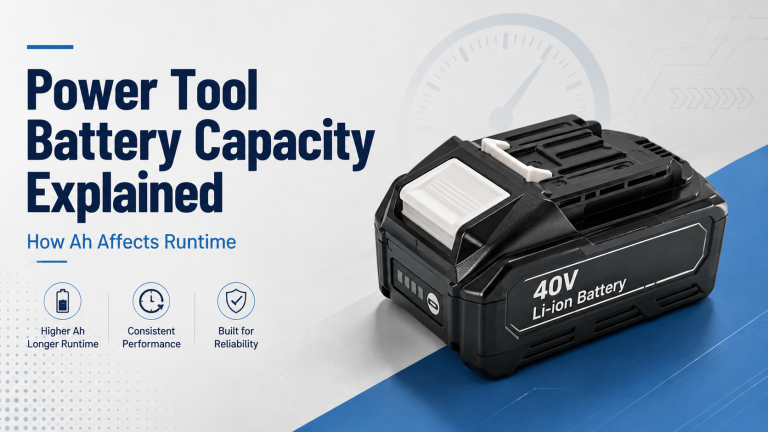
Amp-hours (Ah) describe a battery’s charge capacity. Conceptually, a 5.0Ah battery represents five amp-hours of charge—for example, 5 amps for one hour under specified conditions.
That definition helps compare capacity, but it does not directly tell you how long a cordless tool will run. Real operating time changes with the tool, workload, battery condition, temperature, and battery technology. Higher-capacity batteries generally provide longer runtime when the other conditions are comparable. For a broader explanation of the relationship between power tool battery capacity and runtime, Ah should always be considered together with voltage and application load.
Voltage matters because total nominal energy is better represented in watt-hours. As explained in this reference on battery watt-hours (Wh) and nominal energy, a useful approximation is:
Nominal energy (Wh) ≈ Nominal voltage (V) × Capacity (Ah)
For example:
| Battery rating | Approx. nominal energy |
|---|---|
| 12V 5.0Ah | 60Wh |
| 18V 5.0Ah | 90Wh |
So two batteries with the same Ah but different voltage are not carrying the same nominal energy.
The more interesting comparison begins when both voltage and Ah are already the same.
Why Can Two Batteries With the Same Ah Have Different Runtime?
Consider two batteries both labeled 18V 5.0Ah. On paper, each is approximately a 90Wh battery.
That still does not guarantee identical cordless power tool battery runtime.
The reason is the difference between rated energy and usable energy under load. A battery can meet the same nominal capacity target while behaving differently when the tool starts drawing substantial current. One pack may hold its voltage more effectively, stay cooler, and continue operating deeper into the discharge cycle. Another may develop more voltage sag or reach a protection threshold sooner.
The broader relationship between discharge behavior, load, and usable capacity is also reflected in technical guidance on lithium-ion battery discharge characteristics and usable capacity.
An illustrative comparison looks like this:
| Parameter | Battery A | Battery B |
|---|---|---|
| Nominal voltage | 18V | 18V |
| Rated capacity | 5.0Ah | 5.0Ah |
| Nominal energy | 90Wh | 90Wh |
| Voltage sag under heavy load | Lower | Higher |
| Heat generation | Lower | Higher |
| Protection cutoff | Later | Earlier |
| Effective runtime | Longer | Shorter |
The important number, therefore, is not only the Ah printed on the housing. It is how much of the battery’s nominal energy remains practically usable in the intended tool and operating condition.

Cell Design and Pack Configuration Change How the Battery Handles Load
Two battery packs can reach the same Ah rating with different cell designs and internal configurations. Those differences matter most when current demand rises.
Cell Quality and Discharge Capability
Lithium-ion cells with similar nominal capacities can have different discharge characteristics. Relevant differences include internal resistance, high-current capability, thermal behavior, and consistency between cells.
This is why battery capacity and discharge capability should be treated as separate specifications.
A cell may offer good energy capacity but be less suited to sustained high-current work. Another cell with similar nominal capacity may maintain voltage more effectively under a grinder, circular saw, or large drilling load.
A product such as an 18V 5Ah high-discharge power tool battery illustrates why capacity and discharge design are often specified separately. Two packs can both be labeled 5Ah while targeting different current-delivery requirements.
Increasing Ah does not automatically change the tool’s rated power. However, some larger or differently designed packs can sustain demanding loads more effectively.
Parallel Cells and Current Sharing
Pack architecture adds another layer.
When lithium-ion cells are arranged in parallel, the total pack current is shared across the parallel paths. With well-matched cells and connections, this reduces the current burden on each individual cell.
That can reduce electrical stress and heat during high-current operation.
Two same-Ah packs may therefore differ in:
- cell size or format,
- number of cells,
- parallel grouping,
- per-cell discharge capability,
- and connection resistance.
For example, an 18V 5S3P 18650 high-discharge battery pack shows how series-parallel architecture and discharge-rate requirements are part of the battery specification, not just the final Ah number.
In simple terms, capacity tells you how much charge the pack holds; pack architecture helps determine how effectively it can deliver that charge.
Internal Resistance, Voltage Sag, and Heat Explain Much of the Difference
Internal resistance is the electrical resistance inside the cells, connections, and battery pack. Under load, it causes part of the battery voltage to be lost internally.
A useful approximation is:
Voltage drop ≈ Current × Internal resistance
As current rises, voltage sag becomes more noticeable.
This explains why two 5.0Ah batteries can appear nearly identical in a light screwdriving task but behave quite differently in continuous grinding or heavy cutting. High-current applications expose differences that light loads may never reveal.
Heat follows the same pattern. Resistive heating rises strongly with current, approximately according to I²R behavior. A battery with higher effective resistance can therefore generate more heat during demanding operation.
That matters because heat affects how long the battery can remain inside its allowable operating limits.
Applications that tend to make these differences easier to see include:
- grinding,
- large-hole drilling,
- masonry drilling,
- cutting dense material,
- and driving large structural fasteners.
Cordless circular saws are a good example because repeated cutting places a sustained load on the battery. Choosing battery capacity for cordless circular saws therefore involves more than checking Ah; load profile and pack performance matter as well.
This is one of the main reasons battery runtime comparisons should include the actual workload, not only the nameplate capacity.
How BMS and Protection Limits Affect Usable Runtime
The battery management system (BMS) monitors and protects the battery pack during charge and discharge. Depending on the design, its functions may include cell monitoring and balancing, temperature supervision, current protection, and low-voltage cutoff.
These controls directly affect usable runtime.
For example, a high load can cause voltage sag. If one cell or the complete pack reaches its low-voltage limit, the system may stop output even though some electrochemical energy remains in the cells.
The same principle applies to temperature and current protection. A pack that heats rapidly or reaches its current threshold earlier may reduce output or shut down before another same-Ah pack operating under the same job.
The BMS does not create additional capacity. It determines, together with the cells and tool, how much of the rated capacity can be safely accessed under a particular condition.
That distinction is central to understanding usable battery capacity.

The Tool and the Job Matter as Much as the Battery Label
Battery runtime is a system result. The battery supplies the energy, while the tool determines how that energy is converted into work.
Tool Efficiency and Electronics
Brushless motor efficiency, electronic speed control, winding resistance, and mechanical transmission all influence energy consumption.
This is why a battery cannot have one universal runtime figure.
A 5.0Ah pack used on a compact drill, angle grinder, rotary hammer, and circular saw is operating under very different electrical demands. Even two tools performing similar work may draw different current because of their motor design, gearing, control strategy, or mechanical efficiency.
Load and Duty Cycle
Workload changes the picture again.
Driving drywall screws is a relatively light, intermittent load. Drilling large holes in wet lumber or running a grinder continuously can demand far more current. The same battery will last very different lengths of time.
Duty cycle also matters.
Continuous operation gives the battery less time to release heat between load events. Intermittent drilling or fastening allows short recovery periods, which can change the thermal condition of the pack during the job.
For that reason, “runtime” should always be tied to an application and a test condition.
Temperature, Battery Age, and State of Charge Can Change Runtime Too
Runtime is not fixed over the battery’s entire life or temperature range.
Temperature
Cold conditions generally reduce lithium-ion discharge performance and increase the difficulty of supplying high current. Under some conditions, effective runtime at about 20°F (-7°C) can be roughly 30% lower than at around 70°F (21°C). The exact change depends on cell design, workload, battery age, and pack construction.
At the other end of the range, excessive heat can trigger thermal protection and accelerate long-term degradation.
Thermal design can therefore make a measurable difference during sustained work. Certain thermal-management comparisons have shown approximately 15–25% additional effective runtime under specific test conditions. The exact improvement should always be interpreted together with the tool, load, and test method.
Battery Age
A 5.0Ah label describes the original rated capacity. It does not update as the battery ages.
With use, available capacity can decline and internal resistance can increase. An older pack may therefore deliver less runtime and show more voltage sag than a new battery carrying the same original rating.
State of Charge
State of charge also changes loaded behavior.
As the battery approaches the lower end of its discharge range, loaded voltage moves closer to the system’s cutoff threshold. A pack with higher resistance or weaker cell matching may therefore stop sooner near the end of discharge even if its early-cycle performance looked similar.
That is one reason two batteries can feel almost identical at first and separate more clearly toward the end of a job.
How to Compare Two Same-Ah Power Tool Batteries Fairly
A meaningful power tool battery runtime test requires controlled conditions. Otherwise, it is difficult to know whether the difference came from the battery, the tool, the material, or the operator.
Keep the Test Conditions the Same
For a practical comparison, control the main variables:
- same tool model,
- same blade, bit, or accessory,
- same work material,
- same operating mode,
- comparable starting state of charge,
- same ambient temperature,
- same duty cycle,
- comparable battery age and condition,
- and the same test endpoint.
This is especially important for power tool replacement batteries. A runtime result measured in one tool and one load should not automatically be generalized to another application.
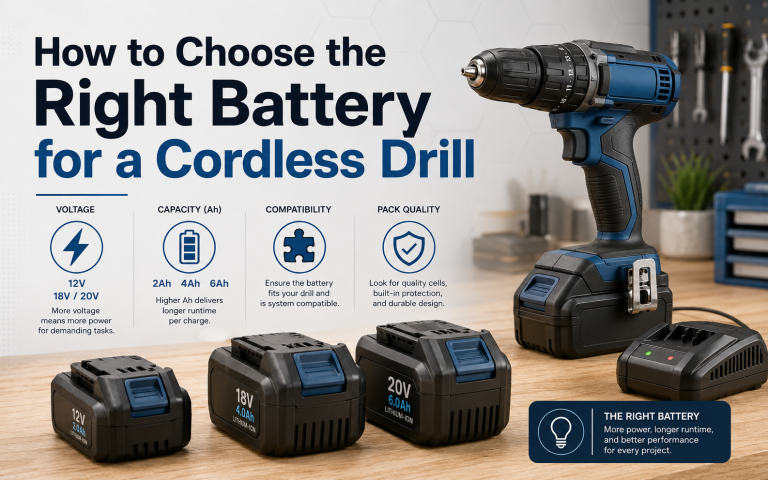
Voltage and platform compatibility should also be confirmed before comparing performance. If the voltage label itself is unclear, this guide to matching battery voltage with your power tool platform provides a useful starting point.
Measure More Than Minutes
Elapsed time is useful, but it does not tell the whole story.
For a more informative battery performance test, record:
| Test metric | What it helps reveal |
|---|---|
| Runtime | Total operating duration |
| Cuts, holes, or fasteners completed | Useful work delivered |
| Loaded voltage | Voltage stability under demand |
| Voltage sag | Resistance-related performance |
| Pack temperature | Thermal behavior |
| Protection events | BMS or operating-limit behavior |
| Delivered Wh | Actual energy supplied, where equipment allows |
For sourcing and engineering review, this type of application-level sample validation is more useful than comparing Ah labels alone. A broader replacement power tool battery buyer’s guide can help connect runtime evaluation with compatibility, voltage, charger matching, and application requirements.
GeB Power follows the same practical logic through its battery engineering and sample validation support, where application review, pack engineering, sample validation, and production handoff are connected to the intended tool, load, voltage, protection requirements, and operating environment.

Conclusion
Two cordless power tool batteries with the same Ah rating can perform differently because their usable energy under real load is influenced by cell design, pack configuration, resistance, voltage sag, thermal behavior, protection limits, tool efficiency, environment, and duty cycle.
GeB Power supplies compatible replacement power tool batteries and supports OEM/ODM battery projects with compatibility review, pack engineering, sample validation, and production planning. If you are comparing battery platforms or defining runtime requirements for a specific application, contact us to discuss the tool, load profile, voltage, capacity, and validation requirements.
FAQ
Do two 5Ah batteries always have the same runtime?
No. If both batteries have comparable voltage, their nominal energy may be similar, but cell characteristics, internal resistance, BMS behavior, temperature, battery condition, and tool load can produce different usable runtime.
Does higher Ah make a power tool more powerful?
Higher Ah does not directly change the tool’s rated power. Its main effect is increased capacity and potential runtime. However, some higher-capacity packs use more parallel cells or different cell designs, which can reduce voltage sag and help the tool sustain performance under high load.
Is an 18V 5Ah battery the same as a 20V MAX 5Ah battery?
The voltage label must be interpreted carefully. Some platforms marketed as 20V MAX are approximately 18V nominal, with the higher number referring to maximum fully charged voltage.
The electrical architecture and compatibility still need to be checked before treating two packs as equivalent.
What matters besides Ah when comparing replacement batteries?
Look at the complete application: confirmed voltage platform, cell and pack design, discharge capability, voltage stability, thermal behavior, protection strategy, charger and tool compatibility, and sample performance under the intended workload.
Ah is the starting point for comparison. It should not be the final acceptance criterion.