How Battery Capacity Affects Cordless Jigsaw Runtime and Handling
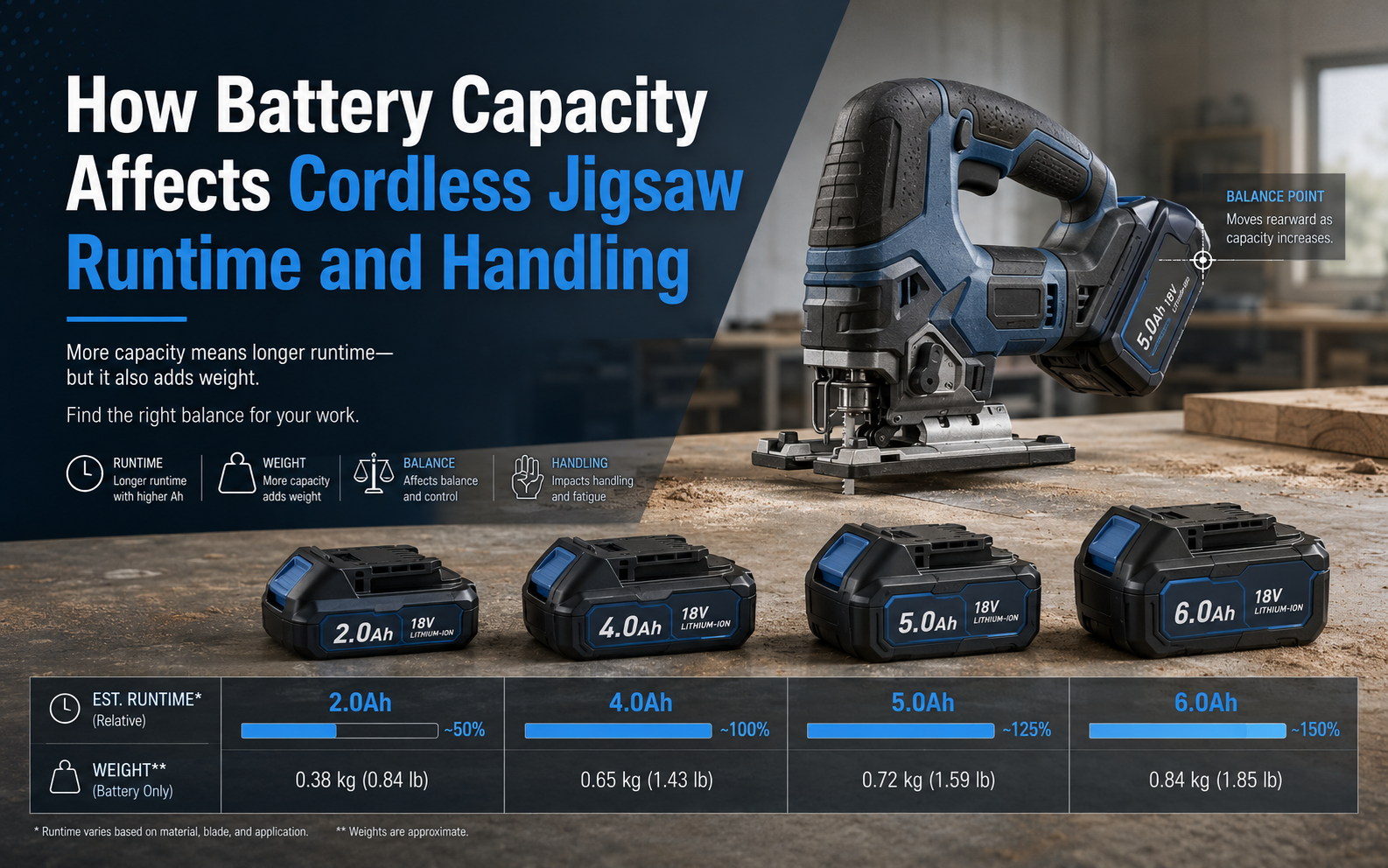
Battery capacity has a direct effect on how long a cordless jigsaw can work between charges, but runtime is only part of the decision. Higher-capacity batteries usually store more energy, yet they can also add weight and bulk that change the saw’s balance, maneuverability, and operator fatigue.
For most jigsaw applications, the best battery is not simply the pack with the highest Ah rating. It is the capacity that provides enough runtime without making the tool unnecessarily heavy for the work being performed.
What Does Battery Capacity Mean on a Cordless Jigsaw?
Battery capacity is commonly expressed in amp-hours, or Ah. In practical terms, Ah indicates how much electrical charge a battery can store. When comparing batteries on the same voltage platform, a higher Ah rating generally means more available energy and longer potential runtime.
For a clearer comparison of stored energy, it is useful to look at watt-hours, or Wh:
Watt-hours ≈ nominal voltage × amp-hours
For an 18V cordless jigsaw platform:
| Battery | Approximate nominal energy |
|---|---|
| 18V 2.0Ah | 36Wh |
| 18V 4.0Ah | 72Wh |
| 18V 5.0Ah | 90Wh |
| 18V 6.0Ah | 108Wh |
This explains why a 5Ah battery normally runs longer than a 2Ah battery on the same compatible tool platform: it contains substantially more stored energy.
For a broader explanation of this relationship, see GeB Power’s guide to how power tool battery capacity and Ah affect runtime.
The comparison becomes less useful if voltage is ignored. A 4Ah battery on one voltage platform should not automatically be treated as equivalent to a 4Ah battery on another platform. When comparing replacement packs, matching battery voltage with the power tool platform should come before comparing capacity.
Wh is therefore a better indicator of nominal stored energy, but it still does not tell you exactly how many minutes a jigsaw will cut.
How Higher Battery Capacity Affects Jigsaw Runtime
Cordless jigsaw runtime is the amount of active operating time a tool can deliver before the battery reaches its discharge limit or the protection system stops the pack.
Under comparable conditions, increasing battery capacity usually increases runtime.
A compact 2Ah or 3Ah pack may be sufficient for intermittent trimming, short curved cuts, or occasional installation work. Moving to 4Ah or 5Ah gives the tool more available energy and can significantly reduce battery changes during longer cutting sessions. Packs of 6Ah and above extend the operating window further when runtime matters more than minimum weight.
The basic theoretical relationship is straightforward:
Estimated runtime in hours ≈ battery energy in Wh ÷ average tool power draw in W
However, a cordless jigsaw does not draw constant power. Current demand rises and falls as blade load changes, so this calculation should be treated as an estimate rather than a runtime guarantee.
Typical active cutting time may fall roughly within these ranges:
| Battery capacity | Illustrative active runtime | General positioning |
|---|---|---|
| 2–3Ah | About 15–40 min | Short or intermittent work |
| 4–5Ah | About 30–80 min | General-purpose cutting |
| 6Ah+ | About 60–120 min in suitable conditions | Longer continuous work |
These are reference ranges, not fixed specifications. Tool model, material, blade condition, cutting settings, and battery design can move actual results outside them.
The reliable conclusion is simpler: more usable battery energy normally extends jigsaw runtime, but Ah should be used to compare capacity rather than to predict an exact number of minutes.
Why Actual Jigsaw Runtime Varies Even at the Same Ah
Two cordless jigsaws using the same battery capacity can deliver noticeably different runtime.
Cutting load is one reason. Thin plywood places a very different demand on the motor than thick hardwood. Curved cuts, tight-radius work, aggressive feed pressure, and high orbital settings can also change current demand.
Blade condition matters as well. A sharp blade that matches the material cuts more efficiently than a dull or poorly selected blade. More resistance at the blade means the motor must work harder.
Other runtime factors include:
- Material type and thickness
- Blade type and sharpness
- Stroke speed and orbital setting
- Feed pressure
- Straight versus curved cutting
- Motor and electronic-control efficiency
- Battery temperature
- Cell and pack design
- Battery age and state of charge
- Battery-management and protection limits
Battery temperature deserves particular attention. Under sustained load, cell temperature rises. A battery management system may reduce output or stop discharge when defined voltage, current, or thermal thresholds are reached.
Ah tells you how much capacity is available; it does not tell you exactly how many minutes the jigsaw will run.
A meaningful runtime comparison requires similar tools, materials, blades, cutting settings, and operating conditions.
How Battery Capacity Changes Jigsaw Weight, Balance, and Handling
Higher-capacity batteries are often heavier because additional capacity may require more cells, different cell configurations, or a larger pack structure. That extra mass becomes part of the tool.
Typical battery weights may fall around:
- 2Ah: approximately 0.4–0.5 kg
- 5Ah: approximately 0.6–0.7 kg
- 8Ah: approximately 0.9–1.1 kg
Actual values vary considerably by cell format, energy density, enclosure design, and battery architecture. Ah alone does not determine pack weight.
For a cordless jigsaw, the difference matters because the tool is continuously guided through the cut. Additional battery mass can shift the center of gravity toward the battery end of the saw and change how easily the operator steers it.
A lighter battery usually improves maneuverability during:
- Tight curved cuts
- Detailed woodworking
- Frequent direction changes
- Vertical cutting
- Overhead work
A heavier pack can feel more planted when the saw is supported on a horizontal workpiece. For long straight or repetitive cuts, that extra stability may not be a disadvantage.
The trade-off becomes more noticeable during detailed work. Additional rear weight can increase wrist and forearm fatigue, and a physically larger pack may also make the tool less convenient in confined spaces.
Battery technology can reduce some of this penalty. Higher-energy-density cells and different pack architectures can store more energy without increasing weight in direct proportion to Ah. For example, a 20V MAX 6.0Ah replacement battery using 21700 cells illustrates how cell format and pack design become part of the capacity discussion.
For handling, the important specification is therefore not capacity alone. Pack weight, dimensions, battery position, and the resulting tool balance should all be considered.
2Ah vs 4Ah vs 5Ah and Larger Batteries: Which Is Better for a Jigsaw?
There is no single capacity that fits every cordless jigsaw application. The useful comparison is between the runtime gained and the weight added.
| Capacity | Runtime | Handling | Best suited for |
|---|---|---|---|
| 2–3Ah | Shorter | Light and agile | Detail work, short jobs, overhead cutting |
| 4–5Ah | Medium to long | Balanced | General woodworking and renovation |
| 6Ah+ | Longer | Usually heavier and bulkier | Extended or repetitive cutting |
2Ah–3Ah: Best When Low Weight Matters Most
Compact batteries are a strong choice when precision and mobility matter more than maximum jigsaw battery runtime.
They keep the saw lighter during curved cuts, short trimming operations, installation work, and overhead use. They are also practical when spare batteries and chargers are readily available.
For platforms where compact pack size is important, 18V 1.5Ah, 2Ah, and 3Ah replacement battery options for Makita power tools provide an example of lower-capacity configurations intended for the same general cordless-tool voltage class.
The limitation is straightforward: lower capacity means more frequent battery changes during sustained cutting.
4Ah–5Ah: A Practical Balance for General Jigsaw Work
For many 18V-class applications, 4Ah to 5Ah is a practical middle ground between runtime and handling.
These packs provide substantially more stored energy than compact 2Ah batteries without automatically moving into the largest and heaviest battery format. They suit general woodworking, remodeling, installation, and routine job-site cutting.
GeB Power’s 18V 3Ah, 4Ah, 5Ah, and 6Ah replacement battery range for Makita cordless tools shows the type of capacity range buyers may evaluate within one tool platform.
This does not make 5Ah universally “best.” Pack design matters, and a modern compact high-energy battery may have very different dimensions from another battery with a similar Ah rating.
6Ah and Above: When Runtime Takes Priority
Higher-capacity packs become more attractive when frequent battery changes interrupt the job.
They can make sense for repetitive cuts, longer work sessions, heavier materials, or locations where charger access is limited.
The additional weight should still earn its place on the tool. For short precision cuts or overhead work, carrying maximum capacity can reduce handling quality more than it improves productivity.
The right battery Ah for a jigsaw depends on the job. More capacity is valuable when the extra runtime solves a real operating problem.
Does a Higher-Ah Battery Make a Jigsaw More Powerful?
Not necessarily.
Battery capacity and battery power are different specifications. Ah primarily describes how much charge the battery stores. It does not independently define how much current the pack can deliver under load.
High-load performance also depends on factors such as:
- Cell type and cell configuration
- Internal resistance
- Current capability
- Nominal voltage
- Pack temperature
- Electrical contacts
- Battery-management limits
Some higher-capacity packs may also have stronger discharge capability because of their cell selection or parallel configuration. But that relationship comes from battery engineering, not from the Ah number itself.
A 6Ah pack should therefore not automatically be described as more powerful than a 4Ah pack simply because its capacity is larger.
When evaluating battery capacity vs power, treat runtime capability and high-current capability as related but separate engineering questions.
How to Choose the Right Battery Capacity for Your Cordless Jigsaw
Choosing the best battery size for a cordless jigsaw starts with the cutting task rather than the largest battery available.
Choose a Lighter Pack for Precision and Mobility
Prioritize a compact battery when the work involves tight curves, frequent repositioning, detailed cuts, or overhead operation.
In these applications, reduced tool weight can improve control and lower fatigue. A shorter runtime may be an acceptable trade if the tool is only running intermittently.
Choose More Capacity for Long or Repetitive Cutting
A higher-capacity pack is more useful when the jigsaw will run repeatedly for extended periods.
Long cuts, repetitive job-site work, limited access to charging, or costly battery-change interruptions all increase the value of additional Ah.
The decision becomes practical: if changing batteries creates more downtime than the added battery weight creates fatigue, more capacity is justified.
Consider a Two-Battery Strategy
One battery size does not have to handle every task.
For users working within the same confirmed battery platform, a compact pack plus a higher-capacity pack can be more useful than relying exclusively on the largest battery available. Use the lighter pack for precision work and switch to the larger pack when runtime becomes the priority.
Capacity, however, cannot be selected independently from compatibility. A replacement battery should be checked against the original battery reference, voltage platform, physical interface, terminal arrangement, charger requirements, and tool model.
For a broader procurement framework, see how to choose the right replacement power tool battery.
Choose capacity after the platform is confirmed, not before.
Cordless Jigsaw Battery Capacity FAQs
Is a Higher-Ah Battery Always Better for a Jigsaw?
No. Higher Ah usually extends runtime, but the pack may also be heavier and larger. For detailed cuts or overhead work, a lighter battery can provide better handling even if it requires more frequent charging.
Will a Higher-Capacity Battery Damage My Jigsaw?
Higher capacity by itself is not the deciding compatibility factor. The battery must match the tool’s voltage platform, mechanical interface, terminal arrangement, electrical requirements, and charger system.
Before replacing or increasing capacity, confirm the tool and battery platform rather than relying on Ah or brand name alone.
How Much Longer Will a 5Ah Battery Run Than a 4Ah Battery?
At the same nominal voltage, a 5Ah battery has 25% more nominal Ah capacity than a 4Ah battery.
That does not guarantee exactly 25% more cutting time. Material, blade condition, motor efficiency, temperature, cutting load, and battery design still affect actual runtime.
Is an 8Ah Battery Worth Using on a Cordless Jigsaw?
It can be, especially for long repetitive cutting where battery changes create downtime.
For precision work, vertical cuts, or overhead use, the extra mass and bulk may outweigh the benefit. Compare the actual pack weight and dimensions before choosing solely on Ah.
Choosing Capacity Around the Work
Battery capacity has a clear effect on cordless jigsaw runtime: more Ah on the same compatible voltage platform generally provides more stored energy and longer operation between charges. The trade-off is that higher-capacity packs can add weight and bulk, changing balance, maneuverability, and operator fatigue.
For most applications, choose enough capacity to complete the required work comfortably rather than simply selecting the highest Ah available.
GeB Power provides power tool replacement batteries and supports replacement battery supply, compatibility review, OEM/ODM development, battery engineering, and sample validation through its power tool battery solutions. If you are evaluating a jigsaw replacement battery or developing a battery pack for a specific cordless tool platform, contact GeB Power with the original battery model, tool and charger models, voltage, target capacity, and application requirements for review.