How Long Does a Cordless String Trimmer Battery Last?
If you are shopping for cordless string trimmers—or sourcing replacement batteries for them—the first question is deceptively simple: how long does a cordless string trimmer battery last?
The answer matters in two different ways. “Last” can mean runtime per charge, or how many minutes of trimming you get before the battery needs recharging. It can also mean overall battery lifespan, or how many years and charge cycles the battery can provide before noticeable capacity loss makes replacement necessary.
Both measurements affect purchasing decisions, warranty expectations, and long-term cost of ownership, but they are often confused in product listings.
This guide explains both meanings of string trimmer battery life, the factors that affect runtime and lifespan, and what buyers should evaluate when selecting a cordless string trimmer battery or compatible replacement pack.

How Long Does a String Trimmer Battery Run Per Charge?
Runtime per charge is what most users notice first. You pick up the trimmer, pull the trigger, and the clock starts.
Actual string trimmer battery runtime depends on the relationship between battery capacity in amp-hours (Ah), battery voltage (V), and the current or power demanded by the motor under the specific cutting conditions.
That last point matters. Battery runtime is not only a battery specification. It is the result of the interaction between the battery, tool, cutting load, and operating environment.
For a deeper explanation of the relationship between amp-hours and tool operating time, see this guide to how battery capacity affects runtime.
How to Estimate Battery Runtime
At its simplest, runtime can be estimated with:
Runtime (hours) ≈ Battery capacity (Ah) ÷ Current draw (A)
A 2.0 Ah battery discharging at 4 A will run for roughly 30 minutes. The same 2.0 Ah pack at 8 A will last about 15 minutes.
Double the capacity to 4.0 Ah at the same electrical load, and the theoretical runtime approximately doubles as well. In practice, however, real-world results also depend on motor demand, battery condition, temperature, protection settings, and how the tool is being used.
Once the battery reaches its applicable discharge or protection limits, the battery management system may reduce or interrupt output to protect the cells.
For buyers and engineering teams, this is why answering “does a higher Ah battery last longer?” requires more than comparing labels. Higher capacity can provide more available energy, but actual runtime still needs to be considered together with the tool’s voltage platform, discharge load, battery configuration, and application.
Typical Cordless String Trimmer Battery Runtime
Real-world runtime figures commonly fall into recognizable ranges. The table below shows typical expectations for several common configurations.
| Battery Voltage | Capacity | Typical Runtime | Best Suited For |
|---|---|---|---|
| 18V–20V | 2.0 Ah | 15–25 min | Small yards, light edging |
| 18V–20V | 4.0–5.0 Ah | 30–45 min | Medium yards, mixed grass |
| 40V | 2.0–2.5 Ah | 25–45 min | Medium yards, taller grass |
| 40V | 4.0–5.0 Ah | 45–60+ min | Large yards, dense weeds |
| 56V–62V | 2.5–4.0 Ah | 30–45 min | Large properties, heavy brush |
| 80V | 4.0–5.0 Ah | 60+ min | Commercial-grade trimming |
These figures are not guarantees. They represent moderate cutting conditions.
Thick, wet, or overgrown grass pushes motor demand higher, and runtime can drop by 30–50% under heavy load.
This also explains why two cordless string trimmers using batteries with similar Ah ratings may not produce identical runtime. Tool efficiency, motor load, cutting conditions, voltage platform, and battery behavior all influence how much usable work is obtained from the stored energy.
For buyers comparing common outdoor-tool voltage classes, GeB Power also offers examples such as a 20V high-capacity battery pack for cordless tools and a 40V replacement battery for cordless outdoor tools.
What Makes a String Trimmer Battery Run Out Faster?
Several factors can reduce cordless string trimmer battery runtime below the typical figures above.
Grass Density and Height
Trimming through 6-inch turf draws meaningfully less current than powering through 18-inch overgrown weeds.
Wet grass creates additional drag on the cutting head, forcing the motor to work harder and the battery to supply more current. The more demanding the cutting load, the faster stored battery energy is consumed.
Cutting Swath Width
A 15-inch cutting swath covers more ground per pass but generally demands more torque than a 13-inch head.
A wider cutting path can improve productivity, but the higher instantaneous power demand may reduce runtime depending on the tool and operating conditions.
Brushed vs. Brushless Motors
Brushless motors are typically 20–30% more efficient than comparable brushed motors because more battery energy is converted into useful mechanical work and less is lost as heat.
Many higher-performance cordless trimmers now use brushless motors, while some lower-cost tools continue to use brushed motors that can consume battery energy more quickly.
Temperature
Lithium-ion cells generally deliver their strongest performance between approximately 15°C and 35°C (59°F–95°F).
Below 10°C (50°F), internal resistance rises, usable capacity declines, and runtime can shrink. A battery that delivers 40 minutes at 25°C may provide only 25–30 minutes at 5°C.
High temperatures create a different problem: even when short-term output remains adequate, sustained heat can accelerate long-term battery degradation. Temperature and state of charge are also widely recognized as important variables affecting lithium-ion battery life.
Battery Age and State of Health
A battery that has completed hundreds of charge cycles generally stores less usable energy than it did when new.
For example, a battery originally capable of providing around 45 minutes of runtime may deliver only 30–35 minutes after two seasons of heavy use. The battery may still function normally, but its available capacity has declined.
For this reason, string trimmer battery runtime is also a useful indicator of battery health. A significant runtime reduction under otherwise similar working conditions may indicate aging cells, increased resistance, or declining usable capacity.

How Long Does a String Trimmer Battery Last Before Replacement?
Runtime describes a single trimming session. Battery lifespan describes how many sessions the battery can provide before degradation makes replacement necessary.
This distinction is especially important for distributors, fleet operators, landscapers, brands, and other B2B buyers because overall string trimmer battery lifespan affects replacement demand, warranty planning, and total lifecycle cost.
Battery Cycle Life
A charge cycle represents one full discharge and recharge, although partial discharges accumulate toward a complete cycle.
For example, ten trimming sessions that each consume approximately 10% of the battery’s capacity would add up to roughly one full cycle.
Lithium-ion batteries are commonly rated for around 300 to 1,000 full charge cycles before capacity falls to approximately 80% of the original value.
Typical cycle-life ranges include:
| Cell Chemistry / Format | Typical Cycle Life | Common Use |
|---|---|---|
| Standard 18650 NMC | 500–800 cycles | Mainstream power tool packs |
| Higher-quality 18650 NMC | 800–1,200 cycles | Higher-demand tool applications |
| 21700 NMC | 500–1,000 cycles | High-drain outdoor equipment |
| LiFePO4 (LFP) | 2,000–5,000 cycles | Specialty / industrial packs |
For a homeowner trimming once a week during a six-month growing season—roughly 25–30 sessions per year—a 500-cycle battery theoretically represents many years of cycling.
In practice, calendar aging means the pack will generally need replacement much sooner. Typical homeowner use may result in a practical service life of around 3–5 years, while a commercial landscaping operation using and recharging batteries every day may consume the same cycle capability in 1–2 seasons.
The important purchasing lesson is that cycle life cannot be evaluated separately from the intended application. A pack designed for occasional residential trimming and one intended for frequent commercial operation may face very different discharge loads, thermal conditions, and charging schedules.
Battery Calendar Life
Lithium-ion batteries gradually degrade even when they are not being used. This process is known as calendar aging.
Temperature and state of charge during storage are major contributors. Research into lithium-ion battery calendar aging shows why storage conditions can influence long-term capacity retention even when a battery is not being actively cycled.
A battery stored fully charged in a hot garage at 40°C or above will generally lose capacity more quickly than a battery kept at roughly 50% charge in a cool, dry environment.
Industry studies and cell-manufacturer data commonly indicate that for every 10°C increase in storage temperature, the rate of capacity degradation can roughly double.
A battery stored at 35°C can therefore age substantially faster than one stored at 25°C.
For distributors and dealers managing inventory, this is particularly important. Batteries stored for long periods in hot warehouses, freight environments, or poorly controlled storage facilities may lose some lifespan before reaching the end customer.
What Causes String Trimmer Batteries to Wear Out Faster?
Several conditions can shorten both cycle life and calendar life.
Deep Discharge Habits
Regularly running a battery until it reaches its cutoff point places more stress on the cells than shallower discharge patterns.
Batteries repeatedly discharged near empty can degrade more quickly than packs that are recharged with approximately 20–30% capacity remaining.
Modern battery management systems typically prevent cells from reaching a true zero-voltage condition, but repeated deep cycling can still contribute to faster wear.
High-Temperature Use and Storage
Heat is one of the most important contributors to lithium-ion battery degradation.
Operating a cordless string trimmer in summer heat and then immediately storing the battery in a hot shed can expose the pack to prolonged thermal stress.
A storage temperature of approximately 10–25°C, with the battery maintained at around 40–60% state of charge during extended storage, can help reduce unnecessary degradation. Additional guidance on lithium-ion battery storage conditions can help users and distributors manage packs during long periods of inactivity.
Frequent Fast Charging
Fast charging improves equipment uptime, but it also produces additional heat and may place greater stress on cell chemistry than lower-rate charging.
For users who fast-charge every day, cycle life may be reduced by approximately 15–30% compared with standard-rate charging.
For commercial operators, this trade-off may be acceptable because equipment availability has greater operational value. For procurement teams, however, charging strategy should be considered when estimating total lifecycle cost.
Physical Abuse
Drops, impacts, and repeated vibration can damage internal connections, cell assemblies, housings, or battery management components.
Outdoor power equipment is often exposed to rough working conditions, making mechanical construction and protection an important part of replacement battery evaluation.
How to Make a String Trimmer Battery Last Longer
Whether you are maintaining your own cordless trimmer or specifying a replacement battery program, several practices can help preserve both runtime and overall battery life.
Store Batteries at Partial Charge
If the string trimmer will not be used for several weeks or longer, store the battery at approximately 40–60% charge in a cool, dry location.
Avoid leaving the battery fully depleted for extended periods or keeping it permanently connected to a charger unless the battery and charging system are specifically designed for that storage method.
Avoid Extreme Temperatures
Do not charge or store lithium-ion batteries in freezing conditions or in environments above approximately 35°C.
If a battery has been exposed to very cold conditions, allow it to return toward room temperature before charging.
Use the Correct Charger
Use a charger designed for the battery’s voltage platform, chemistry, interface, and charging requirements.
This is also where compatibility becomes important. A replacement battery should not be selected solely because its voltage appears similar. The original battery reference, charger model, electrical interface, terminals, tool model, and mechanical fit should all be checked before use.
Keep Battery Contacts Clean
Dirt, oxidation, and contamination around battery terminals can increase electrical resistance.
Higher resistance creates additional heat and can contribute to poorer power delivery. Keeping contacts clean and dry helps maintain a reliable electrical connection.
Rotate Multiple Batteries
For users operating several battery packs, rotating them can distribute cycling more evenly so one battery does not absorb all of the workload.
For commercial operators, battery rotation can also make charging schedules easier to manage while reducing repeated deep cycling of a single pack.
For a broader view of pack selection in trimmers, blowers, mowers, and similar equipment, see these battery pack requirements for cordless lawn and garden equipment.

How to Choose a Replacement Battery for a String Trimmer
When the original battery reaches the end of its useful life through cycle exhaustion, calendar aging, reduced capacity, or physical damage, buyers can consider either original replacement packs or compatible power tool replacement batteries.
For B2B buyers evaluating a replacement battery for a string trimmer, several factors determine whether a battery can deliver suitable performance and service life.
Cell Performance
The cells inside the battery pack strongly influence capacity, discharge capability, heat generation, and cycle life.
Buyers should evaluate documented cell specifications such as rated capacity, applicable discharge performance, and cycle-life characteristics rather than relying only on the Ah value printed on the finished battery pack.
Battery Management and Protection
A properly designed battery management and protection system may include functions such as overcharge protection, over-discharge protection, temperature monitoring, balancing, and short-circuit protection depending on the pack design.
The protection requirements should match the cell configuration and expected discharge demands of the target application.
For an OEM/ODM battery project, this is one reason battery pack engineering should begin with the intended application and workload rather than with a target capacity alone.
Battery and Tool Compatibility
Compatibility is one of the most important considerations when choosing a string trimmer replacement battery.
Matching the brand name or nominal voltage alone is not enough. Buyers should verify factors such as:
- Original battery model or reference
- Voltage platform
- Battery interface and enclosure dimensions
- Terminal position and electrical contacts
- Tool model
- Charger model
- Applicable communication or control requirements
- Expected discharge load and operating environment
Some cordless tools may use additional signal or communication contacts. A battery can therefore appear to fit physically while still being electrically or functionally unsuitable.
A useful principle is:
Fit first, runtime second.
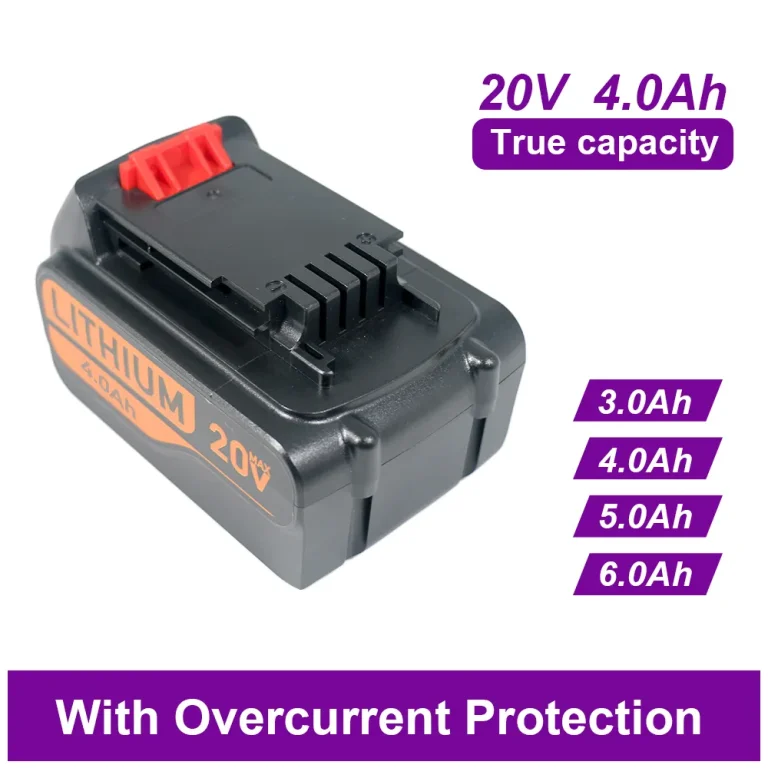
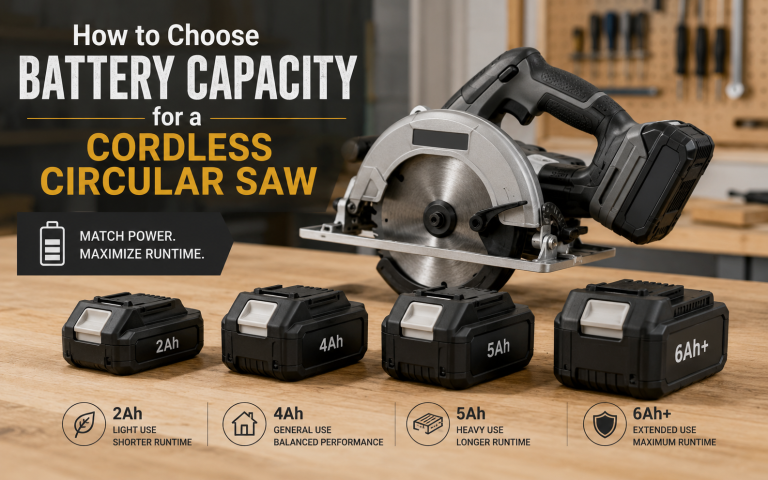
Before comparing 2.0 Ah, 4.0 Ah, 5.0 Ah, or other capacity options, first confirm that the battery, tool, and charger belong to a compatible system.
For buyers who need a broader selection framework, this replacement power tool battery buyer’s guide explains how voltage, capacity, compatibility, and application requirements fit together.
For B2B projects, GeB Power follows a similar application-oriented review process: the intended tool, voltage platform, load, interface, charger, and working environment are reviewed before pack requirements are defined. For customized projects, this can progress from cordless string trimmer battery compatibility review and engineering solutions to sample validation before production requirements are finalized.
Quality and Sample Validation
Battery specifications on paper do not completely predict performance in the intended tool.
For replacement battery and OEM/ODM projects, a sample should be evaluated with the intended string trimmer and charger before a volume production decision is made.
Testing under realistic operating conditions can help buyers verify:
- Mechanical fit
- Electrical compatibility
- Charging behavior
- Runtime expectations
- Protection behavior
- Thermal performance
- User acceptance
For buyers asking how long a string trimmer battery will actually last, this type of application-specific validation provides a more useful answer than relying only on nominal voltage and Ah.
Conclusion
So, how long does a cordless string trimmer battery last? For runtime per charge, a typical range is approximately 15 to 60+ minutes, depending on battery capacity, voltage, motor efficiency, cutting load, temperature, and battery condition. For overall lifespan, typical homeowner use may result in around 3–5 years, while intensive commercial use may consume the battery’s useful cycle life much faster.
The most useful way to think about string trimmer battery life is not as a single number. Runtime and lifespan are both outcomes of a complete battery–tool–load–environment system, which is why capacity, compatibility, application conditions, and validation should be considered together.
GeB Power is a Shenzhen-based B2B manufacturer of compatible replacement power tool batteries and an OEM/ODM battery project partner, supporting global distributors, brands, procurement teams, and engineering teams with compatibility verification, pack engineering, sample validation, and structured production handoff. If you are sourcing replacement batteries or developing a battery pack for a cordless string trimmer or another cordless outdoor application, contact GeB Power to discuss your tool platform, performance requirements, and project specifications.
FAQ
How long does a 40V string trimmer battery last?
A 40V string trimmer battery commonly provides around 25–60+ minutes of runtime, depending on capacity and cutting conditions. A 2.0–2.5 Ah battery may deliver around 25–45 minutes, while a 4.0–5.0 Ah battery may provide 45–60 minutes or more under moderate loads.
Heavy weeds, wet grass, high-speed operation, and battery age can reduce these figures.
Does a higher Ah battery last longer in a string trimmer?
At the same voltage and similar operating load, a higher-Ah battery generally provides longer runtime because it stores more usable energy.
However, higher capacity does not guarantee compatibility. Before installing a larger replacement battery, verify the voltage platform, interface, terminals, tool model, charger requirements, and applicable discharge characteristics.
Why does my string trimmer battery die so quickly?
Short runtime can result from heavy or wet grass, continuous high-speed operation, cold temperatures, an aging battery, poor electrical contacts, or higher-than-normal motor load.
If runtime has declined significantly compared with previous use under similar conditions, declining battery state of health may also be a factor.
How many years does a cordless string trimmer battery last?
For typical homeowner use, a lithium-ion string trimmer battery may provide around 3–5 years of practical service, although actual lifespan depends on cycle frequency, temperature, charging habits, storage conditions, and battery quality.
Commercial users who charge and discharge batteries daily may reach the battery’s practical cycle limit within 1–2 working seasons.
Can I use a replacement battery with a higher capacity than the original?
Potentially, but capacity alone should not determine the choice.
The replacement battery still needs to match the required voltage platform, physical interface, terminal configuration, charger, tool requirements, and applicable electrical or communication conditions. For B2B purchasing, validating a sample with the intended tool and charger before volume ordering is the safer approach.