How to Choose a Battery for a Cordless Hedge Trimmer
Choosing the right cordless hedge trimmer battery starts with compatibility, then comes down to voltage, capacity, runtime, weight, and the actual cutting workload. A larger battery may extend operating time, but it also changes tool balance. A higher-voltage platform may support heavier work, but it must still match the hedge trimmer’s electrical and mechanical design. For an existing tool, battery selection should always begin with the original battery model, tool model, voltage platform, interface, and charger.

1. Start With Compatibility Before Comparing Battery Specs
For an existing hedge trimmer, compatibility comes first.
A compatible hedge trimmer battery is one that matches the tool electrically, mechanically, and functionally. The voltage rating is only one part of that match. Battery interface geometry, terminal layout, housing dimensions, discharge requirements, charger compatibility, and, in some platforms, electronic communication also matter.
Before choosing a replacement battery, confirm:
- Original battery model
- Hedge trimmer model
- Nominal voltage
- Battery interface and terminal layout
- Battery dimensions and locking structure
- Charger model
- Required discharge capability
- Protection or communication requirements
For a deeper explanation of the mechanical side of compatibility, see our guide to power tool battery interfaces and contacts.
This is also the basic logic GeB Power uses when reviewing replacement battery projects: the original battery reference, voltage, interface, tool model, charger model, mechanical fit, and electrical requirements should all be checked before the battery is confirmed.
If You Already Own the Hedge Trimmer
Stay within the tool’s supported battery platform unless the manufacturer explicitly specifies otherwise.
Two packs can carry the same voltage label and still use different housings, terminals, control logic, or chargers. Even batteries from the same brand may belong to separate platforms.
If you are unsure whether packs can move between tools, our power tool battery interchangeability guide explains the main compatibility checks in more detail.
If You Are Choosing a New Battery Platform
Then the decision becomes broader. Yard size, hedge density, cutting duration, battery weight, and the other cordless tools you may buy later all become relevant.
In that case, voltage is the next place to look.
2. Choose the Right Voltage for Your Hedge Trimmer
Battery voltage describes the electrical potential of the pack and, in cordless outdoor equipment, usually indicates the general power class of the platform.
For new equipment selection, the following ranges are a useful practical guide:
| Voltage class | Typical use | Typical hedge conditions |
|---|---|---|
| 18V / 20V MAX | Light to medium residential trimming | Boxwood, privet, routine maintenance |
| 36V / 40V | Larger yards and longer sessions | Taller, denser, more mature hedges |
| 56V and above | Heavy-duty or professional outdoor work | Dense growth, large properties, frequent use |
This progression is common across cordless outdoor power equipment: 18–20V systems are widely used for lighter residential work, 36–40V platforms suit larger or denser jobs, and 56V+ systems are common in heavier outdoor applications.
Higher voltage does not, by itself, define cutting capacity. Blade geometry, motor design, gearing, stroke rate, and control electronics also influence how a hedge trimmer performs under load.
If you need a broader explanation of how tool and battery voltage should be matched, see how to match battery voltage with a power tool platform.
For example, GeB Power offers a 40V Greenworks G-MAX compatible replacement battery for applications built around that specific battery platform.
18V vs. 20V MAX
This naming causes unnecessary confusion.
In common lithium-ion tool platforms, an “18V” pack and a “20V MAX” pack can belong to the same nominal voltage class. The difference is often how the voltage is labeled: nominal working voltage versus maximum initial voltage.
That does not make different brands interchangeable. Voltage class and physical compatibility are separate questions.
A practical example is a 20V MAX 5.0Ah compatible replacement battery for DeWalt tools. It belongs to a defined platform and should be selected by model compatibility, not by the 20V label alone.

3. Understand Ah, Wh, and What They Actually Tell You
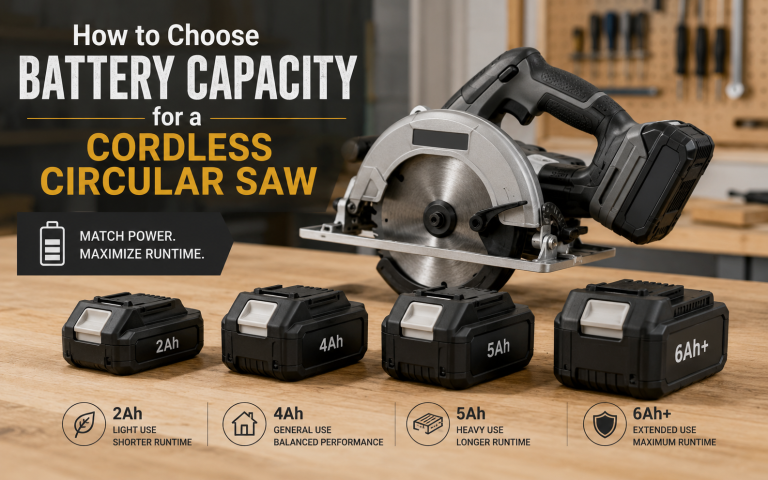
Amp-hours (Ah) describe battery capacity. Within the same voltage platform and a comparable pack design, a higher Ah rating generally means more stored energy and longer potential runtime.
It also usually means a heavier battery.
That is why a 2.0Ah, 4.0Ah, and 5.0Ah battery can all be valid choices for the same hedge trimmer, depending on how the tool is used.
A lower-capacity pack often works well for short sessions, shaping, vertical cuts, and overhead trimming. A 4.0Ah or larger pack makes more sense when uninterrupted runtime matters more than minimum tool weight.
For a more detailed explanation of how amp-hours relate to runtime, see Power Tool Battery Capacity Explained: How Ah Affects Runtime.
Use Watt-Hours When Comparing Different Voltage Platforms
Amp-hours should not be compared across different voltage classes without considering voltage.
Watt-hours (Wh) represent the nominal stored energy of the battery:
Wh = Voltage × Amp-hours
For example:
| Battery | Nominal energy |
|---|---|
| 18V 4.0Ah | 72Wh |
| 18V 5.0Ah | 90Wh |
| 40V 4.0Ah | 160Wh |
| 56V 5.0Ah | 280Wh |
This is why a 40V 4.0Ah battery can store more nominal energy than an 18V 5.0Ah battery even though its Ah figure is lower.
For purchasing and engineering work, this distinction matters. Ah is useful within a platform; Wh is more informative when comparing stored energy across platforms.
4. How Much Runtime Do You Really Need?
There is no universal runtime for a 2Ah, 4Ah, or 5Ah hedge trimmer battery.
Actual operating time depends on more than capacity:
- Hedge density
- Branch thickness
- Blade length and design
- Motor efficiency
- Cutting load
- Stop-and-start duty cycle
- Battery condition
- Ambient temperature
A useful comparison is that a Makita XHU02 paired with a 4.0Ah battery is rated for up to 120 minutes under no-load conditions, while a DeWalt DCHT821 paired with a 5.0Ah battery is cited at up to 78 minutes.
The point is straightforward: battery capacity does not determine runtime by itself.
Motor design and cutting conditions matter considerably.
For procurement work, a runtime claim is most useful when the test conditions are known. “Up to 90 minutes” means very little without the battery size, cutting load, tool model, and test method.
If you are evaluating an 18V platform, an 18V Makita LXT compatible replacement battery provides multiple Ah options that can be matched to runtime and weight requirements within that platform.

5. Balance Runtime Against Battery Weight and Tool Balance
Weight matters more on a hedge trimmer than on many bench-supported or short-duration cordless tools.
A hedge trimmer is frequently held in front of the body, moved laterally, raised above shoulder height, or rotated for vertical cuts. Extra battery mass changes the center of gravity and becomes more noticeable as the session continues.
A typical comparison is roughly 0.8 lb for a 2.0Ah pack versus about 1.3–1.5 lb for a 5.0Ah pack, depending on the platform and battery design.
On paper, that difference looks modest. During thirty minutes of overhead shaping, it is not.
For detailed shaping, vertical cuts, and overhead work, a lighter 2.0–2.5Ah pack can improve maneuverability. For sustained horizontal trimming or large hedges, 4.0Ah and larger batteries reduce interruptions and battery changes.
One Large Battery or Two Smaller Batteries?
Both approaches can make sense.
A larger battery gives longer continuous runtime and fewer swaps. Two medium-capacity batteries keep the tool lighter and allow one pack to be charged while the other is in use.
For hedge trimmers, two moderate packs can be a better working setup than one very heavy pack when overhead work is common. For long horizontal runs at chest height, the larger pack becomes more attractive.
The best hedge trimmer battery is therefore not automatically the largest battery that fits.
6. Match the Battery to Your Yard and Cutting Conditions
Battery selection becomes easier once the cutting conditions are defined.
Small Yard or Routine Maintenance
For light residential trimming, shorter sessions, and regularly maintained hedges, prioritize low weight and easy handling.
An 18V/20V platform with a lower-to-medium capacity battery is often sufficient, especially when the same platform is already used for drills, blowers, or other garden tools.
Large Yard or Mature, Dense Hedges
Longer cutting sessions and denser growth increase the demand on both the tool and the battery.
Look for:
- An appropriate higher-output tool platform
- Enough Wh for the required working time
- Adequate battery discharge capability
- A battery size that still keeps the tool manageable
- A spare pack where long interruptions are unacceptable
These are the same types of engineering factors that apply more broadly to battery pack requirements for cordless lawn and garden equipment.
Professional or Extended Daily Use
For frequent landscaping work, battery rotation becomes part of the system design.
Runtime, charging time, pack temperature, charger capacity, and the number of batteries in circulation all matter. A professional user may benefit more from multiple matched packs than from simply selecting the highest Ah battery available.
This is also where discharge capability and pack thermal design become more important. Dense cutting can place short periods of high electrical demand on the battery, so the pack has to deliver current without excessive voltage drop or heat buildup.

7. Consider Motor Efficiency and the Battery Ecosystem
The hedge trimmer itself determines how efficiently stored battery energy is converted into cutting work.
Brushless motors are common in newer cordless garden tools because electronic commutation can reduce losses and improve control under changing loads. The practical consequence is straightforward: two hedge trimmers using batteries with similar nominal energy can still deliver different runtimes.
That is another reason to avoid treating Ah as a direct runtime conversion.
The battery ecosystem also deserves attention, especially when choosing a platform from scratch. A battery that can power a hedge trimmer, leaf blower, string trimmer, mower, or chainsaw may be more useful over its service life than a pack dedicated to a single tool.
If your outdoor equipment fleet includes several tools, our guide on how to choose a battery for a cordless leaf blower provides a useful comparison because blower applications place a different type of sustained load on the same general class of battery system.
For an established fleet, platform compatibility can be as important as an incremental increase in battery capacity.
8. How to Choose a Compatible Replacement Hedge Trimmer Battery
A hedge trimmer replacement battery should be evaluated as an engineered battery pack, not only as a housing that fits the tool.
Start with compatibility verification:
- Original battery reference
- Hedge trimmer model
- Charger model
- Nominal voltage
- Interface and terminal arrangement
- Pack dimensions
- Required capacity
- Expected load and discharge demand
Then look at the pack itself.
A quality replacement battery should have appropriate protection against overcurrent, overcharge, over-discharge, and abnormal temperature where required by the design. Cell quality, internal connections, thermal paths, housing construction, and BMS design all affect how the pack behaves under real cutting loads.
For buyers comparing aftermarket options across established tool platforms, GeB Power maintains a broader range of power tool replacement batteries organized by compatible tool platforms and models.
For B2B sourcing, documentation should also be checked against the exact battery model, configuration, destination market, and shipping method. Compatibility verification remains the first filter. A voltage label or generic “fits 20V tools” statement is not enough for a reliable sourcing decision.
Choosing the Right Cordless Hedge Trimmer Battery
For an existing hedge trimmer, begin with the original battery model, voltage platform, interface, tool model, and charger. After compatibility is confirmed, choose capacity according to the runtime you actually need, then check whether the added battery weight still works for the way the tool will be held and used. When comparing different voltage platforms, use Wh as well as Ah, and consider the whole tool system instead of the battery label in isolation.
GeB Power supplies compatible replacement power tool batteries and supports OEM/ODM battery projects, including compatibility verification, pack engineering, sample validation, production handoff, and document review. If you are evaluating a hedge trimmer battery, replacement platform, or custom battery pack, you can review our battery solutions and project support or contact us with the tool model, original battery reference, charger model, voltage, target capacity, quantity, and destination for project review.
FAQ
Is a Higher Ah Battery Better for a Hedge Trimmer?
It can be better when longer runtime is the main requirement.
Within the same platform, a higher Ah battery generally provides more stored energy. It also tends to add weight. Ah is a capacity rating, so it should not be treated as a direct measure of cutting power.
Can I Use a Higher-Voltage Battery on My Hedge Trimmer?
Only if the tool platform is specifically designed to support that battery.
Do not substitute a higher-voltage battery simply to obtain more power. The tool, controller, battery, and charger must be electrically compatible.
Is a 20V Battery Better Than an 18V Battery?
Not based on the label alone.
Some 20V MAX platforms use 20V as the maximum initial voltage and 18V as the nominal voltage. In that case, 18V and 20V MAX belong to the same basic voltage class.
Can I Use the Same Battery for a Hedge Trimmer and Other Garden Tools?
Yes, when both tools belong to the same compatible battery platform and the battery meets the required electrical and mechanical specifications.
Do not assume interchangeability only because two tools display the same voltage. Load demand, physical fit, electrical specifications, and charger compatibility still have to match.