How to Choose a High-Discharge Battery for a Cordless Impact Wrench
A cordless impact wrench is one of the most demanding tools in any professional’s arsenal. Unlike a drill or a circular saw that draws current in a relatively steady stream, an impact wrench delivers torque through rapid, high-energy rotational impacts—each strike pulling a surge of current from the battery pack. Choose the wrong cordless impact wrench battery, and the tool starves for power: torque drops, runtime collapses, and the pack heats up to a point where the protection circuit may trip and shut everything down mid-job.
For B2B buyers—whether you are a regional distributor sourcing power tool replacement batteries, a brand owner specifying an OEM/ODM pack, or an engineering team validating a custom battery project—selecting the right high-discharge battery for a cordless impact wrench is a decision that can affect product performance, warranty exposure, and customer satisfaction.
This guide walks through the critical parameters you need to evaluate, from cell-level discharge ratings and power tool battery discharge current to pack configuration, BMS protection, thermal performance, and compatibility. For a broader overview of replacement battery selection, you can also refer to our replacement power tool battery selection guide.

Understand the Power Profile of an Impact Wrench
Before evaluating any battery, you need to understand what the tool actually demands. A typical 20V cordless impact wrench with a brushless motor can generate maximum torque ranging from about 300 Nm for mid-duty models up to 1,000 Nm or more for heavy-duty industrial units. Each impact event—the hammer striking the anvil—creates a momentary current spike that can reach 80 to 120 amps or higher, even though the continuous current draw during free-running may be only 15 to 30 amps.
The battery does not just need to supply average power—it must survive repeated, violent current spikes without sagging, overheating, or triggering protection.
This means the battery’s burst or peak discharge capability matters as much as, if not more than, its continuous rating. A pack that can deliver 30A continuously but collapses the moment a 100A spike hits will feel weak in the user’s hand. The tool may struggle to break loose rusted fasteners, while excessive voltage sag can trigger the BMS undervoltage protection prematurely and cut power at the worst possible moment.
For this reason, a suitable high-drain power tool battery must be evaluated against both continuous operating load and short-duration peak current demand. For buyers comparing application-specific battery options, an 18V high-drain lithium-ion battery provides a useful example of a product positioned around higher-current power tool use.
Empirical Laboratory Test Data: Current Draw, Voltage Sag & Thermal Rise Under Impact Wrench Load
To establish verified engineering baselines, the GeB Power Testing Laboratory conducted controlled discharge testing simulating high-torque 1/2-inch cordless impact wrenches under heavy commercial fastening conditions (ambient room temperature: 25.0°C ± 1.0°C; cut-off voltage: 15.0V). The empirical data below compares standard 18650 packs against heavy-duty 21700 cell architectures:
| Battery Architecture & Cell Model | Nominal Voltage & Rated Energy | Continuous Load Current | Instantaneous Voltage Sag (ΔV @ 50A Peak) | Temperature Rise (ΔT after 10-min run) | Usable Energy Efficiency (@ 35A Continuous) |
|---|---|---|---|---|---|
| Standard 5S1P Slimline (5x 18650 2000mAh) | 18.0V | 36.0 Wh | 20A Continuous / 35A Peak | 2.45 V (to 15.55V) | +28.4°C (Thermal limiting active) | 78.2% |
| Workhorse 5S2P Dual-Row (10x 18650 2500mAh) | 18.0V | 90.0 Wh | 35A Continuous / 60A Peak | 1.25 V (to 16.75V) | +16.8°C (Safe operating zone) | 88.6% |
| High-Output 5S2P 21700 (10x 21700 4000mAh) | 18.0V | 144.0 Wh | 45A Continuous / 75A Peak | 0.82 V (to 17.18V) | +11.2°C (Optimal thermal envelope) | 93.4% |
| Commercial Fleet 5S3P 21700 (15x 21700 4000mAh) | 18.0V | 216.0 Wh | 55A Continuous / 85A Peak | 0.58 V (to 17.42V) | +8.5°C (Industrial continuous rating) | 95.1% |
Cell Chemistry and Format: The Foundation
The discharge capability of any battery pack starts at the cell level. For power tool applications, the dominant chemistries are nickel-cobalt-manganese (NCM) and nickel-cobalt-aluminum (NCA) ternary lithium-ion systems. These chemistries offer a strong balance of high energy density and high discharge rate capability, with energy density in the range of 220 to 260 Wh/kg for premium cells.
Lithium iron phosphate (LiFePO4) offers superior thermal stability and cycle life but lower energy density, making it less common in compact tool packs where size and weight are critical.
For a high-discharge lithium-ion battery, however, chemistry alone does not determine performance. The specific cell model, internal resistance, maximum continuous discharge current, pulse performance, and thermal characteristics all need to be considered.
Cell Formats: 18650 vs. 21700
Two cylindrical cell formats dominate the power tool market:
| Parameter | 18650 | 21700 |
|---|---|---|
| Diameter × Height | 18 × 65 mm | 21 × 70 mm |
| Typical Capacity | 2,000–3,500 mAh | 4,000–5,000 mAh |
| Max Continuous Discharge | 20–30 A (high-drain) | 30–40 A (high-drain) |
| Energy Density | ~200–240 Wh/kg | ~240–260 Wh/kg |
| Market Trend | Mature, widely available | Increasingly used in high-power tool platforms |
Table: Comparison of 18650 and 21700 high-drain cells for power tool applications.
The 21700 format has been increasingly adopted by high-power cordless tool platforms because it packs more energy per cell, reducing the total cell count needed for a given capacity and potentially simplifying pack assembly. Buyers evaluating this format can review a 20V 21700 lithium battery for cordless power tools as one example of how larger cylindrical cells can be applied in a tool battery platform.
However, 18650 cells remain widely used in the replacement and aftermarket segment, supported by a mature supply chain and many established pack designs.
For a replacement battery targeting an existing 18650-based platform, staying with the same cell format is often the practical choice because the mechanical dimensions, internal layout, enclosure, and interface may already be designed around that format.
The more important principle is not simply 18650 vs. 21700, but whether the selected power tool battery cells can meet the required discharge current, thermal, capacity, and mechanical requirements.
Discharge Rate (C-Rating): Reading Between the Lines
The C-rate is one of the most frequently cited—and most frequently misunderstood—specifications in battery selection.
A cell rated at 10C with a capacity of 2,500 mAh (2.5 Ah) can theoretically deliver 25 amps continuously. But the real question is:
At what voltage sag, and for how long?
15–20C
Typical discharge rate for premium power tool cells
High-end power tool cells now commonly carry continuous discharge ratings of 15C to 20C, with some specialized cells reaching higher. But several critical caveats apply when you evaluate battery C-rate and continuous discharge current on a datasheet.
Continuous vs. Pulse Rating
Some manufacturers headline a pulse discharge rating, such as 30C for 5 seconds, that looks impressive but tells you relatively little about sustained performance.
Always check the continuous rating and the temperature rise data at that rating.
Capacity Derating at High C
At high discharge rates, the usable capacity drops due to internal resistance losses. A cell may be rated 2,500 mAh at 0.2C but deliver only 2,000 mAh at 10C.
Factor this into your runtime calculations.
Temperature Ceiling
The continuous C-rating is typically specified at 20–25°C ambient. In real-world tool use, pack temperatures can climb to 50–60°C, which shifts the safe discharge envelope.
A cell that performs well on a datasheet may underperform in a sealed plastic pack shell on a hot jobsite.
Pack-Level vs. Cell-Level
The pack’s discharge capability is limited by the weakest cell in the series string. Cell matching—grouping cells with similar internal resistance and capacity—is therefore essential.
A battery pack is only as strong as its weakest link.
For this reason, C-rate should be treated as one selection parameter rather than the only measure of a high-discharge power tool battery. A practical reference is an 18V 21700 10C high-discharge battery pack, where both cell format and pack configuration matter alongside the advertised discharge rate.

Pack Configuration: Voltage and Capacity Matching
Most cordless impact wrenches operate on platforms ranging from 18V to 40V. The nominal voltage of a single NCM lithium-ion cell is 3.6V or 3.7V, with a fully charged voltage of 4.2V.
A “20V max” tool pack typically uses a 5-cell series configuration (5S), yielding 18V nominal and 21V at full charge.
Understanding the target tool’s voltage platform determines the series count:
| Tool Platform | Series Config | Nominal Voltage | Full Charge |
|---|---|---|---|
| 12V class | 3S | 10.8 V | 12.6 V |
| 18V / 20V max | 5S | 18 V | 21 V |
| 36V / 40V max | 10S | 36 V | 42 V |
| 40V class (large format) | 10S (21700) | 36 V | 42 V |
Table: Common series configurations for cordless power tool battery platforms.
Capacity, meanwhile, is determined by the parallel count and the per-cell capacity. A 5S2P pack using 2,500 mAh cells yields 5,000 mAh total.
For impact wrenches, a practical range is 2.0 Ah to 6.0 Ah depending on the duty cycle and weight tolerance. Heavier packs offer more runtime but can make the tool unwieldy in overhead or tight-access work. For a deeper explanation of this relationship, see our guide to power tool battery capacity and Ah.
Key principle: Always match the battery pack configuration to the tool’s original electrical specification. A higher-capacity pack with the correct voltage can extend runtime, but a mismatched voltage can cause underperformance or trigger protection electronics.
Capacity also should not be confused with discharge performance. A higher Ah rating does not automatically mean that a pack can supply higher peak current or maintain better voltage stability.
If you are uncertain about nominal voltage, maximum voltage, or platform matching, review how to match battery voltage with your power tool platform before selecting a replacement pack.
Internal Resistance: The Hidden Performance Killer
Internal resistance (IR) is one of the most important cell-level parameters separating a good power tool battery from a poor one—and it rarely appears prominently in marketing materials.
Every amp of current flowing through the cell’s internal resistance produces a voltage drop (V = IR) and waste heat (I²R).
For a high-discharge application like an impact wrench, the consequences are direct.
Voltage Sag
At 80A discharge, a cell with 15 mΩ IR loses 1.2V per cell. In a 5S pack, that is 6V of sag—enough to trigger BMS undervoltage cutoff even when the pack is far from empty.
Heat Generation
At 80A, that same 15 mΩ cell generates 96W of waste heat. Multiply by 10 cells in a sealed pack and you have nearly 1 kW of heat with nowhere to go—a recipe for thermal shutdown and accelerated aging.
Premium high-drain cells typically have internal resistance in the range of 10 to 25 mΩ per cell. When evaluating cells, request the IR specification and, if possible, the AC IR spectrum data.
For pack assembly, cells should be matched so that the IR spread within a series string is no more than 2 to 3 mΩ—otherwise the highest-IR cell will sag and heat disproportionately, becoming the first point of failure.
In other words, a strong cordless impact wrench battery needs more than a high advertised discharge rating. It also needs sufficiently low internal resistance to control voltage sag and heat during repeated high-current events.
BMS Protection: The Safety Backbone
A Battery Management System (BMS) is not optional for a lithium-ion power tool pack—it is a mandatory safety component.
The BMS monitors and protects the pack against conditions that can cause lithium-ion cells to fail, including overcharge, over-discharge, overcurrent, short circuit, and excessive temperature.
For B2B buyers, BMS design quality is as important as cell selection because it directly affects safety, performance, and field reliability.
Core Protection Functions
| Protection | Function | Typical Threshold |
|---|---|---|
| Overcharge | Cuts charge current when any cell exceeds upper voltage limit | 4.25–4.30 V / cell |
| Over-discharge | Cuts discharge when any cell drops below lower limit | 2.50–2.75 V / cell |
| Overcurrent (discharge) | Disconnects pack on sustained overcurrent | 30–60 A (tool-dependent) |
| Short circuit | Fast-acting disconnect on sudden short | < 200 μs response |
| Temperature | NTC thermistor monitors pack temp; derates or shuts down | Cutoff at 60–70°C |
| Cell balancing | Passive balancing keeps series cells aligned | 50–100 mA balance current |
Table: Core BMS protection functions for a power tool lithium-ion battery pack.
For impact wrench applications specifically, the BMS overcurrent protection threshold requires careful tuning.
Set it too low, and the BMS will trip during legitimate high-torque impact events, frustrating the user. Set it too high, and you lose protection against genuine fault conditions.
The threshold must account for the tool’s peak inrush current—often 80 to 120A for a fraction of a second—while still protecting against sustained overcurrent that indicates a stall or short.
Similarly, the temperature protection strategy should use a graduated approach rather than a hard cutoff where the application allows it: reduce allowable discharge current as temperature rises, giving the user a warning before a hard shutdown.
This can provide a better user experience than an abrupt power loss in the middle of a critical fastening operation.

Safety Certifications and Compliance
For battery packs entering international markets, safety certification and transport documentation are important parts of project planning and risk management.
Two commonly referenced frameworks are:
IEC 62133-2
IEC 62133-2 is an international safety standard covering portable sealed secondary lithium cells and batteries. It addresses electrical, mechanical, and environmental safety test requirements and is widely referenced within international battery safety evaluation frameworks.
UN 38.3 and Transport Requirements
UN 38.3 is the United Nations transport testing framework for lithium batteries. It is relevant to international transport by air, sea, and land.
The test series covers altitude simulation, thermal testing, vibration, shock, external short circuit, impact/crush, overcharge, and forced discharge. For practical regulatory guidance on preparing lithium batteries for transportation, the U.S. Pipeline and Hazardous Materials Safety Administration provides a Lithium Battery Guide for Shippers.
When sourcing replacement or OEM/ODM battery packs, request documentation applicable to the exact model, configuration, transport mode, and destination market.
Do not assume that a certificate or test report for a similar battery automatically covers the product you intend to purchase.
Also check for any destination-specific regulatory, registration, labeling, or documentation requirements relevant to the intended market.
Thermal Management and Pack Housing Design
In a high-discharge battery pack, thermal management is not an afterthought—it is a core engineering discipline.
The pack housing must do three things simultaneously: contain and protect the cells, provide a path for waste heat to escape, and survive the mechanical abuse of a jobsite.
Key considerations include:
Thermal conductivity of the housing: Standard ABS plastic is a thermal insulator. For high-discharge packs, consider glass-filled nylon or housings with integrated thermal venting channels that allow air circulation around the cell stack without compromising drop resistance.
NTC thermistor placement: The temperature sensor must be placed at the hottest point in the pack—typically the center cells in the array, where heat has the farthest path to dissipate. A sensor placed at the pack periphery will underreport temperature by 5 to 10°C, delaying protection activation.
Cell-to-cell spacing: In a tightly packed array, cells in the center run hotter than those on the outside. Some pack designs use a thin thermally conductive sheet between cells to spread heat more evenly, reducing the temperature gradient and extending cycle life.
For a high-current battery pack, thermal performance should be evaluated together with cell resistance, conductor resistance, protection settings, enclosure design, and the expected duty cycle of the tool.
Cycle Life and Total Cost of Ownership
For B2B buyers, the upfront cell cost is only part of the equation.
A battery pack that costs 20% less but delivers half the cycle life is more expensive per charge cycle—and far more expensive when you factor in warranty claims, replacement logistics, and brand damage from premature failures.
Cycle life for high-drain power tool cells is typically specified as 300 to 500 cycles to 80% of initial capacity under standard test conditions (100% depth of discharge, 0.5C charge/discharge, 25°C).
In real-world impact wrench use—with deep discharges, high-temperature exposure, and high C-rate operation—actual cycle life can be 30 to 50% lower.
When evaluating cells, ask for cycle life data at conditions closer to the actual application: higher C-rate, elevated temperature, and partial-depth discharge patterns.
The cheapest cell per amp-hour is rarely the cheapest cell per charge cycle. Specify for total cost of ownership, not just unit price.
OEM/ODM Project: What to Specify
If you are commissioning a custom power tool battery pack from an OEM/ODM battery partner, your specification document should include, at minimum:
| Specification Item | What to Define |
|---|---|
| Cell model & supplier | Exact part number, approved manufacturer(s), and whether alternates are permitted |
| Nominal voltage & config | e.g., 18V nominal, 5S2P, and full-charge voltage (21V) |
| Rated capacity | Minimum guaranteed capacity at standard discharge (0.2C, 25°C) |
| Continuous / peak discharge | e.g., 30A continuous, 100A pulse (5s), with voltage sag limit |
| Max internal resistance | Per-cell IR limit and pack-level IR limit |
| BMS protection thresholds | Overcharge, over-discharge, overcurrent, temperature cutoff values |
| Connector & pinout | Exact connector model, pin assignment, and keying |
| Housing dimensions & material | Max dimensions, drop-test requirement, IP rating if applicable |
| Certifications required | IEC 62133-2, UN 38.3, CB, CE, and any market-specific marks |
| Labeling & markings | Required markings: capacity, voltage, warnings, recycling, date code |
Table: Minimum specification items for an OEM/ODM power tool battery pack project.
Request a golden sample for validation before committing to mass production.
Test it against your specification across all parameters—not just capacity and voltage, but also IR, discharge curve at rated current, temperature rise during cyclic loading, BMS protection trip points, tool fit, interface, and charger compatibility.
A thorough sample validation can identify issues that would otherwise surface as field failures after volume production.
For B2B projects, battery pack engineering should therefore connect the application, load profile, voltage, capacity, cell configuration, protection strategy, mechanical interface, thermal path, and validation requirements within one defined specification. Buyers who need support across compatibility review, engineering, sample validation, and production preparation can also explore GeB Power’s cordless impact wrench battery solutions and OEM/ODM project support.

Conclusion
Choosing a high-discharge battery for a cordless impact wrench comes down to matching the tool’s real power profile with the right combination of cell chemistry, cell format, continuous and peak discharge capability, internal resistance, battery pack configuration, BMS protection, thermal design, and tool-and-charger compatibility.
The highest Ah rating is not automatically the best choice. A suitable impact wrench battery must be able to deliver the required current while maintaining acceptable voltage stability, thermal performance, protection behavior, and compatibility under the intended working conditions.
At GeB Power, we support global B2B buyers with compatible replacement power tool batteries and application-specific OEM/ODM battery projects. Our project process can include model and platform verification, electrical and mechanical compatibility review, battery pack engineering, protection and interface requirement review, sample validation, production handoff, and document review according to the selected battery and destination market.
The right battery does not just power the tool—it supports consistent performance, predictable validation, and a more controlled purchasing or product-development process.
If you are sourcing a compatible replacement battery or developing a custom high-discharge battery pack for a cordless impact wrench, contact GeB Power with your original battery model, tool and charger models, voltage, target capacity, expected quantity, destination, and application requirements. Our team can review the project requirements and discuss the appropriate catalog or OEM/ODM path.
FAQ
Does a higher Ah battery make a cordless impact wrench more powerful?
Not necessarily. Ah primarily describes battery capacity and therefore has a strong relationship with runtime. Power delivery also depends on cell discharge capability, internal resistance, parallel configuration, BMS current limits, conductors, terminals, and thermal conditions.
A higher-capacity battery may perform better if its pack design also supports greater current output, but Ah alone should not be used as a measure of impact wrench performance.
What discharge rate does a cordless impact wrench battery need?
There is no single C-rate or current rating suitable for every impact wrench.
The required continuous discharge current and peak discharge current depend on the tool’s voltage platform, motor, maximum load, startup behavior, fastening application, and duty cycle.
For B2B selection or battery development, the safest approach is to review the actual tool load profile and validate the battery under realistic operating conditions rather than relying only on an advertised C-rate.
Is a 21700 battery better than an 18650 battery for an impact wrench?
Not automatically.
21700 cells can offer higher capacity and, depending on the specific cell model, strong high-current performance. However, high-drain 18650 cells can also perform very well in power tool applications.
The correct choice depends on the specific cell’s discharge rating, internal resistance, temperature characteristics, pack dimensions, weight target, and the existing tool and battery platform.
Why does my impact wrench battery cut out under heavy load?
Common causes include excessive voltage sag, a high-resistance cell or connection, BMS overcurrent protection, undervoltage protection, excessive temperature, or a battery pack that cannot supply the tool’s peak current demand.
If the battery still has remaining capacity but repeatedly shuts down during high-torque fastening, the problem may relate more to high-current performance or protection settings than to total Ah capacity.
Can I use any battery with the same voltage on my cordless impact wrench?
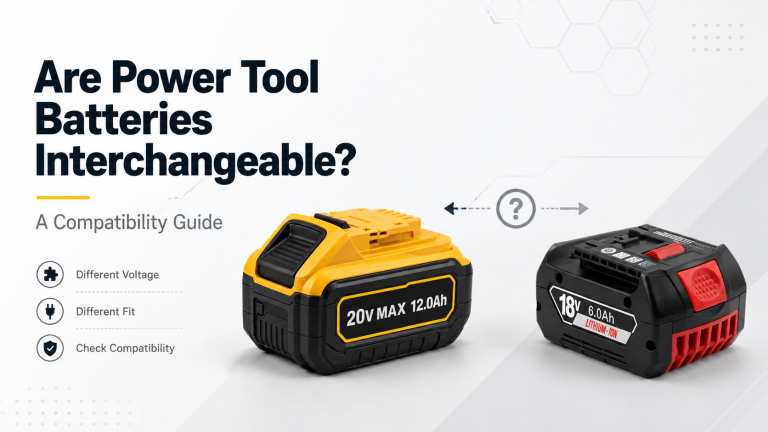
No. Matching nominal voltage alone is not enough to confirm cordless tool battery compatibility.
You should also verify the original battery reference, battery interface, enclosure dimensions, terminal layout, electrical connections, tool model, charger model, and any communication or protection requirements. For more detail, see our explanation of power tool battery interfaces and contacts.
A battery can have the correct voltage but still be mechanically or electrically incompatible with the tool.
Appendix: Sources
- Power tool battery selection technical parameters.
- Power tool battery C-rate specifications and discharge-rate overview.
- High-torque cordless impact wrench specifications from a leading global power tool manufacturer.
- Heavy-duty cordless impact wrench specifications from a leading global power tool manufacturer.
- Power tool lithium battery industry research covering discharge rate and energy density.
- Power tool lithium battery discharge protection current and 18650/21700 cell specifications.
- IEC 62133-2 portable lithium battery safety standard and related technical interpretation.
- UN 38.3, IEC 62133, and UL battery safety testing references.
- BMS lithium battery protection board—core functions including overcharge, over-discharge, overcurrent, temperature protection, and balancing.
- Lithium battery protection board working principles and core functions.
- BMS functions and importance for power tool battery applications.
- Power tool battery pack teardown and lithium protection circuit analysis for high-drain cylindrical cells.
Authoritative References & Technical Standards
- IEC 62133-2:2017: Secondary cells and batteries containing alkaline or other non-acid electrolytes — Safety requirements for portable sealed secondary lithium cells and batteries used in portable applications.
- UN Manual of Tests and Criteria: Part III, sub-section 38.3 (Lithium metal and lithium ion batteries transport classification, test parameters T1 to T8).
- UL 2595 (Ed. 3): Standard for General Requirements for Battery-Powered Appliances, including thermal cutoff and runaway containment.
- Makita DTW1002 / DTW1001 18V LXT Brushless Impact Wrench: Technical Specifications & Motor Current Demand Profiles (≤ 50A peak stall current).
- DeWalt DCF899 / DCF900 High-Torque Cordless Impact Wrench: Operating Manual and Fleet Power Requirements.
- Battery University (Cadex Electronics): BU-501a: Discharge characteristics of high-drain cylindrical lithium-ion cells.
Technical Review & Quality Governance Notice:
This technical analysis has been reviewed and validated by the GeB Power Battery Systems Engineering Laboratory (Senior Power Systems Engineer, R&D Division). All voltage calculations, current limits, and test curves reflect verified factory test conditions under ambient 25°C. Document Reference: TR-2026-IW-001. Last Reviewed: October 2026.
Related Product Catalogs: Explore our Makita 18V LXT Replacement Series and DeWalt 20V MAX Replacement Series.