How to Choose the Right Replacement Power Tool Battery: A Buyer’s Guide
Direct Answer: Comprehensive buyer’s guide to choosing the right replacement power tool battery. Compare cell grades, Ah ratings, BMS protections, and manufacturer quality.
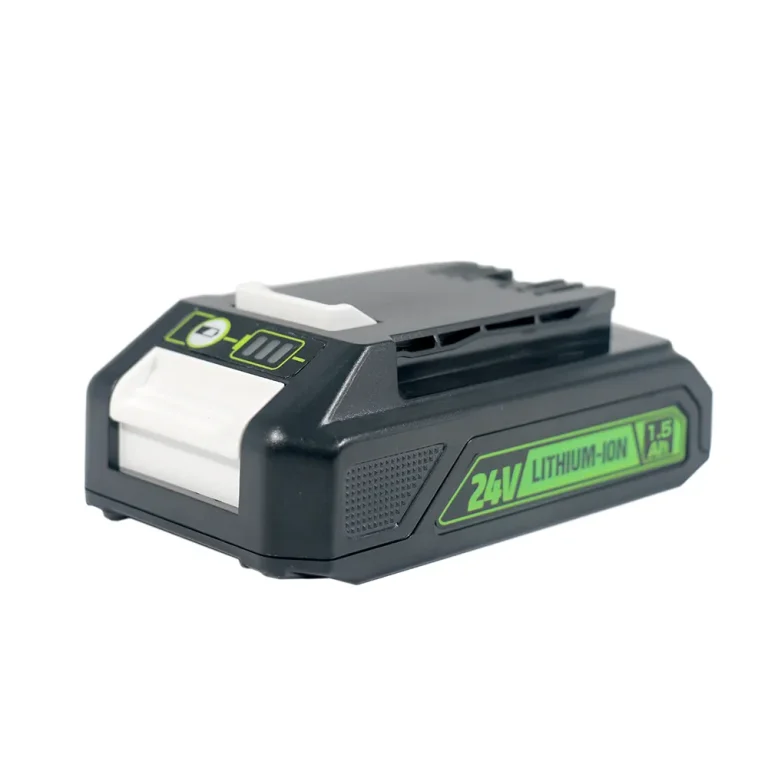
A replacement power tool battery is a battery pack supplied to replace an original pack used with a cordless tool platform. The correct choice must match the tool, charger, voltage platform, interface, and electrical requirements. Capacity and price matter only after compatibility is confirmed.
Use the original battery model as your starting point. Then check mechanical fit, charger support, runtime, power delivery, protection design, and supplier documentation. This approach reduces compatibility problems and gives buyers a clearer basis for comparing original and aftermarket batteries.

Start with the Exact Battery, Tool, and Charger Models
Do not begin with a broad search such as “18V battery for Makita” or “20V DeWalt replacement battery.” Begin with three exact references:
| Item | Information to record | Where to find it |
|---|---|---|
| Original battery | Complete model number, voltage, and Ah rating | Battery label, base, or side |
| Power tool | Complete tool model number | Tool nameplate or housing |
| Charger | Complete charger model number | Charger label or manual |
These numbers serve different purposes. The battery model identifies the pack you are replacing. The tool model identifies the equipment and its operating requirements. The charger model helps confirm whether the replacement pack can be charged correctly.
Also identify the battery platform. A battery platform is a defined family of tools, batteries, and chargers designed to work together. A single brand may operate several platforms with different voltages, interfaces, or product generations.
Take clear photographs of all three labels when requesting compatibility support. This is more reliable than describing the battery by color, shape, or brand alone.
GeB Power’s standard compatibility review starts with the original battery model, voltage, interface, power tool model, and charger model. The review then covers battery contacts, enclosure, workload, mechanical fit, and electrical requirements.
The model numbers establish the product path. Without them, even a visually similar battery remains an assumption.
Match the Voltage and Battery Platform
Battery voltage describes the electrical potential of the pack. The replacement battery must match the voltage platform specified for the tool.
A voltage mismatch may prevent the tool from starting, trigger protection, cause poor performance, or create a risk of damage. However, matching the voltage number alone does not confirm compatibility.
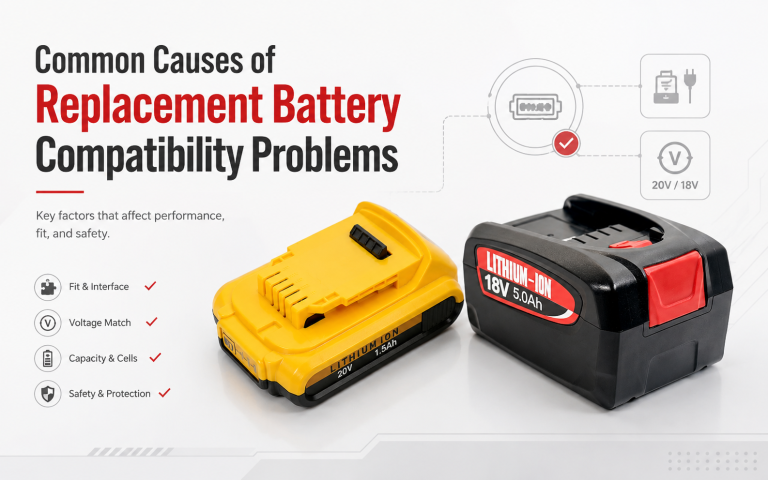
Two 18V batteries may still have different:
- Mounting interfaces
- Terminal positions
- Polarity arrangements
- Identification contacts
- Protection systems
- Charger requirements
The same rule applies within one brand. A manufacturer may have separate 12V, 18V, 20V Max, 36V, or 40V systems, as well as different generations within those systems.
The relationship between 18V and 20V Max also requires care. In some defined platforms, the two labels reflect nominal voltage and maximum fully charged voltage. That does not make every 18V and 20V battery interchangeable, especially across different brands.
Check the official platform information and the exact battery references. The practical rule is simple:
Match both the voltage and the battery platform. Never approve a replacement from the voltage label alone.
Check the Interface, Terminals, and Charger Compatibility
Full power tool battery compatibility includes both mechanical and electrical compatibility. A battery must install securely, connect through the correct terminals, communicate as required, and charge on an approved charger.
Verify the Physical Fit and Locking Design
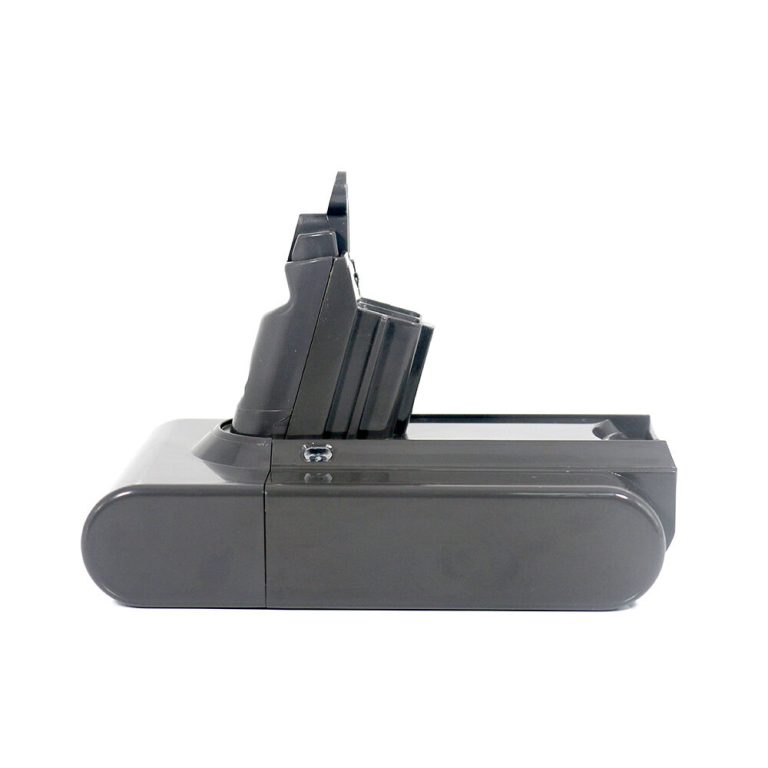
Mechanical compatibility describes whether the replacement battery physically fits and locks into the tool as intended.
Check:
- Slide-rail, stem, or insert-style interface
- Rail width and insertion depth
- Battery enclosure dimensions
- Latch position and movement
- Contact alignment
- Clearance around the tool housing
- Secure locking after installation
A battery that enters the tool only partway is not compatible. Neither is a pack that fits loosely, requires excessive force, or fails to lock.
Housing design also affects handling. A higher-capacity pack may technically fit but interfere with a belt hook, guard, work surface, or restricted operating position.
Verify the Terminals, Electronics, and Charger
Electrical compatibility covers voltage, terminal arrangement, polarity, load requirements, protection functions, and any identification or communication used by the platform.
Some packs contain more than positive and negative power terminals. Additional contacts may support temperature sensing, battery identification, charger control, or communication with the tool.
The battery management system, or BMS, is the electronic protection and control system inside a battery pack. Its functions may include overcurrent protection, over-discharge control, temperature monitoring, cell supervision, and charging protection. BMS behavior can differ between platforms even when their voltage labels appear similar.
Confirm that the original charger model is explicitly supported. A battery fitting into a charger does not prove that the charge profile, temperature monitoring, or terminal functions are correct.
Physical fit does not automatically mean electrical or charger compatibility.
A complete match must work as a system: battery, tool, charger, interface, terminals, and protection requirements.
Choose the Right Ah Capacity for Runtime and Weight
An ampere-hour, or Ah, rating indicates battery capacity. On the same compatible platform and under similar working conditions, a higher Ah rating generally provides longer potential runtime.
It does not directly measure tool power.
Actual runtime also depends on the tool, operating load, temperature, battery condition, work cycle, and pack efficiency. A circular saw under heavy load will consume energy much faster than an LED work light using the same battery.
The following ranges are useful planning references, not universal rules:
| Capacity range | Typical advantage | Common considerations |
|---|---|---|
| Around 2.0Ah | Low weight and compact size | Shorter runtime; useful for assembly, service work, and overhead operation |
| Around 4.0–6.0Ah | Practical balance of runtime and handling | Common choice for many 18V and 20V handheld tools |
| 8.0Ah and above | Longer work periods between battery changes | Greater size, weight, cost, and possible tool imbalance |
A lighter battery may be the better choice for repetitive fastening, confined areas, or work above shoulder height. Higher capacity can be more useful for long cutting, grinding, outdoor equipment, or applications where battery changes are disruptive.
Do not assume that the highest Ah option is automatically the best purchase. Select enough capacity for the expected work cycle without adding unnecessary weight or cost.
Match Battery Output to the Tool’s Workload
Battery capacity tells you how much charge the pack stores. It does not, by itself, tell you how effectively the pack can support a demanding tool.
Why Equal Ah Ratings Do Not Mean Equal Performance
Two batteries with the same voltage and Ah rating may behave differently during startup or sustained loading. Differences can appear in:
- Voltage drop
- Tool speed under load
- Battery temperature
- Protection shutdown frequency
- Effective runtime
- Long-term durability
Pack performance depends on the specific cells, series and parallel configuration, internal resistance, protection settings, conductive connections, terminals, and thermal path.
This matters most with high-load tools such as grinders, saws, rotary hammers, and impact equipment. These applications can demand far more current than light drilling, fastening, or lighting.
A 5.0Ah pack designed for moderate loads should not be treated as equivalent to every other 5.0Ah pack.
What Discharge Rate Means
Discharge rate is sometimes expressed as a C-rate, which relates current to cell capacity. For example, a 2.0Ah cell rated at 10C has a theoretical current relationship of:
2.0Ah × 10 = 20A
That figure must be interpreted carefully. A cell rating is not automatically the continuous output rating of the complete battery pack. The BMS, internal connections, terminal design, temperature, and enclosure can all impose lower limits.
Labels such as “high output,” “HP,” or “professional” are not universal technical standards. Ask what application, current limits, test conditions, and temperature data support the claim.
For high-load applications, confirm that the complete battery pack has been designed or evaluated for the intended tool and operating cycle. Ah alone is not enough.
Compare Original and Aftermarket Power Tool Batteries
An original battery is supplied by the tool’s original manufacturer for its own platform. An aftermarket replacement battery is independently produced and marketed as compatible with specified tools, batteries, or chargers.
Neither category should be judged only by its label.
| Comparison factor | Original battery | Aftermarket replacement battery |
|---|---|---|
| Price | Usually premium-priced | Often offers a lower initial cost |
| Compatibility | Usually clear within the stated original platform | Requires model-specific verification |
| Capacity options | Limited to the original product range | May offer additional capacity choices |
| Availability | May become limited for older models | May support mature or discontinued platforms |
| Quality consistency | Generally controlled within one brand system | Varies significantly by manufacturer |
| Warranty | Usually standardized | Depends on the supplier and order |
| Customization | Usually limited | May support private label, packaging, or OEM/ODM work |
Some market comparisons place aftermarket products about 30%–50% below roughly comparable original-brand batteries. Treat that as a possible price range, not a fixed industry rule. Voltage, capacity, cell selection, seller, market, quantity, and warranty can change the comparison substantially.
Lower price is a valid commercial advantage only when compatibility, capacity accuracy, protection, and manufacturing consistency are acceptable.
Aftermarket batteries are independently supplied products. Compatibility wording does not imply affiliation with or endorsement by the original tool manufacturer.
Evaluate Safety, Build Quality, and Supplier Support
A replacement battery should be assessed as an engineered pack, not just a plastic housing with a capacity label.
Check Protection Features and Construction
Review whether the product specification addresses:
- Overcharge protection
- Over-discharge protection
- Overcurrent protection
- Short-circuit protection
- Temperature monitoring or thermal protection
- Cell balance or supervision, where applicable
- Secure terminal construction
- Reliable latches and enclosure
- Clear model and traceability markings
Cell format can affect pack design. Common cylindrical formats such as 18650 and 21700 may provide different capacity, current, size, and thermal options. Neither format guarantees better performance by itself. The specific cell model and the complete pack design matter more than diameter alone.
The same applies to newer structures such as tabless cells. Reduced current path resistance may support higher output or faster charging in a properly designed system, but charge time and cycle life still depend on the exact cells, pack, charger, temperature, and test conditions.
Be cautious with unusually low prices, exaggerated Ah claims, and vague compatibility descriptions.
Review Warranty, Documents, and After-Sales Support
A credible supplier should define:
- Warranty period and claim process
- Product identification requirements
- Compatibility support
- Sample availability
- Test or inspection scope
- Batch and order traceability
- Response process for fit, charging, or performance issues
Customer reviews can reveal repeated problems involving latches, charger recognition, runtime, or durability. They are useful screening evidence, but they cannot replace technical compatibility confirmation.
Documents must also be reviewed by scope. A company certificate, product certificate, safety data sheet, test report, and transport document serve different purposes. UN38.3, for example, concerns lithium battery transport testing; it should not be treated as a blanket approval of every product characteristic.
Document availability may depend on the battery model, configuration, transport method, and destination market.
The right supplier should be able to connect each claim and document to the product being quoted.
Use a Final Compatibility Checklist Before Buying
Before approving a replacement power tool battery, complete one final review.
| Check | Information to confirm |
|---|---|
| Original battery | Complete model, voltage, capacity, and chemistry |
| Power tool | Brand, exact model, battery platform, and application |
| Charger | Exact model and supported battery series |
| Mechanical fit | Rails, insertion depth, latch, enclosure, and contacts |
| Electrical fit | Voltage, polarity, terminals, identification, and protection |
| Capacity | Required runtime, acceptable size, and weight |
| Workload | Light, intermittent, high-load, or continuous operation |
| Quality | Protection functions, construction, traceability, and warranty |
| Documentation | Product- and destination-specific document requirements |
Do not approve a product from an image or broad compatibility statement when the exact model relationship is missing.
Additional Checks for Bulk Orders
For distribution, private-label, or project purchasing, add the following information to the review:
- Expected order quantity
- Destination market
- Required label and packaging
- Application and workload
- Acceptance and inspection criteria
- Required certificates, reports, or shipping documents
- Sample configuration
- Approved production specification
A sample should be tested with the intended tool and charger before a volume order is approved. Check installation, locking, startup, operating load, charging, temperature behavior, protection response, identification, labeling, and packaging. GeB Power’s project process places sample validation before production handoff, with production based on approved specifications and inspection requirements.
For an efficient RFQ, provide the original battery, power tool, and charger models, along with voltage, required capacity, order quantity, and destination.
Compatibility should be demonstrated before it becomes a purchasing commitment.
Frequently Asked Questions About Replacement Power Tool Batteries
Are power tool batteries interchangeable between brands?
Most are not directly interchangeable. Brands and platforms may use different voltages, housings, rails, terminals, identification systems, chargers, and protection arrangements.
Some adapters provide a physical and basic electrical connection. They do not automatically reproduce all communication, temperature monitoring, low-voltage control, or protection functions.
Can I use a higher Ah battery in my power tool?
Usually, yes—when the higher-capacity battery is explicitly compatible with the same tool, voltage platform, interface, and charger.
A higher Ah rating can extend runtime, but it may also increase weight, size, price, and charging time. It does not automatically make the tool more powerful.
Will a replacement battery work with my original charger?
Only when charger compatibility has been confirmed. Check the charger model, battery platform, voltage, chemistry, contact layout, and any identification requirements.
A battery entering the charger is not proof of correct charging.
Is it safe to use a third-party replacement battery?
A properly designed and correctly matched aftermarket battery can be a practical replacement. Safety depends on the specific product, not the category name.
Review compatibility, protection functions, construction, capacity claims, supplier controls, warranty, and model-specific documentation. Avoid unverified products with vague specifications.
Choose the Battery That Fits the Complete System
The right replacement power tool battery must first match the original battery reference, tool, charger, voltage platform, interface, terminals, and electrical requirements. After that, choose the Ah capacity and output capability that suit the expected workload, runtime, handling, and budget.
Do not buy by brand, voltage, capacity, or price alone.
GeB Power supplies compatible replacement power tool batteries and supports model identification, compatibility review, sample validation, catalog supply, and OEM/ODM battery projects. Send us the original battery, tool, and charger models together with your capacity, quantity, application, and destination requirements to begin a product review.
Looking for Reliable OEM/ODM Replacement Batteries for Your Tool Fleet?
As a professional lithium-ion battery manufacturer with over 16 years of engineering experience, GeB Power (General Electronics Technology Co., Ltd.) provides high-grade, direct-fit replacement battery packs and custom battery solutions for power tool distributors, fleet contractors, and equipment brands worldwide.
- Tier-1 High-Drain Cells: Premium 18650 and 21700 lithium cells for maximum discharge rate and prolonged runtime.
- Intelligent BMS Protection: Multi-layer circuitry preventing overcharge, over-discharge, short circuit, and thermal runaway.
- Global Certifications: Fully certified to CE, UL 2054, UN38.3, RoHS, and MSDS transport standards.
- Flexible MOQ & Fast Prototyping: Customized housing colors, labeling, private labeling (OEM), and fast-turnaround sampling.
Get a factory-direct quote or request evaluation samples today: Send your required voltage, capacity, tool models, and estimated order quantity to our engineering team at info@gebattery.co or submit your inquiry via our Request a Quote page.