How to Identify Your Original Power Tool Battery Model Number
Direct Answer: How to identify your original power tool battery model number: Step-by-step guide to decoding OEM part numbers, label specifications, and cross-references.
The original power tool battery model number is usually printed on a label on the bottom, side, or upper housing of the battery pack. Look for terms such as Model, Model No., Part No., P/N, Type, or Cat. No.
Record the complete reference exactly as printed. Voltage, capacity, serial numbers, and QR codes may support identification, but they are not normally the battery model number.

Why the Original Battery Model Number Matters
A battery model number is the manufacturer’s reference for a specific battery product or product family. It is the most useful starting point when searching for a replacement power tool battery.
The correct reference helps distinguish between batteries that may share the same brand, voltage, or general appearance but belong to different platforms. It also gives a supplier or technical team a reliable basis for checking capacity options, charger requirements, mounting interfaces, and terminal layouts.
Do not treat model identification as complete compatibility confirmation. A matching reference is important, but the tool model, charger model, voltage platform, and physical interface must still be reviewed.
Where to Find the Model Number on a Power Tool Battery
Turn off the tool and remove the battery before inspecting it. Use good lighting and check every labeled surface.
Common model number locations include:
- The bottom of the battery housing
- A side specification label
- The top surface near the mounting rails
- The area beside the terminals or release latch
- The original product packaging
- The user manual, invoice, or purchase record
The bottom is one of the most common locations, but label placement varies by brand, battery generation, and housing design. Some slide-style batteries place the main identification label on the side, while others use a smaller label near the interface.
When the battery label and packaging show different references, verify both before ordering. The package may display a kit or commercial SKU rather than the model of the battery itself.

How to Read a Power Tool Battery Label
A typical cordless tool battery label contains several identifiers and electrical specifications. Each field serves a different purpose.
Model Number and Part Number
Start with fields marked:
- Model or Model No.
- Part No. or P/N
- Type
- Cat. No. or Catalog Number
A model number identifies the battery product or series. A part number is a manufacturer’s ordering or internal product reference. Depending on the brand, either may be used to locate an exact replacement.
Record every character, including letters, numbers, spaces, hyphens, and suffixes. For example, if the label reads BL1850B, do not shorten it to BL1850. A final letter or number may distinguish a version, generation, region, or product configuration.
Watch for easily confused characters such as 0 and O or 1 and I. A clear photograph is more reliable than a handwritten note.
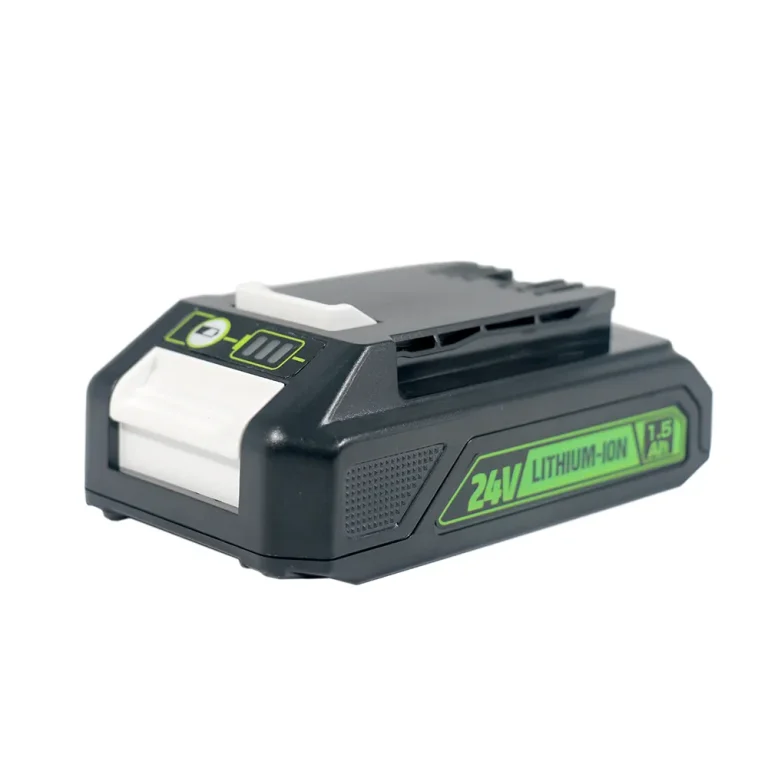
Voltage, Capacity, and Battery Chemistry
Voltage and capacity are specifications, not complete model numbers.
| Label field | What it means | How it helps |
|---|---|---|
| Voltage, such as 18V or 24V | The battery platform or nominal voltage class | Helps confirm the electrical platform |
| Capacity, such as 2.0Ah or 5.0Ah | The amount of charge the battery can store | Helps compare expected runtime |
| Energy, shown in Wh | A calculated energy rating | Supports specification comparison |
| Li-ion, Ni-Cd, or Ni-MH | The battery chemistry | Helps determine charger and platform requirements |
A label that only shows 18V 5.0Ah Li-ion does not provide enough information to identify the exact battery. Many products can share those specifications while using different rails, contacts, housings, or chargers.
Serial Number, Batch Code, Barcode, and QR Code
A serial number normally identifies one individual battery. It may support warranty, service, registration, or recall tracking, but it is not usually the reference used to order a replacement.
A batch or date code identifies a production run or manufacturing period. Barcodes and QR codes may open a product page, registration system, inventory record, or support resource. Their purpose varies by manufacturer and market.
Use these codes as supporting evidence. Do not automatically treat them as the battery model number or as universal proof of authenticity.

Battery Model vs. Tool, Charger, and Combo Kit Numbers
A cordless tool system may contain several different model references.
| Reference | What it identifies |
|---|---|
| Battery model number | The removable battery pack |
| Tool model number | The drill, saw, grinder, or other tool |
| Charger model number | The charging unit |
| Combo kit number | A packaged combination of tools, batteries, and chargers |
| Serial number | One individual product |
For example, a code such as DCF887D2 may identify a tool kit configuration rather than the battery supplied inside the kit. The battery itself will normally carry a separate reference on its own rating label.
This distinction matters when reviewing receipts or online listings. A retailer may display the kit number prominently while placing the actual battery model deeper in the specifications.
How to Identify the Battery Model Step by Step
Use the following process to create a reliable battery model record:
- Remove the battery safely. Switch off the tool and release the battery pack.
- Inspect all labeled surfaces. Check the bottom, sides, top, rails, and terminal area.
- Find model-related fields. Look for Model, P/N, Type, or Cat. No.
- Record the complete reference. Keep every prefix, suffix, space, and hyphen.
- Note the supporting specifications. Record voltage, Ah, Wh, and chemistry.
- Photograph the battery. Capture the full label, housing, rails, latch, and terminals.
- Record the tool and charger models.
- Cross-check the information. Compare it with the packaging, manual, purchase record, or official product documentation.
Photograph the label before it becomes scratched, faded, or covered by workshop dirt. For fleets or repeat purchasing, store the images with the tool asset record or supplier file.
A complete record is much easier to review than a message that only says “18V battery for a drill.”
What If the Battery Label Is Missing or Unreadable?
Do not identify the battery by color, shape, brand, or voltage alone.
Start with the power tool rating plate. Record the tool model and voltage platform, then inspect the charger label. These references may help narrow the original battery family.
Next, check:
- Original packaging and invoices
- Online order histories
- User manuals and parts lists
- Manufacturer product or support pages
- Previous quotations or inventory records
Take clear photographs of the battery interface, terminal arrangement, release mechanism, and housing from several angles. Approximate dimensions may also help distinguish similar-looking products.
When only part of a reference remains visible, record the characters you can read without guessing the missing section. Submit those characters together with the tool model, charger model, voltage, and photographs.
What Else Should You Verify Before Buying a Replacement?
The original battery model number is the starting reference. Compatibility depends on a wider set of electrical and mechanical conditions.
Before requesting a quote or approving a replacement, verify:
- Original battery model
- Power tool model
- Charger model
- Nominal voltage
- Battery capacity
- Mounting rails or insertion interface
- Terminal number, position, and layout
- Latch and housing fit
- Battery chemistry
- Intended application and tool load
The same brand or voltage marking does not make two batteries interchangeable. Even when a battery appears to fit, its charger requirements, terminal functions, protection design, or communication features may differ.
GeB Power’s compatibility review follows this broader approach, covering battery information, tool platform, charger matching, mechanical fit, and electrical requirements before a product path is confirmed.
Quick Questions About Battery Model Identification
Is the Voltage the Battery Model Number?
No. Voltage identifies the electrical platform or voltage class. Several battery models with different capacities, interfaces, and terminal arrangements may share the same voltage.
Can a QR Code Tell Me the Battery Model?
Sometimes. A QR code may link to product information, registration, support, or inventory data. Scan it as an additional lookup method, then confirm the model against the printed label or official documentation.
What Information Should I Send for Identification Help?
Provide:
- A clear battery-label photograph
- Any visible model or part-number characters
- The tool model
- The charger model
- Voltage and capacity
- Interface and terminal photographs
For a commercial inquiry, also include the required quantity, destination market, packaging needs, and requested documents.
The most reliable method is simple: locate the battery label, record the complete model reference, and verify it against the tool, charger, voltage, and interface.
GeB Power supplies compatible replacement power tool batteries and supports model identification, compatibility review, and OEM/ODM battery projects. Contact our team with your battery, tool, and charger information for a structured review.
Technical references: For deeper insight into lithium-ion cell chemistry, discharge rates, and cycle degradation standards, consult the Battery University Guide on Li-ion Lifespan and the UL Standards for Battery Safety Testing.
Frequently Asked Questions (FAQ)
Q1: What if the battery model label is completely scratched off?
Check the model number on your power tool or charger. Most OEM tool specification plates list compatible battery part numbers directly in the manual or underneath the handle.
Q2: Can I cross-reference an aftermarket part number to an OEM model?
Yes, reputable replacement manufacturers like GeB Power provide exact OEM cross-reference SKU charts matching part numbers for DeWalt, Milwaukee, Makita, Bosch, and Ryobi.
Looking for Reliable OEM/ODM Replacement Batteries for Your Tool Fleet?
As a professional lithium-ion battery manufacturer with over 16 years of engineering experience, GeB Power (General Electronics Technology Co., Ltd.) provides high-grade, direct-fit replacement battery packs and custom battery solutions for power tool distributors, fleet contractors, and equipment brands worldwide.
- Tier-1 High-Drain Cells: Premium 18650 and 21700 lithium cells for maximum discharge rate and prolonged runtime.
- Intelligent BMS Protection: Multi-layer circuitry preventing overcharge, over-discharge, short circuit, and thermal runaway.
- Global Certifications: Fully certified to CE, UL 2054, UN38.3, RoHS, and MSDS transport standards.
- Flexible MOQ & Fast Prototyping: Customized housing colors, labeling, private labeling (OEM), and fast-turnaround sampling.
Get a factory-direct quote or request evaluation samples today: Send your required voltage, capacity, tool models, and estimated order quantity to our engineering team at info@gebattery.co or submit your inquiry via our Request a Quote page.