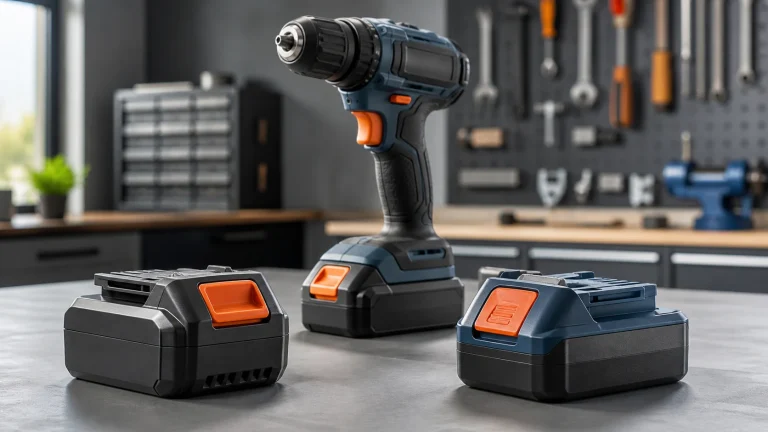
How to Match Battery Voltage With Your Power Tool Platform
Direct Answer: Learn how to match power tool battery voltage with your cordless platform. Master nominal vs max voltage, multi-voltage cross-compatibility, and safety tips.
Battery voltage is the first compatibility check when selecting a replacement power tool battery. It is not the final one. The battery must belong to the voltage platform specified for the tool, then match the original battery reference, mechanical interface, terminal layout, charger, and expected load. A battery marked with the same voltage can still be unsuitable if any of those conditions differ.

What Does Battery Voltage Mean in a Cordless Tool Platform?
Voltage, measured in volts (V), describes electrical potential difference. In a cordless tool system, it also identifies the electrical class for which the tool, battery, and charger were designed.
A power tool voltage platform is a defined system that connects a group of cordless tools with compatible batteries, chargers, interfaces, contacts, and control requirements. One platform may include drills, impact drivers, saws, grinders, and other tools, even though those products have very different performance levels.
Voltage does not describe the complete output of a tool. Actual performance also depends on the motor, electronic controls, drivetrain, battery current capability, thermal design, and behavior under load. Two tools on the same 18V platform can perform very differently. A higher voltage label also does not make a tool automatically better for every task.
Use voltage to identify the correct electrical system. Do not use it as a stand-alone measure of power or quality.
Nominal Voltage vs Maximum Voltage: Why the Labels Can Be Confusing
Cordless battery voltage changes as the pack charges and discharges. The value printed on the housing may describe nominal voltage, maximum voltage, or a platform name chosen by the manufacturer.
What Nominal Voltage Means
Nominal voltage is the reference voltage used to classify a battery system. It is not the exact voltage the pack maintains during operation. A fully charged lithium-ion battery starts above its nominal rating, then its voltage falls as energy is used.
For example, a five-cell-series lithium-ion pack may use cells rated at about 3.6V or 3.7V nominal. That produces a pack rating of about 18V or 18.5V. If each cell reaches about 4.2V at full charge, the pack may measure about 21V before load is applied.
Why Some Platforms Use “20V MAX”
Some manufacturers market a platform by nominal voltage. Others emphasize a maximum or no-load value. This is why an 18V label and a 20V MAX label can sometimes describe similar five-cell-series electrical configurations.
That does not create one universal 18V/20V platform.
A battery with a similar cell count can still have a different interface, terminal assignment, polarity, identification method, protection arrangement, or charging system. Compare voltage labels within the manufacturer-defined platform and verify the exact battery and tool models before drawing a compatibility conclusion.
How to Match a Replacement Battery to Your Tool Voltage Platform
A reliable power tool battery compatibility check starts with complete model identification. Do not begin with color, housing shape, or a voltage number alone.
Step 1: Identify the Complete Tool Model
Find the product label on the tool body, base, handle, or battery mounting area. Record the full brand and model number, not a description such as “18V drill.”
Also note the printed voltage and any platform name or series designation. The manual or official product page can help when the tool label is worn or incomplete.
Step 2: Identify the Original Battery Reference
Record the complete model number from the original battery. Also capture:
- Voltage marking
- Capacity in amp-hours
- Platform or series name
- Battery chemistry, where stated
- Clear photos of the mounting rails, latch, and terminals
The original battery model is usually more useful than capacity or appearance. Several batteries may share the same voltage and housing style while serving different tool generations.
Step 3: Confirm the Defined Voltage Platform
Check whether the tool, original battery, and proposed replacement belong to the same supported platform. Pay attention to:
- Platform generation
- Professional versus consumer product families
- Nominal versus maximum voltage labeling
- Fixed-voltage versus multi-voltage systems
- Region-specific model differences
The same brand can operate several battery systems that are not interchangeable.
Step 4: Check the Interface and Terminal Layout
A compatible battery must install securely and make the correct electrical connections. Compare the slide rails or stem, latch position, housing clearance, positive and negative terminals, and any auxiliary contacts.
Auxiliary terminals may support temperature sensing, identification, or communication. A pack that physically enters the tool can still be electrically unsuitable if those contacts are missing or assigned differently.
Step 5: Verify the Charger and Intended Load
Check the full charger model separately. Tool compatibility does not prove charger compatibility.
Then review the actual application. A battery for a drill used in short fastening cycles faces a different duty cycle from a pack used in sustained cutting or grinding. For new replacement models or volume orders, test the sample with the intended tool, charger, and realistic load before approval.
| Check | Information to Confirm |
|---|---|
| Tool | Complete model, voltage, platform, and generation |
| Original battery | Full model, capacity, chemistry, interface, and terminals |
| Replacement battery | Supported tool and battery references |
| Charger | Full model and supported battery range |
| Application | Tool type, workload, duty cycle, and environment |
The correct process is model first, platform second, physical and electrical verification next. Voltage narrows the search; it does not finish it.
Why the Same Voltage Does Not Guarantee Battery Compatibility
Two batteries can display the same voltage and still be incompatible. Voltage confirms only one electrical characteristic. The rest of the platform must also align.
| Compatibility Factor | Why It Matters |
|---|---|
| Platform and generation | One brand may use several unrelated battery systems |
| Mechanical interface | Rails, stems, latches, and clearances may differ |
| Terminal layout | Main power and auxiliary contacts may use different positions or functions |
| Electronic identification | The tool may require a specific signal or communication method |
| Protection arrangement | Low-voltage, overcurrent, and temperature control may be divided differently between the tool and battery |
| Charger compatibility | A battery that powers the tool may still be unsuitable for the existing charger |
| Load capability | A pack may run the tool at no load but fail during sustained work |
Cross-brand batteries should not be treated as directly compatible by default. Even within one brand, the battery must belong to the correct voltage system, product family, and generation.
A physical fit or a successful no-load start is not complete validation. The battery must operate correctly through charging, startup, sustained load, and low-state-of-charge conditions.
Voltage, Capacity, and Tool Load Are Different Selection Factors
Voltage vs Amp-Hour Capacity
Voltage and capacity describe different battery characteristics.
Voltage identifies the electrical platform. Amp-hour capacity, expressed in Ah, describes how much charge the battery can store. A higher Ah rating can provide more available energy and potentially longer runtime when the tool, battery design, and operating conditions are otherwise comparable.
A higher Ah rating does not move a battery into another voltage platform. It also does not solve an interface, terminal, or charger mismatch.
An 18V 5.0Ah pack and an 18V 2.0Ah pack may belong to the same platform, but capacity alone does not prove that both are approved for every tool in that system. Size, weight, current capability, and model restrictions still matter.
Why Tool Load Still Matters
Power tools can place high startup and transient current demands on a battery. Sustained drilling, sawing, or grinding can also expose limitations in cell configuration, internal resistance, protection settings, and thermal management.
A battery that turns the tool at no load has not necessarily been validated for the real application. Check performance under the intended duty cycle, especially for high-load tools and B2B sample approval.
Voltage determines the platform boundary. Capacity and load capability determine whether the selected pack is practical within that boundary.

What Happens If the Battery Voltage or Platform Is Wrong?
Battery Voltage Above the Tool’s Design Range
A higher-voltage battery may cause the tool to reject the pack, trigger protection, or expose electronics and motor controls to conditions outside their design range. The result can be abnormal operation, excessive heat, or component damage.
Do not assume a higher voltage will produce a stronger tool.
Battery Voltage Below the Tool’s Design Range
A lower-voltage battery may prevent startup, reduce output, cause unstable operation, or trigger low-voltage shutdown early. The tool may also stall more easily under load.
Lower voltage is not a safe substitute simply because the number is smaller.
Different Labels Within a Supported Platform
An 18V tool and a battery labeled 20V MAX should not be judged from those numbers alone. Determine whether the labels represent nominal and maximum voltage within the same supported platform, then verify the exact model combination.
The practical rule is firm: use the battery system specified for the tool, not the closest voltage number you can find.
Battery Adapters and Chemistry Conversions Need Separate Review
Cross-Platform Battery Adapters
A battery adapter mainly changes the mechanical connection between a battery and a tool. It may allow one pack to slide into another platform, but it does not automatically convert voltage or reproduce communication, temperature sensing, identification, or protection functions.
Some adapters also leave low-voltage cutoff dependent on the wrong part of the system. A tool may run while important safeguards do not operate as intended.
Treat adapter use as a separate technical configuration. Never assume that tool-side adapter operation confirms charger compatibility.
Replacing NiCd With Lithium-Ion
A nickel-cadmium pack and a lithium-ion pack can have similar nominal voltage labels while using very different charging methods and protection requirements. NiCd cells are commonly rated around 1.2V nominal, while lithium-ion cells use a higher per-cell voltage and require controlled charge limits.
A NiCd-to-lithium conversion therefore needs a purpose-designed pack, suitable protection, correct polarity and interface, a compatible charger, and load validation. Similar voltage is only the starting point.
Adapters and chemistry conversions are engineering decisions, not shortcuts around platform compatibility.
Final Battery Voltage Matching Checklist and FAQs
Use this checklist before buying, sampling, or approving a replacement battery:
- Confirm the complete power tool model.
- Record the original battery model.
- Identify the manufacturer-defined voltage platform.
- Check whether the label uses nominal or maximum voltage.
- Do not confuse Ah capacity with voltage.
- Confirm that the replacement battery covers the intended model range.
- Compare the mechanical interface and latch.
- Verify positive, negative, temperature, and signal contacts.
- Confirm charger compatibility by full model number.
- Check the battery against the expected tool load.
- Validate a sample before volume production or distribution.
Does the Battery Voltage Have to Match the Power Tool?
The battery must belong to the voltage platform specified for the tool. The printed numbers may use nominal or maximum-voltage conventions, so confirm the platform and model—not just the label.
Can I Use a 20V MAX Battery on an 18V Tool?
Only when both products are part of the same supported platform and the exact models are listed or verified as compatible. Similar 18V and 20V MAX electrical configurations do not create cross-brand compatibility.
Are All Batteries With the Same Voltage Interchangeable?
No. The platform, generation, interface, terminal functions, electronic requirements, charger, and load capability must also match.
Can I Use a Higher-Ah Battery on the Same Tool?
Yes, but only when that battery model is approved or verified for the same platform and tool. Higher capacity does not change voltage, but it can change pack size, weight, charging time, and available current.
The correct battery voltage narrows the available options. Exact platform and model verification determine whether the battery is suitable for the tool, charger, and application.
GeB Power supplies compatible replacement power tool batteries and supports OEM/ODM battery projects with model identification, compatibility review, pack engineering, sample validation, and production handoff. For product selection or a project review, send the original battery model, tool model, charger model, voltage, required capacity, order quantity, and destination to the GeB Power team.
Technical references: For deeper insight into lithium-ion cell chemistry, discharge rates, and cycle degradation standards, consult the Battery University Guide on Li-ion Lifespan and the UL Standards for Battery Safety Testing.
Looking for Reliable OEM/ODM Replacement Batteries for Your Tool Fleet?
As a professional lithium-ion battery manufacturer with over 16 years of engineering experience, GeB Power (General Electronics Technology Co., Ltd.) provides high-grade, direct-fit replacement battery packs and custom battery solutions for power tool distributors, fleet contractors, and equipment brands worldwide.
- Tier-1 High-Drain Cells: Premium 18650 and 21700 lithium cells for maximum discharge rate and prolonged runtime.
- Intelligent BMS Protection: Multi-layer circuitry preventing overcharge, over-discharge, short circuit, and thermal runaway.
- Global Certifications: Fully certified to CE, UL 2054, UN38.3, RoHS, and MSDS transport standards.
- Flexible MOQ & Fast Prototyping: Customized housing colors, labeling, private labeling (OEM), and fast-turnaround sampling.
Get a factory-direct quote or request evaluation samples today: Send your required voltage, capacity, tool models, and estimated order quantity to our engineering team at info@gebattery.co or submit your inquiry via our Request a Quote page.