Power Tool Battery Applications: A Guide to Cordless Equipment
The cordless power tool revolution is built on one foundational component: the battery. What began in 1961 with the introduction of one of the first cordless drills has evolved into a global industry where lithium-ion battery packs power everything from compact driver drills to industrial-grade demolition hammers and outdoor equipment. By 2024, lithium-ion batteries accounted for approximately 93% of all cordless power tool shipments worldwide, effectively replacing legacy nickel-cadmium (NiCd) and nickel-metal hydride (NiMH) chemistries.
For distributors, brand owners, procurement teams, and engineering groups, understanding power tool battery applications means looking beyond voltage and capacity alone. Cell chemistry, pack engineering, battery compatibility, charging requirements, protection systems, operating load, and the intended cordless equipment all influence whether a battery is suitable for a particular application.
This guide explains the main battery technologies, compatibility factors, application categories, safety considerations, and OEM/ODM development requirements behind modern battery-powered equipment.

Why Lithium-Ion Batteries Dominate Cordless Tools
Lithium-ion technology has become the dominant power source for cordless tools for compelling technical reasons. Compared with the NiCd and NiMH batteries it replaced, lithium-ion delivers significantly higher energy density, providing more runtime in a lighter and more compact package. Lithium-ion cells also exhibit lower self-discharge rates, hold their charge longer in storage, and support hundreds of charge cycles before meaningful capacity loss.
The practical impact on the job site is immediate: a tool that weighs less, runs longer, charges faster, and remains ready for use after periods of inactivity. For professionals who depend on cordless equipment daily, these advantages can translate directly into productivity.
The dominant cylindrical cell formats in power tool battery packs are the 18650, measuring approximately 18 mm in diameter and 65 mm in length, and the larger 21700 format. According to industry data, 18650 2.0Ah and 2.5Ah variants together accounted for roughly 74.5% of power tool cell shipments in 2024, while the 21700 4.0Ah format is gaining share as cordless equipment demands greater capacity and sustained power.
How Battery Chemistry and Cell Format Affect Performance
Selecting the right cell for a cordless power tool battery is an engineering decision that balances capacity, discharge capability, pack size, weight, thermal performance, cost, and the intended application.
| Parameter | 18650 (2.0–2.5 Ah) | 21700 (4.0 Ah) |
|---|---|---|
| Diameter × Length | 18 × 65 mm | 21 × 70 mm |
| Typical Capacity | 2.0–2.5 Ah | 3.0–4.0 Ah |
| Energy Density | High, mature technology | Higher due to larger format |
| Discharge Rate | Up to 15–20C continuous | Up to 15–20C continuous |
| Cost | Lower with mature supply chain | Slightly higher |
| Best Fit | Compact tools, DIY and prosumer equipment | Professional, industrial and high-demand equipment |
Source: Industry shipment data, 2024
Most power tool cells use nickel-manganese-cobalt (NMC) or nickel-cobalt-aluminum (NCA) cathode chemistries because they offer the high discharge rates and energy density required by demanding cordless equipment. Lithium iron phosphate (LiFePO4 or LFP), known for its thermal stability and long cycle life, is increasingly used in some industrial and outdoor applications where longevity and safety margin can outweigh maximum energy density.
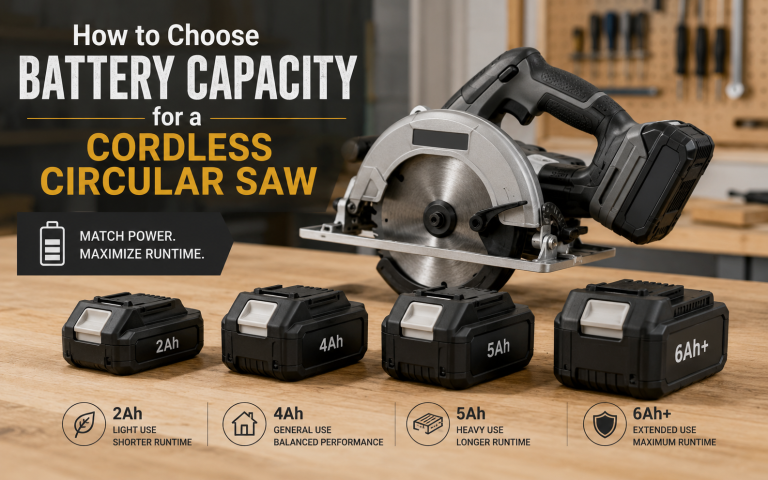
The important point for battery selection is that application comes before battery specification. A higher-capacity cell is not automatically the best choice. Working load, peak and continuous discharge requirements, desired runtime, available enclosure space, pack weight, operating environment, and protection requirements need to be considered together. Buyers who want to compare capacity choices in more detail can also review how power tool battery capacity affects runtime.
Why Voltage Alone Does Not Guarantee Battery Compatibility
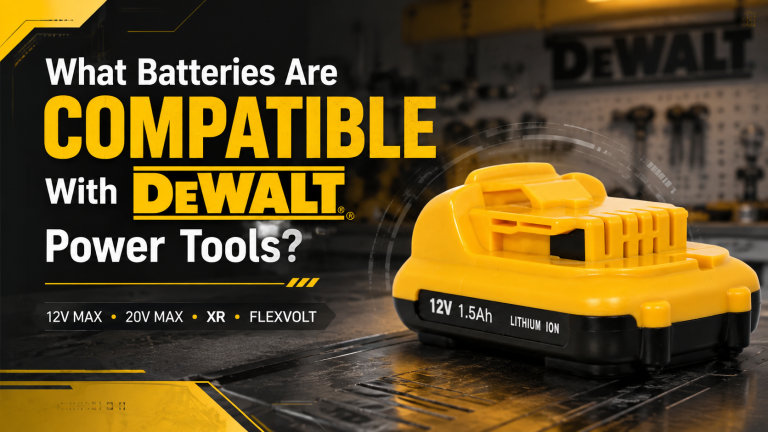
One of the most important developments in cordless tools is the battery platform concept. Manufacturers organize cordless equipment around voltage platforms such as 12V, 18V/20V, 36V, and higher-voltage systems for outdoor applications. Within a compatible platform, users may be able to operate multiple tools with batteries and chargers designed for that specific ecosystem.
However, similar nominal voltage does not mean that different batteries are interchangeable.
Two batteries may both be labeled 18V or 20V while using different mounting interfaces, terminal arrangements, enclosure dimensions, protection requirements, electrical characteristics, charger requirements, or tool-side control systems. A battery that physically fits a piece of cordless equipment is therefore not necessarily electrically compatible with it.
This is an important distinction when evaluating compatible power tool batteries or a replacement battery for cordless tools. For a deeper explanation, see this guide to power tool battery compatibility and interchangeability. A reliable compatibility review should consider the original battery reference, voltage platform, capacity, interface geometry, terminal layout, tool model, charger model, discharge load, connection method, and operating environment.
For GeB Power projects, compatibility verification is approached as a combination of mechanical and electrical checks rather than a voltage-only comparison. The review process may include:
| Review Step | What Is Checked |
|---|---|
| Battery identification | Original battery model, voltage, capacity and product platform |
| Mechanical compatibility | Pack dimensions, mounting interface, structural fit and contact position |
| Electrical compatibility | Voltage platform, discharge load, protection requirements and connection method |
| Tool review | Tool model, intended application and working load |
| Charger compatibility | Charger model and its relationship with the replacement battery |
| Sample validation | Sample expectations and acceptance checks before volume production |
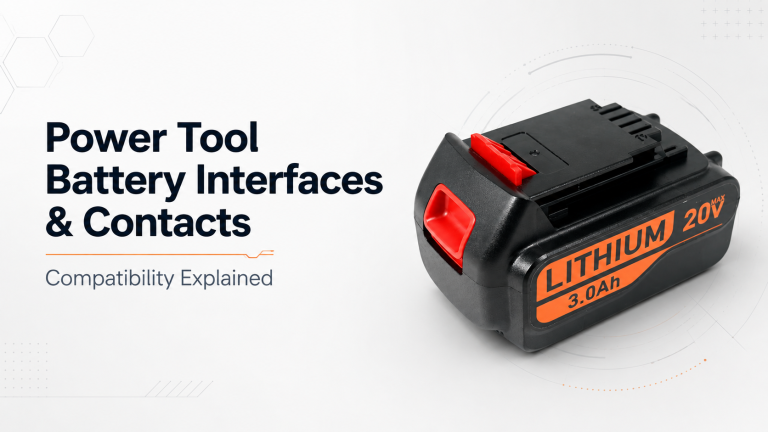
Buyers who need to confirm the platform first can refer to this guide on matching battery voltage with a power tool platform. Interface geometry and terminal design also deserve separate attention, as explained in this overview of power tool battery interfaces and contacts.
This leads to a useful rule for B2B buyers: broad battery applications do not mean universal battery interchangeability.
How the BMS Protects a Power Tool Battery
A Battery Management System, or BMS, is a critical protection component inside a lithium-ion battery pack. Power tool applications can expose batteries to high current demand, vibration, impact loads, repeated charge and discharge cycles, and changing operating temperatures.
The BMS monitors operating conditions and helps prevent the battery from being used outside defined electrical and thermal limits.
A well-designed power tool BMS can provide multiple layers of protection:
| Protection Function | What It Helps Prevent |
|---|---|
| Overcharge protection | Cell voltage exceeding the defined maximum during charging |
| Over-discharge protection | Cell voltage falling below the defined minimum under load |
| Over-current protection | Excessive discharge current |
| Short-circuit protection | High fault current caused by abnormal terminal conditions |
| Thermal protection | Operation outside the defined temperature range |
| Cell balancing | Excessive voltage imbalance between cells during charge and discharge |
Modern battery systems can go beyond passive protection. Depending on the battery and equipment platform, monitoring and control functions may support temperature management, battery status information, power control, or other interactions between the battery and cordless equipment.
For an OEM/ODM project, protection requirements should therefore be defined from the equipment’s actual load profile rather than selected independently of the application.

Key Safety Standards and Shipping Documents
For battery-powered equipment entering global markets, product safety and transport documentation are important considerations. Three standards commonly associated with lithium battery packs include:
| Standard | Scope | Market / Use |
|---|---|---|
| UL 2054 | Household and commercial battery packs at pack level | North American market |
| IEC 62133-2 | Portable sealed secondary lithium cells and batteries | International markets |
| UN 38.3 | Transport safety testing for lithium batteries | International transportation |
Source: UL Solutions and IEC standards documentation
UL 2054 is a pack-level standard, distinct from cell-level standards such as UL 1642, and addresses the complete battery assembly including protection circuitry, housing, and interconnections. Major retail channels in North America may require relevant safety documentation as part of product qualification.
IEC 62133-2 addresses portable secondary lithium cells and batteries in international markets. UN 38.3 focuses on lithium battery transport testing and is an important consideration when batteries are prepared for international shipment. Buyers shipping lithium batteries by air should also review current IATA lithium battery guidance when planning logistics.
For B2B buyers, however, certification should never be treated as a catalog-wide assumption.
GeB Power reviews documentation requirements according to the specific battery model, product configuration, transport method, and destination market. Available documentation can include product certificates, safety data sheets, test reports, UN38.3-related reports, and shipping documents, but the exact scope should be confirmed for the particular product and order.
This makes documentation review part of the sourcing process rather than an afterthought at the shipping stage.
How Battery Requirements Change by Cordless Equipment Type
Power tool battery applications vary significantly because different cordless equipment creates different load profiles. Runtime, current demand, thermal conditions, size, weight, environmental exposure, and duty cycle can all change the battery requirements.
A useful engineering principle is to define how the equipment operates first, then determine the battery specification.
GeB Power’s existing catalog illustrates this variation. For example, an 18V power tool battery for cordless equipment is offered with multiple capacity options, while other cordless platforms use different voltage and capacity configurations. These are platform-specific examples rather than universal recommendations—the appropriate voltage and capacity depend on the equipment and intended load.
Drilling and Fastening Tools
Cordless drills, impact drivers, and hammer drills represent the largest single segment of the cordless tool market, with drills alone accounting for approximately 25% of cordless tool sales.
These tools typically operate on 12V or 18V/20V platforms with 2.0–5.0Ah battery packs. Their demand profile is often intermittent: short periods of high current during drilling or fastening followed by recovery periods between operations.
For many applications, moderate-capacity packs in the 2.5–4.0Ah range can provide a practical balance between tool weight, runtime, and cost. A 12V lithium-ion replacement battery for cordless power tools is one example of the lower-voltage pack formats used in compact cordless applications.
For a more application-specific selection process, see this guide to choosing a battery for a cordless drill.
Cutting and Grinding Tools
Circular saws, angle grinders, and reciprocating saws place significantly higher demands on a battery pack.
These tools may draw sustained high current for longer periods, generating heat in both the motor and battery pack. Batteries intended for these applications therefore need suitable continuous discharge capability, thermal management, and protection settings that match the tool’s load profile.
Higher-capacity packs in the 4.0–6.0Ah range and larger cell formats such as 21700 cells are increasingly used for demanding applications. A 20V 21700 lithium battery for cordless power tools illustrates how larger-format cells can be incorporated into higher-demand cordless battery platforms.
This is a good example of why amp-hour capacity alone cannot define performance. Discharge capability, internal resistance, thermal behavior, and the BMS protection strategy also influence how a battery performs under sustained load.
Outdoor and Garden Equipment
String trimmers, chainsaws, leaf blowers, and lawn mowers represent a rapidly growing category of cordless equipment.
These applications commonly use higher-voltage battery platforms such as 36V, 40V, or even 80V to provide the sustained power needed for cutting and clearing. Runtime can also be a major consideration. A string trimmer, for example, may operate continuously for 20–40 minutes per charge, making larger-capacity packs such as 4.0–8.0Ah common in this category.
Outdoor equipment introduces additional engineering considerations, including moisture exposure, temperature variation, vibration, mechanical impact, enclosure design, and thermal management.
As a result, selecting a battery for outdoor cordless equipment requires more than simply increasing voltage or capacity. For additional application-specific considerations, see these battery requirements for cordless lawn and garden equipment.
Industrial and Heavy-Duty Applications
Construction, demolition, and industrial maintenance equipment can push battery systems close to their performance limits.
Rotary hammers, breakers, and high-torque impact wrenches may require high current output, repeated heavy-load cycles, and reliable performance in environments involving heat, dust, vibration, and impact.
Industrial-grade platforms of 24V or higher with larger-capacity packs are common. Depending on the equipment, a battery may need to support hundreds of fastening cycles or sustained high-load operation on a single charge.
For these applications, pack reliability and load matching can be more important than maximizing nominal energy capacity.

How OEM/ODM Battery Pack Development Works
Standard power tool replacement batteries are appropriate when the intended cordless equipment platform and compatible battery model are already known. A new device, new interface, specialized operating environment, or brand-specific product platform may instead require a custom battery pack.
This is where OEM/ODM battery manufacturing and battery pack engineering become relevant.
A typical project follows a structured path:
| Phase | Key Activities |
|---|---|
| Requirements definition | Application, voltage, capacity, discharge profile, dimensions, interface and operating environment |
| Cell and protection review | Cell configuration, protection requirements and performance targets |
| Pack engineering | Electrical contacts, connectors, enclosure, mechanical fit, thermal path and assembly requirements |
| Prototyping | Building samples against the defined project specification |
| Sample validation | Establishing sample expectations and acceptance checks before volume production |
| Production handoff | Approved specifications, labels, packaging, quantity and inspection requirements guide production |
| Document review | Relevant certificates, test records and shipping documents are reviewed by model and destination |
Early communication between the battery manufacturer, buyer, and engineering team is particularly important. The battery cannot be engineered in isolation from the device it is expected to power.
GeB Power’s power tool battery applications, engineering support and OEM/ODM solutions therefore begin with Application Review, followed by Pack Engineering, Sample Validation, and Production Handoff. Each stage converts buyer requirements into reviewable project information before the next stage proceeds.
For buyers preparing an OEM/ODM brief, useful starting information includes the equipment application, working load, nominal voltage, target capacity, discharge requirements, interface, contacts, connectors, enclosure requirements, operating environment, expected quantity, destination, and required documentation.
How Battery Pack Quality Is Controlled During Manufacturing
Quality in power tool battery manufacturing is not a single inspection point. It depends on how materials, components, assembly, inspection, validation, and production requirements are controlled throughout the manufacturing process.
Typical quality-control activities may include:
| QC Stage | What Is Checked |
|---|---|
| Incoming cell inspection | Capacity, internal resistance, voltage consistency and visible defects |
| Protection circuit review | Protection functions and defined electrical requirements |
| Pack assembly | Weld quality, insulation, structural assembly and mechanical fit |
| End-of-line inspection | Capacity and defined functional or safety checks |
| Pre-shipment inspection | Inspection and acceptance requirements defined for the applicable project |
Cell consistency is especially important because cells connected in a pack need to operate together. Significant variation in capacity or internal resistance can contribute to imbalance, reduced usable capacity, uneven aging, or protection events.
The same principle applies to the finished pack: quality requirements should be tied to the selected catalog product or approved project specification rather than applied as vague, universal claims.
GeB Power’s manufacturing approach follows the principle “Review the fit. Then define the build.” Materials, components, assembly requirements, inspection points, labels, and packaging are determined by the selected compatible product or approved OEM/ODM project specification.
How GeB Power Supports Replacement and OEM/ODM Battery Projects
GeB Power is a Shenzhen-based B2B manufacturer of compatible replacement power tool batteries and a partner for application-specific OEM/ODM battery projects.
Its support is organized around two primary project paths.
For mature cordless tool platforms, buyers can start with existing compatible power tool battery supply and verify the original battery, tool, charger, voltage, and interface before requesting a quotation.
For new or customized equipment, OEM/ODM development can address electrical requirements, mechanical structure, enclosure, labels, performance targets, interfaces, connectors, protection requirements, and other project-specific specifications.
The broader support process can include:
- Model and battery platform verification
- Electrical and mechanical compatibility review
- Application and load review
- Battery pack engineering
- Sample validation
- Production planning and handoff
- Defined inspection requirements
- Documentation review based on the battery model and destination market
GeB Power currently organizes compatible replacement batteries around several established cordless equipment platforms, while OEM/ODM projects provide a path for applications that do not fit an existing catalog product. Its core positioning is therefore not simply to supply a battery by voltage, but to help buyers determine whether an existing compatible product or a custom development path is more appropriate.
For B2B procurement and engineering teams, this distinction can reduce one of the most common sourcing risks: selecting a battery based on nominal specifications before confirming how it will actually interact with the intended equipment and charger.

Future Trends in Cordless Battery Technology
The cordless power tool battery landscape continues to evolve. Cell energy density improved from approximately 200 Wh/kg in 2020 to around 260 Wh/kg by 2025, enabling longer runtime in lighter battery packs.
Emerging technologies—including tabless or full-tab cell designs for lower internal resistance and faster charging, sodium-ion chemistry for cost-sensitive applications, and solid-state cells as a longer-term prospect—may continue to reshape battery-powered equipment.
For buyers and engineers, technological change makes application-based battery selection increasingly important.
Higher capacity, higher voltage, or newer cell technology does not automatically produce a better pack. The right choice still depends on the application’s load, runtime target, voltage platform, mechanical interface, thermal conditions, charger, protection requirements, and operating environment.
Conclusion
The range of power tool battery applications continues to expand as more professional, industrial, and outdoor equipment moves from corded or fuel-powered operation to cordless platforms. But wider application does not mean universal compatibility. The right battery is determined by the equipment’s load, voltage platform, interface, charger, protection requirements, operating environment, and mechanical fit—not simply by voltage or physical dimensions.
For B2B buyers, the practical decision is often whether an existing compatible power tool battery can be verified for the intended platform or whether the application requires a custom OEM/ODM battery pack. GeB Power supports global distributors, brand owners, procurement teams, and engineering teams with compatibility verification, battery pack engineering, sample validation, production handoff, and model-specific document review. Contact GeB Power to discuss your cordless equipment application, replacement battery requirement, or OEM/ODM battery project.
FAQs
What equipment can power tool batteries be used in?
Power tool batteries are commonly used in cordless drills, impact drivers, saws, grinders, rotary hammers, fastening tools, outdoor and garden equipment, and other battery-powered equipment. However, an application category alone does not determine compatibility. The voltage platform, interface, terminals, load requirements, charger, protection design, and mechanical fit also need to be considered.
Are batteries with the same voltage interchangeable?
Not necessarily. Two batteries can have the same nominal voltage while using different dimensions, mounting interfaces, terminal layouts, electrical requirements, protection systems, or charger configurations.
For replacement battery compatibility, the original battery model, tool model, charger model, voltage platform, interface, and operating requirements should be verified rather than relying on voltage alone.
Does a higher Ah battery always perform better?
No. Higher amp-hour capacity generally provides more stored energy, but battery selection also involves weight, dimensions, discharge capability, heat generation, tool balance, protection requirements, and the application’s duty cycle.
A compact drilling tool, for example, may benefit from a lighter moderate-capacity pack, while equipment operating under sustained load may require a different balance of capacity, discharge capability, and thermal performance.
When should a buyer consider an OEM/ODM battery pack?
OEM/ODM battery pack development may be appropriate when an existing compatible battery does not meet the equipment’s voltage, interface, enclosure, capacity, load, protection, labeling, packaging, or other project requirements.
An application review should normally be completed before pack engineering begins so the battery is designed around the actual equipment and operating conditions.
What information should be provided when requesting a battery quotation?
For an efficient review, buyers should provide the original battery reference where applicable, tool or equipment model, charger model, nominal voltage, preferred capacity, expected quantity, destination market, and any label, packaging, or documentation requirements.
For OEM/ODM projects, additional information about the application, load, discharge requirements, interface, connectors, enclosure, working environment, and validation requirements can help determine the appropriate development path.