Trends Shaping the Global Power Tool Battery Market: 2026 Industry Report
Direct Answer: The global cordless power tool battery market is experiencing a profound technological transformation in 2026, characterized by four primary trends: the rapid transition from legacy 18650 cells to 21700 tabless (pouch-less cylindrical) architectures, the expansion of high-voltage multi-battery platforms (36V, 40V Max, 60V, and 80V) into commercial landscaping and masonry, the rise of open battery alliances (AMPShare, CAS, Power for All), and stringent global regulatory compliance driven by the EU Battery Regulation and UN transport safety standards.
1. The Tabless Cell Revolution: 21700 Overcoming Thermal Bottlenecks
Direct Answer: Tabless cylindrical cell design replaces traditional single-point metal collector tabs with continuous laser-etched spiral foil edges, reducing cell internal electrical resistance by over 50% and enabling sustained 40A–60A continuous current draw with 30% less heat accumulation.
For over two decades, high-drain power tool packs relied on standard 18650 cells featuring single metal tabs connecting the anode and cathode rolls to external caps. Under extreme contractor workloads—such as trenching concrete or ripping wet pressure-treated framing lumber—current bottlenecked at the narrow tab connection, causing severe Joule heating ($I^2R$). Tabless design solves this physical limitation:
| Cell Technology Generation | Typical Internal Resistance (IR) | Max Continuous Current | Pack Temp Under 30A Continuous | Cycle Life to 80% Retention |
|---|---|---|---|---|
| Traditional 18650 (2.5Ah) | 14 – 18 mΩ | 20A – 25A | 62°C – 74°C (Severe heat) | 300 – 450 cycles |
| Standard 21700 (4.0Ah) | 10 – 13 mΩ | 30A – 35A | 52°C – 60°C | 500 – 650 cycles |
| Tabless 21700 (4.0Ah–5.0Ah) | 4 – 7 mΩ (50%+ reduction) | 45A – 60A | 38°C – 46°C (Cool running) | 800 – 1,200 cycles |
Contractors operating tabless packs experience zero thermal cutoffs even when performing continuous heavy mortising or metal beveling in direct summer sunlight. The dramatically reduced internal temperature also slows electrolyte dry-out, effectively doubling the calendar service life of the pack.
2. Voltage Migration: Beyond 18V/20V into Heavy Machinery
Direct Answer: Heavy construction, industrial demolition, and commercial outdoor power equipment (OPE) are rapidly migrating to 36V, 40V, 60V, and 80V battery architectures to deliver corded-equivalent power (2,000W to 3,500W output) while keeping operating amperage low to protect electronic switches and brushless motors.
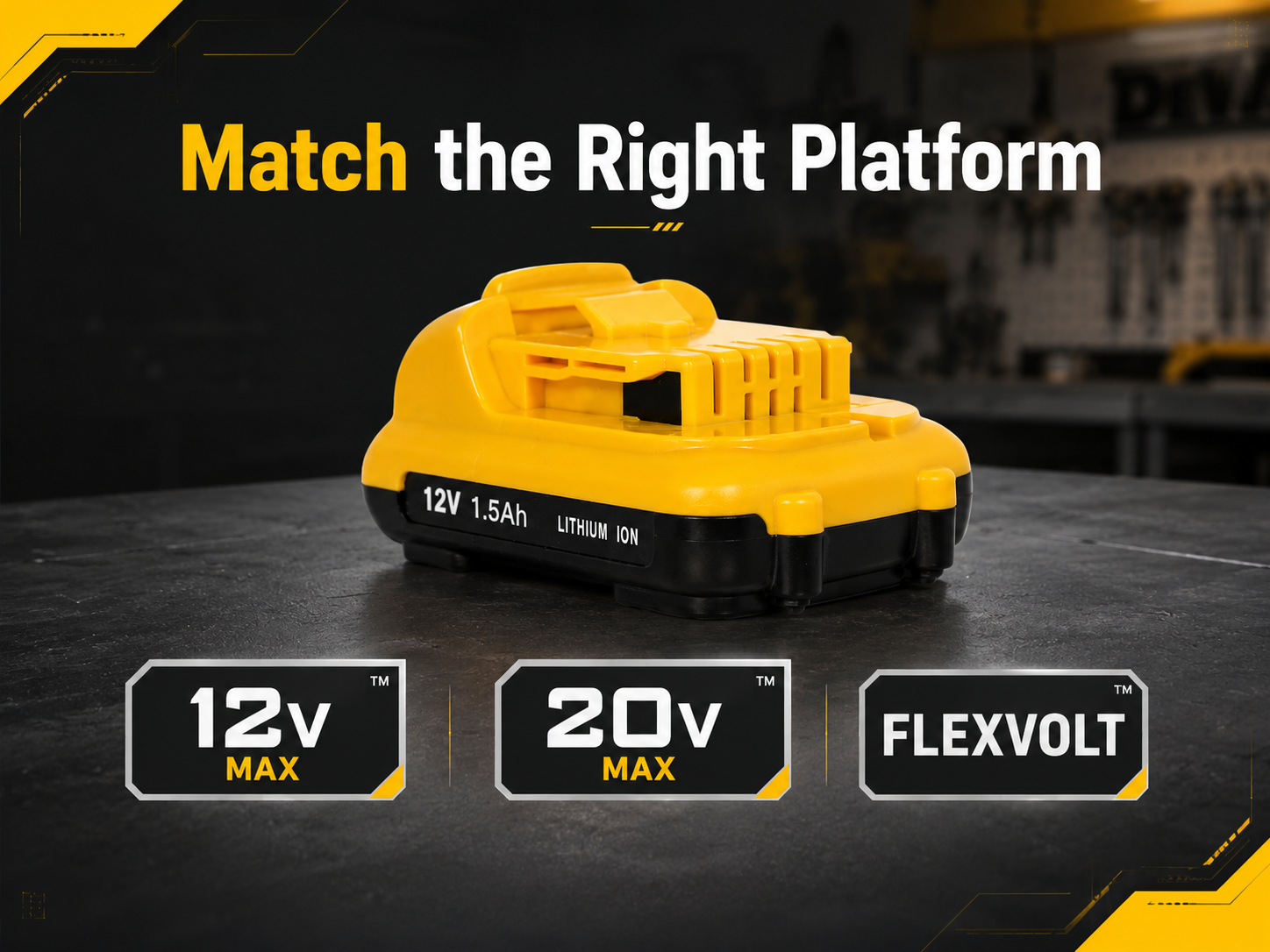
Electrical power in watts is governed by $P = V imes I$. To deliver 2,000 watts of mechanical work on a standard 18V battery platform, the pack must discharge over 110 amperes—generating massive heat and stressing wiring harnesses. By stepping up to a 36V or 40V platform (10S cell topology) or a 60V platform (15S cell topology), current demand is halved to 33–55 amperes, reducing thermal dissipation by 75% ($I^2R$ loss). Learn how to match voltage in our guide on matching battery voltage with power tool platforms.
Modern battery packs now incorporate automated series-parallel switching circuits (such as dual-rail 20V/60V systems) that mechanically and electronically sense whether the tool requires maximum amp-hour endurance at 20V or maximum peak torque at 60V.
3. Cross-Brand Battery Alliances vs Closed Proprietary Ecosystems
Direct Answer: The power tool industry is splitting between major closed proprietary ecosystems (e.g., DEWALT, Milwaukee, Makita) and multi-brand open battery alliances (e.g., Bosch AMPShare, Metabo CAS, Power for All Alliance), creating significant commercial opportunities for certified universal replacement battery suppliers.
Contractors working on modern jobsites rarely own tools from only one brand; plumbers, HVAC specialists, and general contractors routinely operate mixed tool inventories. Learn more about platform compatibility in our report on whether power tool batteries are interchangeable.
| Alliance / Ecosystem | Lead Manufacturer | Partner Brands Included | Strategic Focus |
|---|---|---|---|
| AMPShare Alliance | Bosch Professional | Fein, Rothenberger, Fischer, Wagner, etc. | Specialty MEP trades & industrial fasteners |
| Cordless Alliance System (CAS) | Metabo | Collomix, Starmix, Mafell, Rothenberger | Heavy construction, mixing, dust extraction |
| Power for All Alliance | Bosch Home & Garden | Gardena, Husqvarna, Flymo, Gloria | Residential DIY & lawn maintenance tools |
| Proprietary Closed Systems | DEWALT, Milwaukee, Makita | Dedicated single-brand platform | Total brand lock-in through custom keyed slots |
4. Regulatory Standards & ESG Traceability in 2026
Direct Answer: Global regulatory frameworks, including the EU’s New Battery Regulation (EU 2023/1542), now mandate digital battery passports, minimum recycled material quotas, and strict carbon footprint reporting for industrial battery packs sold across international borders.
Distributors and importers can no longer risk importing generic batteries lacking verified compliance files. Critical compliance standards for 2026 include:
- UN 38.3 Transport Certification: Verifying thermal shock, altitude simulation, vibration, 50g mechanical shock, external short circuit, impact/crush, overcharge, and forced discharge.
- UL 2054 & IEC 62133-2 Safety Standards: Ensuring pack enclosure flame retardance, drop resilience, and fail-safe BMS electronic shutdown.
- Supply Chain Traceability: End-to-end serial number logging linking every manufactured pack back to individual cell lot codes, production shifts, and automated weld logs.
- Digital Battery Passport Readiness: QR-code integration encoding chemistry type, nominal capacity, recycled cobalt/lithium content, and safe disposal protocols.
Frequently Asked Questions (FAQ)
Will 21700 cells completely replace 18650 cells in power tools?
Not entirely. While 21700 cells dominate medium and heavy-duty tool packs (4.0Ah to 8.0Ah), 18650 cells remain the preferred choice for ultra-compact, lightweight 12V and compact 18V/20V single-row packs (2.0Ah–2.5Ah) where minimal tool weight and slim handle profiles are paramount.
What is the advantage of a multi-voltage battery pack like FLEXVOLT?
Multi-voltage packs dynamically reconfigure internal cell groups: in a 20V tool, three 5-cell strings operate in parallel (5S3P) for maximum runtime; when plugged into a 60V heavy-duty tool, internal switches rewire the strings in series (15S1P) to output higher operating voltage.
How does GeB Power adapt to the 2026 market changes?
GeB invests continuously in advanced automated laser welding lines, high-rate tabless cell sourcing partnerships, and multi-protocol BMS firmware engineering, enabling distributors to source high-demand replacement packs that match evolving tool standards.
Looking for Reliable OEM/ODM Replacement Batteries for Your Tool Fleet?
As a professional lithium-ion battery manufacturer with over 16 years of engineering experience, GeB Power (General Electronics Technology Co., Ltd.) provides high-grade, direct-fit replacement battery packs and custom battery solutions for power tool distributors, fleet contractors, and equipment brands worldwide.
- Tier-1 High-Drain Cells: Premium 18650 and 21700 lithium cells for maximum discharge rate and prolonged runtime.
- Intelligent BMS Protection: Multi-layer circuitry preventing overcharge, over-discharge, short circuit, and thermal runaway.
- Global Certifications: Fully certified to CE, UL 2054, UN38.3, RoHS, and MSDS transport standards.
- Flexible MOQ & Fast Prototyping: Customized housing colors, labeling, private labeling (OEM), and fast-turnaround sampling.
Get a factory-direct quote or request evaluation samples today: Send your required voltage, capacity, tool models, and estimated order quantity to our engineering team at info@gebattery.co or submit your inquiry via our Request a Quote page.