What Battery Size Is Best for a Cordless Screwdriver?
For light household fastening, a compact 3.6V–4V lithium-ion cordless screwdriver with roughly 1.5–2.0Ah is usually enough. For longer screws, repetitive assembly, or more demanding work, a 12V platform with around 2.0Ah gives a better balance of capability, runtime, and weight. Larger 18V/20V batteries make more sense when the tool belongs to a broader cordless-tool platform.
The right choice depends on four things: voltage, battery capacity, physical size, and compatibility with the screwdriver and charger.

What Battery Size Is Best for a Cordless Screwdriver? A Quick Answer
Cordless screwdrivers cover a wide range, from small inline electric screwdrivers used for furniture assembly to compact pistol-grip tools used for repeated fastening. That is why one battery size does not fit every application.
A practical starting point is:
| Application | Typical Battery Class | Capacity Direction | Main Priority |
|---|---|---|---|
| Furniture assembly, hinges, electronics | 3.6V–4V | About 1.5–2.0Ah | Low weight and compact size |
| General household installation | 12V | Around 2.0Ah | Balanced runtime and capability |
| Repetitive assembly or longer screws | 12V | 2.0–4.0Ah | Longer runtime |
| Shared professional tool platform | 18V/20V | About 2.0–5.0Ah depending on the job | Battery sharing across tools |
3.6V–4V for Light Household Screwdriving
This is the natural range for compact electric screwdrivers used on flat-pack furniture, cabinet hinges, electronics, toys, and similar light fastening work.
These tools are usually designed around low weight and easy handling. Many use a built-in lithium-ion battery instead of a removable battery pack. A capacity around 1.5–2.0Ah is common in this type of design.
For occasional DIY work, there is usually little benefit in moving to a larger and heavier platform.
12V for More Demanding or Repetitive Fastening
A 12V cordless screwdriver or compact driver makes more sense when the job involves longer screws, repetitive assembly, shelving, cabinets, or more frequent daily use.
For most screwdriving work in this class, 2.0Ah is a very practical starting point. It keeps the tool compact while providing useful runtime. A 4.0Ah pack becomes more attractive when battery changes are inconvenient or the tool is used continuously.
For a real-world example, a 12V lithium-ion replacement battery available in several capacity options illustrates why the same voltage platform may be offered with different Ah ratings for different runtime requirements.
18V/20V When the Tool Shares a Larger Battery Platform
An 18V/20V platform can certainly handle screwdriving, but a dedicated screwdriver rarely needs that much battery.
Its main advantage is ecosystem compatibility. If the same battery also powers a drill, impact driver, circular saw, or other cordless tools, standardizing on one platform can simplify battery inventory and charging.
For a screwdriver-only application, however, the additional battery mass and bulk often bring limited benefit. Larger packs make more sense when the tool is part of a professional cordless system or when the same batteries must support heavier tools.
What Does “Battery Size” Actually Mean?
For cordless screwdrivers, battery size can refer to several specifications.
Voltage (V) describes the electrical platform the tool is designed around. Higher-voltage systems can support more demanding tool designs, but voltage alone does not determine screwdriving torque. Motor design, gearing, current capability, electronics, and mechanical efficiency also matter.
If you are evaluating a replacement battery, it is useful to first understand how battery voltage should match the power tool platform.
Capacity (Ah) tells you how much electrical charge the battery can store. In practical use, higher Ah usually means more runtime before charging.
Energy (Wh) combines voltage and capacity:
Wh = V × Ah
For example:
- 12V × 2.0Ah = 24Wh
- 18V × 2.0Ah = 36Wh
Two batteries with the same Ah rating can therefore store different amounts of total energy.
Physical dimensions and weight matter as well. A larger battery can make a screwdriver harder to balance, less convenient in tight spaces, and more tiring during one-handed or overhead work.
For cordless screwdrivers, battery size is both an electrical and an ergonomic decision.

How Much Battery Capacity Does a Cordless Screwdriver Need?
For most compact screwdriving applications, the useful range starts around 1.5Ah and extends to about 4.0Ah.
A 1.5–2.0Ah battery is well suited to short jobs, precision work, household repairs, cabinet hardware, and furniture assembly. It keeps the tool light and easy to control.
A 4.0Ah battery provides more runtime and can be valuable for repetitive fastening, installation work, or longer shifts. The tradeoff is additional battery mass and bulk.
For a deeper explanation of the relationship between Ah and operating time, see our guide to how power tool battery capacity affects runtime.
A practical reference test using standard #8 × 2-inch wood screws driven into pine gives an idea of how capacity can affect the number of fastening cycles:
| Battery | Approx. Screws per Charge |
|---|---|
| 12V 1.5Ah | 150–200 |
| 12V 2.0Ah | 250–350 |
| 12V 4.0Ah | 500–700 |
| 18V/20V 2.0Ah | 300–400 |
| 18V/20V 5.0Ah | 800–1,000 |
Continuous heavy driving can reduce these figures substantially. Screw length, material hardness, driving depth, tool efficiency, battery condition, and temperature all affect actual runtime.
Simple rule: higher Ah mainly gives you more runtime. It does not make screwdriving torque increase in direct proportion to capacity.
Runtime vs. Weight: Why a Bigger Battery Is Not Always Better
Cordless screwdrivers are frequently used with one hand, so battery weight has a direct effect on handling.
A 12V 2.0Ah pack may weigh roughly 0.4–0.5 lb, while a 12V 4.0Ah pack can be around 0.7 lb. A difference of 0.2 or 0.3 lb sounds small on a specification sheet, but it becomes more noticeable when installing cabinet hardware, working overhead, or driving dozens of fasteners in sequence.
A smaller-capacity pack usually makes more sense when:
- precision and balance matter;
- jobs are relatively short;
- the tool is used overhead or in tight spaces.
A larger-capacity pack is more useful when:
- work continues for long periods;
- fasteners are installed repeatedly;
- stopping to recharge or replace a battery interrupts production.
For a dedicated screwdriver, the practical goal is to carry enough battery for the work without adding unnecessary mass.
Built-In vs. Removable Batteries
Battery construction also changes what “best battery size” means.
Small 3.6V–4V cordless screwdrivers often use a built-in lithium-ion battery. In that case, the user does not choose between 2.0Ah and 4.0Ah packs after buying the tool. Capacity is already part of the product design.
A removable battery system, common on many 12V and larger platforms, provides more flexibility.
| Built-In Battery | Removable Battery |
|---|---|
| Compact and lightweight | Easy battery replacement |
| Common in small 3.6V–4V screwdrivers | Common in more capable cordless platforms |
| Capacity is usually fixed | Multiple Ah options may be available |
| Convenient for occasional use | Better suited to repetitive work |
| Battery aging affects the whole tool more directly | Battery can usually be replaced independently |
For light household use, an integrated battery is often the cleaner solution. For daily assembly or installation work, removable batteries reduce downtime and make it easier to maintain spare packs.
Intermediate-voltage products also exist. For example, GeB Power offers a 7.2V lithium-ion replacement battery for Makita cordless drill and screwdriver applications, illustrating how some compact cordless platforms sit between the small built-in screwdriver class and modern 12V removable-battery systems.

Can You Use a Bigger Battery in a Cordless Screwdriver?
Sometimes—but the word bigger needs to be separated into capacity and voltage.
Can You Use a Higher-Ah Battery?
A higher-capacity battery may be suitable when it belongs to the same verified battery platform and matches the electrical and mechanical requirements of the tool.
Moving from 2.0Ah to 4.0Ah within a compatible platform generally gives more runtime and more weight. It should not be treated as a way to change the screwdriver’s voltage class.
If you are unsure whether batteries within a platform can be exchanged, our power tool battery compatibility guide explains the main factors that determine interchangeability.
Can You Use a Higher-Voltage Battery?
Do not cross voltage platforms simply because two packs appear mechanically similar.
The screwdriver, battery electronics, charger, and power stage are designed around a defined voltage range. Battery voltage should match the platform specified for the tool.
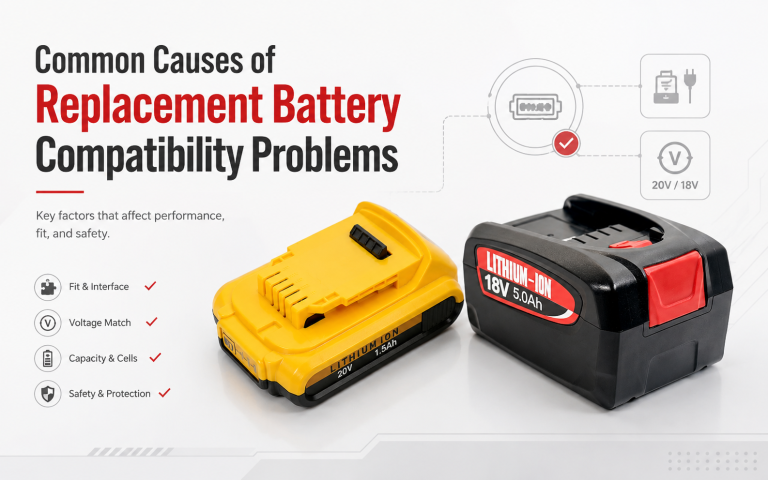
What Should You Check Before Buying a Replacement Battery?
A replacement battery should be checked against the complete tool system:
- original battery model;
- nominal voltage;
- screwdriver model;
- battery interface and physical fit;
- terminal or contact layout;
- charger model;
- required capacity.
The battery interface deserves particular attention. Two batteries can share a similar voltage rating while using different rail geometry, contact positions, electrical communication, or charger requirements. Our guide to power tool battery interfaces and contacts explains these compatibility details in more depth.
If the original battery label is still available, start by confirming its exact reference number. This guide to identifying the original power tool battery model number can help before comparing replacement options.
For a broader purchasing checklist, see how to choose the right replacement power tool battery.
How Should OEM/ODM Projects Choose a Cordless Screwdriver Battery?
An OEM/ODM screwdriver project needs a deeper battery selection process because voltage and Ah are only the starting specifications.
The engineering review should connect the battery to the actual duty cycle of the tool. Relevant inputs include:
- application and screw type;
- peak and continuous current;
- expected duty cycle;
- target runtime;
- nominal voltage;
- capacity target;
- enclosure space and weight;
- connector and interface requirements;
- protection requirements;
- thermal path;
- charging method;
- operating environment.
A screwdriver designed for intermittent household use may need a very different battery configuration from one intended for repetitive assembly in a workshop.
For projects that require custom electrical, mechanical, enclosure, protection, or validation work, GeB Power provides OEM/ODM battery engineering and project support covering application review, pack engineering, sample validation, and production handoff.
For this type of project, battery size should be derived from the application and load profile, then confirmed through engineering review and sample validation.

Bottom Line: Choose the Smallest Battery That Comfortably Handles the Job
For a compact cordless screwdriver used on furniture, hinges, electronics, and light household work, 3.6V–4V with roughly 1.5–2.0Ah is usually enough. For longer screws and repetitive fastening, 12V with around 2.0Ah is a strong balance of runtime, weight, and capability; 4.0Ah becomes useful when longer runtime matters more than compactness.
An 18V/20V platform makes more sense when the tool is part of a larger professional battery ecosystem.
The best battery size is the smallest compatible battery platform that can comfortably handle the workload while providing enough runtime without unnecessary weight.
GeB Power supplies compatible power tool replacement batteries and supports OEM/ODM battery-pack projects for distributors, brands, purchasing teams, and engineering teams. If you are evaluating a replacement battery or developing a cordless screwdriver battery project, contact GeB Power with the tool model, voltage, interface, workload, target capacity, and destination requirements so the project can be reviewed properly.
FAQ
Is a 4V Cordless Screwdriver Powerful Enough?
Yes, for light tasks such as furniture assembly, cabinet hinges, electronics, and small household fastening.
If the work involves longer screws, denser materials, or repetitive assembly, a 12V tool usually provides more useful capability.
Is a 12V Screwdriver Better Than a 4V Screwdriver?
It depends on the job.
A 12V platform usually supports more demanding fastening and provides more battery capacity options. A 4V screwdriver is lighter, more compact, and often easier to use for light precision work.
For a tool that spends most of its life assembling furniture or tightening hardware, the smaller platform can be the better choice.
Can I Replace a 3.6V Battery With a 4V Battery?
Do not decide from the voltage label alone.
Some compact lithium-ion tools use different voltage-labeling conventions, so the battery platform, manufacturer specification, charger, interface, and tool model should all be checked before substitution.
Does a Higher-Ah Battery Give a Screwdriver More Torque?
Not automatically.
Ah mainly affects battery capacity and runtime. Final torque depends on the complete electrical and mechanical design of the screwdriver, including the motor, controller, current capability, and gearing.
Should I Buy One Large Battery or Two Smaller Batteries?
For repetitive work, two moderate-capacity batteries can be more practical than one oversized pack.
One battery can stay on the tool while the other charges. This arrangement maintains working time without forcing the operator to carry the heaviest battery for every task.