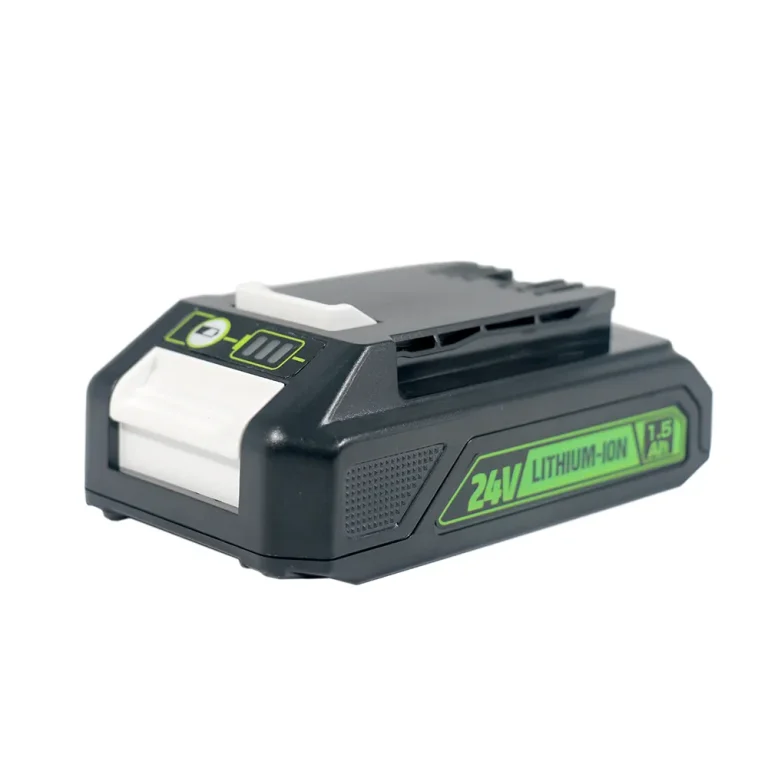
When Should an Impact Driver Battery Be Replaced?
An impact driver battery should be replaced when it can no longer provide dependable runtime or power, repeatedly fails to charge correctly, shuts down under normal load, or develops abnormal heat or physical damage. Battery age provides useful context, but actual performance is the stronger indicator.
For lithium-ion packs, gradual capacity loss is normal. What matters is whether that loss has become large enough to interfere with normal work—or whether the battery has developed a condition that makes continued use unsafe.

When Should You Replace an Impact Driver Battery?
For most users, replacement becomes reasonable when the battery consistently performs far below its previous baseline.
That may mean a pack that once handled a full fastening task now needs to be swapped halfway through, or a battery that shows a full charge but quickly loses power as soon as the impact driver is loaded. Repeated charging errors, premature shutdowns, and unusually slow charging also deserve attention.
Physical condition matters even more. Swelling, deformation, cracked housing, leakage, or persistent abnormal overheating are not ordinary signs of aging. A battery showing these conditions should be removed from service instead of being pushed through another job.
A useful way to think about replacement is simple: performance problems should be diagnosed; physical and thermal safety problems should be acted on immediately.
7 Signs Your Impact Driver Battery May Need Replacing
1. Runtime Has Dropped Significantly
Reduced runtime is usually the first sign users notice.
A lithium-ion battery gradually loses usable capacity as it ages. If the same impact driver, battery capacity, fastener type, and workload now require substantially more battery swaps than before, the pack has likely lost a meaningful part of its usable capacity.
One practical example is a battery that once lasted through an afternoon of work but later runs for only about 20 minutes of light use. That is an extreme case, but the principle is useful: compare the battery with its own past performance under similar conditions.
For professional use, workload is often a better benchmark than time alone. If a repetitive fastening job previously required two packs and now regularly requires three, that change is more informative than the battery’s calendar age.
If capacity selection is part of the problem, it also helps to understand how battery capacity affects runtime.
2. The Battery No Longer Holds a Charge
A battery can appear fully charged and still have very little usable capacity under load.
A common failure pattern is this: the charger indicates full charge, but the battery drops quickly once the impact driver starts driving screws or bolts. Another warning sign is abnormal self-discharge. If a fully charged pack sits unused for several days or a week and loses a large portion of its charge, the cells or battery-management system may no longer be healthy.
Healthy lithium-ion batteries do self-discharge, but a rapid loss of usable charge over a short idle period deserves further checking.
3. The Impact Driver Loses Power or Torque Under Load
Impact drivers make battery weakness easier to notice because fastening work can demand high current in short bursts.
A worn battery may still power the tool at light load, yet struggle when driving long screws, structural fasteners, or lag bolts. The tool may slow down, stall sooner than expected, or lose its normal percussion force.
A typical example is driving a long lag bolt into pressure-treated lumber. A pack that can no longer maintain voltage under that type of load may show obvious torque loss even when its fuel gauge still indicates remaining charge.
This does not automatically prove the battery is defective. The tool, contacts, or protection system can create similar symptoms. The next step is comparison testing with a known-good compatible battery.
4. The Battery Shuts Down Unexpectedly
Repeated shutdown under a workload the tool previously handled normally is another useful warning sign.
Lithium-ion tool batteries include protection circuits designed to respond to conditions such as excessive current, temperature, or cell voltage. As a battery ages, higher internal resistance and weaker cells can make protective shutdown occur earlier under load.
An isolated shutdown can come from overload or temperature protection. Repeated shutdowns with one battery, especially when another compatible battery works normally in the same tool, point more strongly toward the pack.
5. Charging Becomes Slow, Inconsistent, or Fails
Charging behavior often changes as a battery deteriorates.
Typical signs include:
- the charger repeatedly reports an error with one pack;
- charging takes noticeably longer than it used to;
- the charger stops before the battery delivers normal runtime;
- the battery appears full but performs poorly almost immediately.
Deep discharge, cell imbalance, damaged internal connections, temperature conditions, or battery-management faults can all affect charging behavior.
Do not use charging time by itself as a pass/fail rule. Charger design, battery temperature, pack capacity, and ambient conditions can all influence charging time.
6. The Battery Becomes Abnormally Hot
Some warmth during heavy use or charging is normal. Persistent abnormal heat is different.
A battery that becomes unusually hot during moderate work, repeatedly overheats while charging, or gets hot together with reduced runtime or premature shutdown should be taken out of demanding service and inspected.
Heat accelerates lithium-ion degradation, and severe overheating can indicate a more serious internal problem.
7. The Battery Is Swollen, Cracked, or Physically Damaged
This is the clearest case.
Swelling or bulging can indicate gas generation inside the cells. Cracks can expose internal components to moisture and debris. Damaged terminals can create poor electrical contact, resistance, arcing, and additional heat.
If the battery housing is swollen, visibly deformed, cracked, leaking, smoking, or giving off an unusual chemical smell, stop using it immediately.
A physically damaged lithium-ion pack should not be kept in service simply because it still powers the tool.

Is the Battery Really Bad? Check the Battery, Charger, and Impact Driver
Before replacing a battery for a performance problem, confirm that the battery is actually the weak point.
Compare With a Known-Good Compatible Battery
The most useful field test is often the simplest one.
Install another battery from the same compatible platform and, where possible, with similar capacity in the same impact driver. Use the tool for the same type of fastening work.
If the impact driver returns to normal power and runtime with the known-good pack, while the suspect battery repeatedly causes weak performance or early shutdown, the battery becomes the most likely cause.
This A/B comparison is more useful for many users than checking open-circuit voltage, because a worn battery can show a normal-looking voltage with no load and still collapse under high current demand.
Check the Charger and Battery Contacts
If the charger reports an error, try another known-good compatible battery in the same charger.
If other batteries charge normally, the suspect battery deserves closer attention. If several batteries show the same charging problem, inspect the charger before replacing all of them.
Also check accessible battery and tool contacts for contamination, corrosion, mechanical damage, or poor seating. Contact resistance can create voltage drop and heat that resemble battery weakness. For a deeper look at this part of compatibility, see power tool battery interfaces and contacts.
Test the Battery in Another Compatible Tool
If several tools use the same battery platform, place the suspect pack in another compatible tool.
If the same battery shows poor runtime or repeated shutdown across multiple tools, the evidence points more strongly toward the battery. If only one impact driver shows the problem, the tool itself may need attention.

How Long Does an Impact Driver Battery Usually Last?
Lithium-ion impact driver battery life is better understood through two types of aging.
Cycle aging is the wear caused by repeated charging and discharging. One full-equivalent cycle means using a total amount of energy equal to 100% of the pack’s capacity; several partial discharges can add up to one full-equivalent cycle.
Calendar aging occurs with time, even when the battery is not heavily used. Storage temperature and state of charge affect this process.
For many power tool batteries, noticeable degradation may begin after roughly 300–500 full-equivalent cycles, while some higher-quality packs used under favorable conditions may remain useful for 500–1,000 cycles.
In time-based terms, professional daily use may produce significant degradation in roughly 2–4 years, while moderate or occasional DIY use may allow 3–5 years or longer.
These are reference ranges, not automatic replacement deadlines.
A two-year-old battery used every day for high-torque fastening in hot conditions can be more worn than a four-year-old battery used occasionally and stored properly.
Why an Aging Battery Shows Up Quickly in an Impact Driver
An impact driver can expose battery weakness earlier than a lower-demand tool because high-torque fastening can require large current bursts.
As lithium-ion cells age, internal resistance generally increases. Under load, that causes a larger voltage drop. Engineers often refer to this as voltage sag: the battery may show normal voltage at rest but fall more sharply when current demand rises. Battery University provides a useful technical explanation of how rising internal resistance affects battery performance.
That is why an aging battery can appear acceptable in light use yet struggle during structural screw installation or repetitive high-torque fastening.
The user sees the effect as reduced torque, slower driving, inconsistent impact action, or premature shutdown.
This is also why a battery gauge is only part of the picture. Remaining charge and available power are related, but they are not the same measurement.
When Should You Stop Using the Battery Immediately?
Performance loss allows time for diagnosis. Physical damage and severe thermal abnormalities should be treated more urgently.
| Battery condition | Recommended response |
|---|---|
| Moderately shorter runtime | Compare performance and monitor |
| Weak power under load | Test with a known-good compatible battery |
| Repeated charging problem | Check both battery and charger |
| Persistent abnormal overheating | Stop using and inspect |
| Swelling or deformation | Stop using immediately |
| Cracked housing or damaged terminals | Stop using immediately |
| Leakage, smoke, or unusual chemical odor | Stop using immediately |
Do not puncture, open, force-charge, or deliberately heat or cool a damaged lithium-ion battery to test it. Once a pack is retired, follow the manufacturer’s handling guidance and applicable local requirements for used lithium-ion battery recycling and disposal.

How to Choose the Right Replacement Battery for Your Impact Driver
Once replacement is justified, compatibility comes first.
Confirm Compatibility Before Capacity
A replacement battery should be matched to the complete platform, not selected by voltage alone.
Check the:
- original battery model or reference;
- impact driver model;
- nominal voltage;
- battery platform;
- mechanical interface;
- terminal arrangement;
- charger model;
- electrical requirements.
Two batteries can carry similar voltage markings and still use different housings, contacts, communication systems, or charger requirements. Many replacement battery compatibility problems begin when buyers confirm voltage but do not fully verify the rest of the system.
If you are selecting a new pack specifically for fastening work, this guide on how to choose a replacement battery for an impact driver covers the model, platform, capacity, and workload questions in more detail.
GeB Power also organizes its Power Tool Replacement Batteries by compatible tool platform, helping buyers compare available replacement paths after the original battery and tool references are confirmed.
Choose Capacity for the Workload
After platform compatibility is confirmed, capacity becomes a practical selection variable.
A higher amp-hour rating generally means more stored energy and potentially longer runtime. Moving from a compatible 2.0Ah pack to a 4.0Ah or 5.0Ah option can reduce battery swaps during repetitive fastening work.
Capacity can also affect pack size and weight. A compact pack may be preferable for overhead work or short service jobs, while higher-capacity packs can be useful for repetitive structural fastening and longer production runs.
For example, buyers working on compatible Makita 18V platforms may compare an 18V 5Ah replacement battery for Makita power tools. For compatible DeWalt 20V MAX platforms, a 20V MAX 5Ah replacement battery represents another common capacity class.
The important point is that capacity upgrades must stay within the battery system’s electrical, mechanical, and charger compatibility requirements.
How Can You Make a New Impact Driver Battery Last Longer?
Battery life is strongly influenced by temperature, workload, charging behavior, and storage.
Avoid leaving batteries in hot vehicles, direct sunlight, or other high-temperature environments for long periods. Use a charger designed for the battery platform, and allow a pack that has become hot during heavy fastening work to cool before charging when required by the manufacturer’s instructions.
Repeated deep discharge also increases stress. Recharging before the pack is driven completely flat can help reduce unnecessary cycling stress.
For extended storage, a partial state of charge of roughly 40–60% is a practical reference range. Keep the battery in a cool, dry place and inspect the housing and terminals before returning it to service.
Clean contacts when necessary and protect the pack from drops, impacts, water, and conductive debris.
When Is It Time to Replace Your Impact Driver Battery?
Replace an impact driver battery when reduced runtime, weak performance under load, poor charge retention, repeated charging problems, or premature shutdown have become consistent enough to interfere with normal work. Swelling, cracking, leakage, or severe abnormal overheating are stronger signals: remove the battery from service immediately.
Useful battery life can vary from a few years of intensive professional use to considerably longer under lighter duty, so performance and condition remain the best guide.
GeB Power supplies compatible replacement power tool batteries and supports OEM/ODM battery projects for distributors, brands, purchasing teams, and engineering teams. For a specific impact driver platform, you can also review our battery supply, compatibility review, and OEM/ODM project support or contact us with the original battery model, tool and charger models, voltage, required capacity, quantity, and destination so the appropriate supply path can be reviewed.
FAQ
How do I know if my impact driver battery is bad?
Look for a consistent pattern: much shorter runtime, weak performance under load, poor charge retention, repeated charging problems, premature shutdown, abnormal heat, or physical damage.
For performance problems, compare the suspect battery with a known-good compatible pack before making the final decision.
Should I replace a battery just because it is 3 or 4 years old?
No fixed age automatically makes a battery unusable.
A three- or four-year-old battery that still provides stable runtime, normal charging, and adequate load performance may remain serviceable. A younger battery exposed to high heat, heavy cycling, or repeated high-current work may need replacement sooner.
Can a bad charger make a good battery look defective?
Yes.
If several compatible batteries show the same charging problem on one charger, the charger should be checked. If one battery repeatedly fails while others charge normally, the battery becomes the more likely cause.
Can I use a higher-Ah battery in my impact driver?
Yes, provided the battery is designed for the same compatible platform and meets the tool and charger requirements.
Higher Ah generally provides more available energy and longer potential runtime, but compatibility should be verified before capacity.
Can I use a compatible aftermarket replacement battery?
A properly engineered compatible replacement battery can be an option when the voltage platform, interface, terminals, charger requirements, electrical performance, and intended workload are correctly matched.
For buyers evaluating aftermarket options, the broader replacement power tool battery buyer’s guide explains the main selection factors beyond voltage and capacity.