Why Cordless Angle Grinders Need High-Discharge Batteries
Cordless angle grinders place unusually demanding loads on a battery pack. Cutting, grinding, and wheel binding can push current sharply higher within fractions of a second, while extended work keeps average current high for much longer. A suitable battery therefore needs enough stored energy, enough current-delivery capability, low electrical resistance, effective thermal control, and protection settings that match the tool’s real operating load.

Why Cordless Angle Grinders Put So Much Demand on a Battery
Angle grinders are among the more electrically demanding cordless power tools because their load changes quickly while the wheel is running at high speed.
A typical cordless grinder may operate around 8,500 to 10,000 RPM. Once the wheel contacts steel, rebar, masonry, or concrete, motor torque demand changes almost immediately. Press harder into the workpiece and current rises. Ease off and it falls. The battery therefore sees a repeating pattern of sustained load and short current transients rather than one steady discharge level.
Startup Current
During startup, the motor must accelerate the wheel from zero to operating speed. In demanding grinder applications, startup current can briefly rise to several times the normal running current, and high-power systems may experience short current spikes in the tens of amps or more.
The exact value depends on motor design, pack voltage, electronic control, wheel size, and tool platform. The engineering point is consistent: the battery must tolerate short periods of much higher current than the average operating load.
Load Changes During Cutting and Grinding
A grinder cutting thin sheet metal does not place the same load on a battery as a larger grinder working continuously on concrete. Accessory choice and operator pressure also matter. Excessive pressure or an unsuitable wheel can make the motor work harder and increase battery drain.
This is why battery requirements should be tied to the application, not inferred from voltage or capacity alone.
Wheel Binding and Peak Loads
When a wheel pinches or binds, motor current can rise very quickly before electronic protection reduces or interrupts power. Modern grinder systems use electronic safety functions for this reason, but the battery still has to survive the transient electrically and thermally.
For a high-load grinder, current delivery during these short events matters almost as much as average runtime.
What Does “High-Discharge Battery” Mean?
A high-discharge battery is a battery designed to deliver relatively high current safely while limiting voltage drop, heat generation, and excessive stress on the cells.
Three terms are especially useful.
Continuous Discharge Current
Continuous discharge current is the current a cell or battery pack can deliver for an extended period while staying within its specified voltage and temperature limits.
For a grinder, this matters during sustained cutting or grinding where the tool remains under load for many seconds or minutes.
Peak or Pulse Current
Peak current is a higher current level that the battery can tolerate for a short duration.
Startup, sudden contact with dense material, and wheel binding can all create short pulse loads. A battery that handles the average current but cannot tolerate these peaks may trip protection or experience excessive voltage sag.
C-Rate
C-rate expresses current relative to battery capacity.
For example, a 2.0Ah cell rated at 10C corresponds theoretically to:
2.0Ah × 10C = 20A
A 2.0Ah cell rated at 3C corresponds to 6A.
This makes C-rate useful when comparing cells, but it is only one part of battery-pack performance. A complete cordless grinder battery also depends on parallel cell count, BMS limits, terminal resistance, weld quality, conductor size, temperature, and enclosure design.
For high-load applications, packs such as a 40V 10C high-discharge 21700 power tool battery pack illustrate how voltage, cell format, capacity, and discharge rate are combined at pack level rather than treated as isolated specifications.

Why Higher Ah Does Not Automatically Mean More Grinder Power
Amp-hours describe charge capacity. They are useful for estimating how much energy a battery can store, but they do not directly state how much current the pack can deliver under a heavy grinder load.
A practical way to read battery specifications is:
| Battery Parameter | What It Mainly Tells You |
|---|---|
| Voltage | Electrical platform |
| Ah | Charge capacity |
| Wh | Stored energy |
| Continuous discharge current | Sustained current capability |
| Peak current | Short-duration output capability |
| Internal resistance | Voltage drop and heat under load |
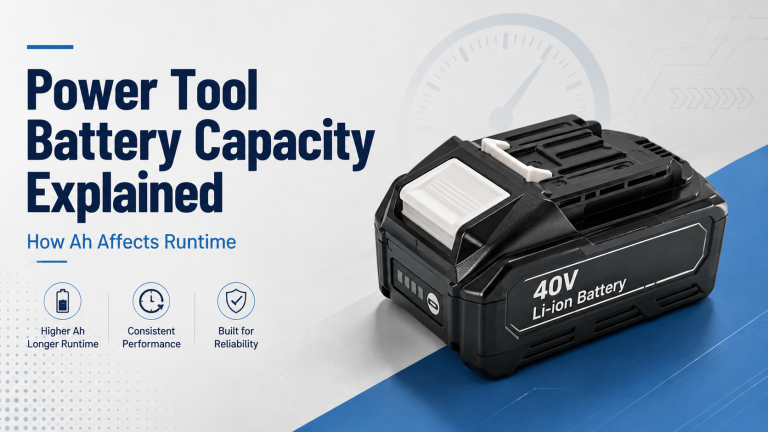
In comparable systems, a higher-Ah pack generally offers longer potential runtime because it stores more energy. For a deeper explanation of this relationship, see our guide to power tool battery capacity and how Ah affects runtime.
But two batteries with the same Ah rating can behave very differently on a grinder if one uses lower-resistance cells, stronger current paths, a higher BMS current limit, or more effective cooling.
There is one important nuance. A larger-capacity pack may also deliver more power when the extra capacity comes from additional cells connected in parallel. The load is shared among more cells, reducing current per cell and lowering effective pack resistance.
So Ah and power can be related through battery architecture. The Ah number itself does not tell the whole story.
Voltage Sag and Heat: What Happens When a Battery Cannot Keep Up
Two basic electrical relationships explain much of what users experience when a grinder battery is overloaded.
The first is voltage drop:
Voltage drop ≈ Current × Resistance
Assume, for illustration, that the total resistance through the cells, welds, terminals, conductors, and contacts is 0.05Ω.
At 20A:
Vdrop ≈ 20 × 0.05 = 1V
At 60A:
Vdrop ≈ 60 × 0.05 = 3V
The current triples, and the voltage loss also triples.
That matters because a grinder may still have plenty of stored energy while the battery voltage under load temporarily falls low enough to trigger an undervoltage threshold or cause the tool to lose speed.
Why Heat Rises So Quickly
Resistive heating follows another useful relationship:
Power loss ≈ I²R
Using the same 0.05Ω example:
- At 20A, resistive loss is about 20W.
- At 60A, resistive loss is about 180W.
The current has increased threefold, but the resistive heat has increased about ninefold.
That is why low internal resistance becomes so important in high-current power tool batteries.
Why a Grinder Can Stop While the Battery Still Shows Charge
State of charge and available power under load are different measurements.
A pack may show remaining charge when the trigger is released. Under heavy grinding load, however, voltage can sag sharply. If pack voltage falls below a protection threshold, or if current or temperature exceeds a defined limit, the BMS or tool electronics may cut power.
Once the load is removed, battery voltage can recover. To the user, the pack appears to “have charge but not run the grinder.”
That symptom does not automatically mean the battery is defective. It can indicate a mismatch between the pack’s discharge capability and the tool’s load.

A High-Discharge Grinder Battery Is a Pack-Level Design
High-rate cells matter, but real grinder performance depends on the complete battery pack.
Cell Selection and Pack Configuration
Cell discharge capability, internal resistance, capacity, and temperature behavior all need to match the application. Series connections establish voltage, while parallel connections increase capacity and share current.
For high-load tools, the parallel arrangement can significantly affect current per cell and pack heating. A pack such as an 18V 21700 10C custom power tool battery is a useful example of how cell format, series-parallel structure, capacity, and discharge capability are considered together.
BMS and Protection Limits
The battery management system typically supervises conditions such as:
- overcurrent,
- undervoltage,
- over-discharge,
- overtemperature.
Protection thresholds need to protect the pack while still allowing normal startup and transient loads.
A BMS that is too restrictive for the intended grinder may trip during normal work. Poorly chosen protection limits can create the opposite problem by allowing excessive electrical or thermal stress.
Current Paths and Thermal Design
Current must pass through welds, bus conductors, terminals, connectors, and tool contacts before it reaches the motor. Every part adds some resistance.
Thermal design matters for the same reason. Sustained heavy discharge produces heat inside the cells and current path. Cooling paths, cell spacing, enclosure materials, and internal construction determine how quickly that heat can leave the pack.
For buyers developing an application-specific pack, these variables are normally reviewed together during battery engineering and OEM/ODM project development, including application load, discharge current, voltage, cell configuration, protection, terminals, connectors, and thermal path.
How Major Power Tool Platforms Handle High Grinder Loads
Different power tool systems solve the high-current problem in different ways. The useful lesson is in the engineering approach.
Higher Voltage: DeWalt FLEXVOLT
Higher system voltage reduces current for the same power requirement.
The relationship is straightforward:
Power ≈ Voltage × Current
For a simplified 1,000W load:
| Nominal Voltage | Ideal Current at 1,000W |
|---|---|
| 20V | 50A |
| 40V | 25A |
| 60V | 16.7A |
Actual current varies with efficiency, battery voltage under load, and control electronics, but the trend is clear.
DeWalt’s FLEXVOLT platform uses a battery architecture that can operate at different voltage configurations depending on the tool. This is one way of reducing the current required for a given power level.
At the 20V end of the market, a 20V MAX 6.0Ah 21700 replacement battery for DeWalt tools shows another route: increasing pack capability through cell format and pack design within a familiar platform voltage.
Lower Resistance: Makita XGT
Makita’s 40V max XGT platform combines higher voltage with high-power cell design and tool-to-battery communication.
The platform also uses 21700-class cells and, in newer high-power packs, tabless construction. Tabless architecture gives current more conductive paths through the cell, which can help reduce internal resistance and heat under high current.
For buyers working with Makita-compatible platforms, GeB Power also maintains a dedicated range of Makita compatible batteries covering different voltage and capacity requirements.
Thermal Management: Bosch ProCORE18V
Bosch uses another approach with ProCORE18V, combining high-output cells with dedicated thermal-management features.
The broader engineering lesson is more important than any one brand implementation: higher voltage, lower resistance, improved current paths, and better heat removal all address the same problem from different directions.
How to Choose a Battery for a Cordless Angle Grinder
For replacement battery selection or an OEM/ODM grinder battery project, start with the tool and its actual application.
Confirm:
- nominal voltage and original battery reference,
- grinder model and wheel size,
- charger model,
- mechanical interface and terminal layout,
- expected cutting or grinding load,
- continuous and peak current requirement,
- target capacity and runtime,
- working temperature,
- BMS and protection requirements.
Voltage is the first screening step, so it is worth reviewing how to match battery voltage with a power tool platform before moving into current capability and runtime.
Mechanical fit and electrical contact geometry are just as important. Our guide to power tool battery interfaces and contacts explains why two packs with the same nominal voltage may still be incompatible.
A compact 4-1/2-inch grinder used for intermittent sheet-metal cutting has a different load profile from a large grinder used continuously on concrete. Operator pressure, accessory selection, and duty cycle change the battery requirement further.
For buyers comparing catalog products, the Power Tool Replacement Batteries category provides a starting point. If the existing platform is already known, our broader guide to choosing the right replacement power tool battery can help organize the required compatibility and performance checks.

Common Signs That a Grinder Battery Cannot Deliver Enough Current
A few field symptoms often point toward battery-output limitations, although the tool, accessory, motor, or mechanical load should also be checked.
| Symptom | Possible Battery-Related Cause |
|---|---|
| Grinder starts, then immediately stops | Startup voltage sag or protection threshold reached |
| RPM falls during a heavy cut | Insufficient current delivery or excessive pack resistance |
| Battery becomes very hot | High current and resistive heating |
| Battery runs a drill but struggles on a grinder | Pack may suit lower-load tools but lack grinder-level output |
| Repeated shutdown under load | Overcurrent, undervoltage, or thermal protection |
| Runtime drops sharply during heavy work | High average power demand, heat, or battery aging |
If a replacement pack fits physically but behaves unpredictably, it is also worth checking the common causes of replacement battery compatibility problems, especially voltage, terminals, charger requirements, and platform-specific communication.
The Battery Has to Match the Load
Cordless angle grinders need high-discharge batteries because their electrical demand is both high and dynamic. Startup, hard cutting, sustained grinding, and binding events can create current levels that expose weak cells, high resistance, inadequate thermal design, or unsuitable protection settings very quickly.
The right battery combines adequate energy capacity with the current capability and pack engineering needed to deliver that energy under load.
GeB Power supplies compatible replacement power tool batteries and supports OEM/ODM battery-pack development for global distributors, brands, procurement teams, and engineering teams. If you are evaluating a grinder battery platform, replacement pack, or custom high-discharge battery project, contact us with the tool model, voltage, application, target capacity, and expected load so the project can be reviewed against the actual working conditions.
FAQ
Does a higher Ah battery make an angle grinder more powerful?
Sometimes, but not automatically. A higher-Ah pack may provide more power when it uses more parallel cells or stronger high-rate cells. Actual output still depends on cell capability, resistance, BMS limits, current paths, and thermal design.
Why does my grinder stop when the battery is not empty?
Heavy current demand can cause temporary voltage sag or trigger overcurrent or thermal protection before the battery reaches a low state of charge.
Is a 21700 battery always better than an 18650 battery?
No. A 21700 format can provide advantages in cell volume and pack architecture, but cell chemistry, internal resistance, discharge rating, manufacturing quality, and pack design are more important than diameter by itself.
Can I use any high-discharge battery with my angle grinder?
No. The pack must also match voltage, electrical interface, terminal layout, mechanical fit, tool communication requirements, and charger compatibility.
Is a bigger battery always better for heavy grinding?
A larger pack can improve runtime and may reduce current stress per cell if it contains more parallel cells. For heavy grinding, the better choice is the pack whose discharge capability, BMS, thermal behavior, and electrical interface are suited to the grinder’s real load.