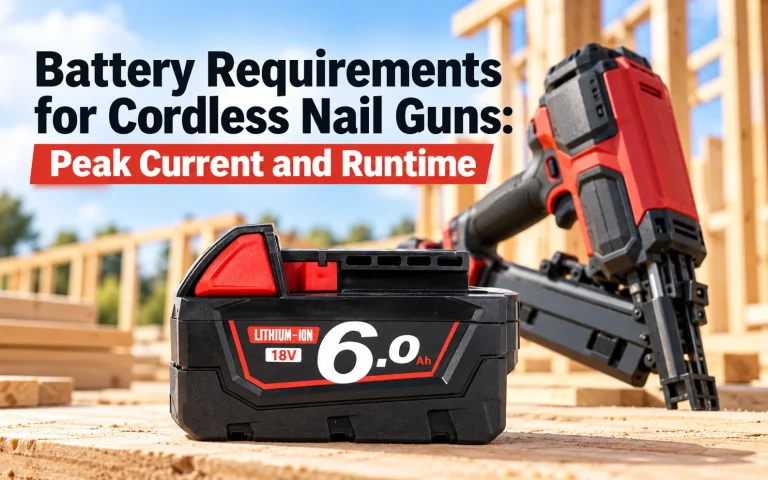
Why Cordless Impact Drivers Need the Right Battery for Peak Power
Impact drivers are the workhorses of modern construction and assembly. They deliver rotational bursts — short, high-torque impulses — that drive long screws and lag bolts into hardwood and metal without the wrist-wrenching kickback of a standard drill.
But here is the catch: every one of those bursts demands a massive, instantaneous surge of current from the battery. If the battery cannot deliver that surge, the tool never reaches its rated torque, no matter how powerful the motor is.
That makes the cordless impact driver battery a critical part of the tool’s overall power-delivery chain.
The battery is not just a fuel tank — it is the engine’s throttle.
A cordless impact driver rated at, say, 180 N·m of peak torque can only hit that number if the battery pack sustains discharge currents in the range of 30 to 80 amps during each impact strike. When the cell chemistry, pack configuration, or BMS (Battery Management System) is mismatched to the tool’s draw, the driver starves.
The result: sluggish fastening, incomplete drives, premature thermal shutdowns, and shortened cell life.
For distributors, brand owners, and procurement teams sourcing power tool replacement batteries or commissioning OEM/ODM battery packs, understanding this power-delivery chain is the difference between a product that performs and one that disappoints the end user.

What “Peak Power” Really Means for an Impact Driver
Torque Is a Function of Current, Not Just Voltage
An impact driver’s brushless motor converts electrical energy into rotational force. The relationship is straightforward: more current through the motor windings means more magnetic field strength, which means more torque.
The tool’s internal controller modulates this current, but it can only work with what the battery provides.
| Parameter | What It Means | Why It Matters for Impact Drivers |
|---|---|---|
| Voltage (V) | Nominal pack voltage, e.g. 18V or 20V | Determines motor speed ceiling and overall power potential |
| Capacity (Ah) | Total energy stored | Determines runtime — how many screws per charge |
| Discharge rate (C-rating) | How fast the pack can release energy | Determines peak current — whether the tool hits rated torque |
| Internal resistance (mΩ) | Resistance to current flow | Lower resistance = less voltage sag under load = more usable power |
Most buyers focus on battery voltage and capacity — the two numbers printed prominently on the battery label.
But for an impact driver battery, the battery C-rate and discharge capability and internal resistance are the parameters that often decide whether the tool performs at full strength or falls short.
If you want a deeper explanation of how amp-hour ratings affect operation time, see this guide to power tool battery capacity and Ah.
The Voltage Sag Problem
When an impact driver fires, it draws a sharp current spike lasting a few milliseconds per strike, repeating hundreds or thousands of times per minute.
If the battery’s internal resistance is too high, each spike causes the terminal voltage to momentarily drop — a phenomenon called voltage sag. The motor sees less voltage, produces less torque, and the tool underperforms.
A pack built with low-discharge cells might show 20V on a multimeter at rest, but under a 50-amp impact load, the voltage at the motor terminals can collapse to 14V or lower.
The tool’s controller may interpret this as a low-battery condition and cut power prematurely — even when the pack still holds plenty of charge.
Engineering Lab Data: Impact Driver Instantaneous Current Surges & Voltage Response
Unlike continuous motors, cordless impact drivers subject battery cells to sharp hammering cycle pulses (≤10 milliseconds duration, up to 3,600 impacts per minute). The GeB Power Engineering Lab evaluated pulse voltage dips across typical battery pack configurations under repetitive 35A anvil engagement cycles:
| Pack Configuration | Internal AC Resistance (1kHz) | Impact Pulse Sag (35A Pulse) | Recovery Time (τ) | Impact Frequency Stability (IPM) |
|---|---|---|---|---|
| 18V 2.0Ah (5S1P 18650) | 32 mΩ ± 2mΩ | ΔV = 1.85 V | 4.2 ms | 91.2% nominal IPM |
| 18V 3.0Ah (5S1P High-Capacity) | 28 mΩ ± 2mΩ | ΔV = 1.55 V | 3.5 ms | 94.5% nominal IPM |
| 18V 5.0Ah (5S2P Standard Dual) | 16 mΩ ± 1.5mΩ | ΔV = 0.88 V | 1.8 ms | 99.2% nominal IPM |
| 18V 6.0Ah (5S2P 21700 High-Output) | 12 mΩ ± 1.0mΩ | ΔV = 0.62 V | 1.2 ms | 99.8% nominal IPM |
Cell Selection: The Foundation of Peak Power
18650 vs 21700: More Than Just Size
The two dominant cylindrical cell formats in power tool batteries are the 18650 (18mm diameter, 65mm length) and the 21700 (21mm diameter, 70mm length).
The 21700 format has become a preferred option for many high-drain applications such as cordless impact drivers.
| Factor | 18650 | 21700 |
|---|---|---|
| Typical capacity | 1.5–3.0 Ah | 3.0–5.0 Ah |
| Max continuous discharge | Up to ~20–30A per cell | Up to ~30–45A per cell |
| Internal resistance | Generally higher | Generally lower |
| Thermal mass | Smaller, heats faster | Larger, more thermally stable |
| Energy density per cell | Lower | ~20–30% higher |
The larger 21700 cell offers a bigger electrode surface area, which translates to lower internal resistance and higher sustained discharge currents.
For an impact driver that repeatedly demands 40–60 amp bursts, this means less heat buildup, less voltage sag, and more usable torque across the full discharge cycle.
A 20V 21700 lithium battery for cordless power tools is one example of how larger cylindrical cells can be used in a high-output power-tool battery platform.
High-Drain Cell Chemistry Matters
Not all lithium-ion cells are created equal. The chemistry and internal design of the cell determine its discharge capability:
- INR (Li-NiCoMn / NMC) hybrid cells — A common choice for power tools. They balance energy density with high discharge rates. Quality cells from established manufacturers can sustain 20–30A continuous discharge with peak bursts well above that.
- IMR (Li-MnO2 / LMO) cells — Very high discharge rates but lower capacity. Sometimes used in ultra-high-drain applications where runtime is secondary to peak power.
- ICR (Li-CoO2 / LCO) cells — High capacity but low discharge rate. Unsuitable for impact drivers because they cannot deliver the current spikes without overheating and degrading rapidly.
For OEM/ODM battery projects, specifying the exact cell model — not just the format — is critical.
Two 21700 cells from different manufacturers can have a 2× difference in continuous discharge capability. A pack that works fine in a low-current application can fail dramatically in a cordless impact driver.
For projects where compact size and high-current output must be balanced, an 18V high-drain power tool battery can also provide a useful reference point.
Pack Configuration: Series, Parallel, and the Current Equation
S and P: More Than a Label
A typical 18V/20V power tool battery is a 5S configuration — five cells in series, each at a nominal 3.6–4.0V, yielding 18–20V nominal.
The parallel count (P) determines both battery capacity and current capability.
| Configuration | Nominal Voltage | Typical Capacity | Max Discharge, per cell ~30A | Typical Application |
|---|---|---|---|---|
| 5S1P | 18V | 2.0–3.0 Ah | ~30A | Compact drivers, light-duty |
| 5S2P | 18V | 4.0–6.0 Ah | ~60A | Standard impact drivers |
| 5S3P | 18V | 6.0–9.0 Ah | ~90A | Heavy-duty impact wrenches |
| 5S4P | 18V | 8.0–12.0 Ah | ~120A | Professional / industrial use |
Key insight: adding parallel cells does not just increase runtime — it multiplies the pack’s current-delivery capability.
A 5S2P pack with 30A cells can deliver roughly 60A, which is the sweet spot for most 18V impact drivers. A 5S1P pack with the same cells tops out at approximately 30A — enough for a drill or driver in light use, but marginal for repeated high-torque impacts.
This is why a 2.0Ah battery and a 4.0Ah battery with identical cells can behave so differently in the same impact driver.
The 4.0Ah pack, typically using a 5S2P configuration, has twice the current headroom, meaning less voltage sag, more torque, and cooler operation — not just longer runtime.
In other words, higher Ah does not automatically mean more power, but pack configuration can make capacity and high-current capability closely related in some battery designs.
For a concrete example of this architecture, see this 18V 5S2P 21700 high-discharge battery pack.

The BMS: Guardian or Bottleneck?
What a Good BMS Does
The Battery Management System is the electronic brain of the battery pack. Its core functions include:
- Over-current protection — Cuts discharge if current exceeds a safe threshold.
- Over-voltage / under-voltage protection — Prevents cells from being charged above 4.2V or discharged below approximately 2.5V.
- Short-circuit protection — Instantly disconnects on a hard short.
- Temperature monitoring — Shuts down if cells exceed the safe operating range, typically around a 60–70°C discharge limit.
- Cell balancing — Keeps all series cells at the same voltage during charging.
For a high-current cordless power tool battery, the BMS must protect the battery pack while still allowing the current required by the intended workload.
When the BMS Becomes the Bottleneck
A well-designed BMS protects the pack without strangling performance. But a poorly matched BMS can become the limiting factor.
| BMS Issue | Symptom in the Tool | Root Cause |
|---|---|---|
| Over-current threshold too low | Tool shuts down mid-drive, resets after a few seconds | BMS trips at 30A when the tool needs 50A |
| Slow protection response | Voltage sag before cutoff, sluggish performance | BMS uses slow MOSFET switching or high-resistance current-sense resistor |
| Inadequate thermal management | Thermal shutdown after 10–15 fasteners | BMS trips on temperature from its own heat, not cell temperature |
| No cell balancing | Pack capacity drops after 50–100 cycles | Cells drift out of balance, one cell hits low-voltage cutoff early |
For replacement battery manufacturers and OEM/ODM battery development projects, the protection system must be reviewed against the tool’s actual power profile, not just a generic specification.
An impact driver’s pulsed load looks very different from the steady draw of a low-current application.
Thermal Management: Heat Is the Silent Killer
Why Impact Drivers Punish Batteries
Impact drivers are uniquely demanding on batteries because of their duty cycle.
A professional tradesperson driving structural screws or lag bolts may fire the tool continuously for 30–60 seconds at a time, with hundreds of impact strikes per session.
Each strike is a current pulse, and the cumulative heat in the cells builds rapidly.
Lithium-ion cells degrade faster at elevated temperatures. The generally accepted guideline is that cell life roughly doubles for every 10°C reduction in operating temperature within the normal range.
A pack that regularly operates at 55°C will age significantly faster than one kept at 35°C.
For additional background, see this technical discussion of lithium-ion battery temperature and service life.
Pack-Level Thermal Design
Good replacement and OEM/ODM battery packs address heat through several design elements:
- Cell spacing and airflow channels — Allow convective cooling between cells.
- Thermal interface materials — Conduct heat away from cells to the pack housing.
- Temperature sensor placement — The BMS thermal sensor must be positioned where it can accurately detect critical cell temperatures.
- Housing material and design — Some battery packs use thermally conductive materials or structural elements to shed heat faster.
A pack that runs cooler delivers more sustained torque, trips thermal protection less often, and lasts more charge cycles — all of which translate to better end-user satisfaction and fewer warranty claims.
Compatibility: The OEM/ODM Challenge
Pin Mapping and Communication Protocols
Modern cordless tool batteries are not just power sources — many contain electronics that interact with the tool and charger.
Depending on the platform, battery compatibility may involve several factors:
- Data pin configuration — The battery connector may include power terminals plus data or thermistor pins. The pin layout and required signals must match the intended tool platform.
- Tool identification — Some systems require the battery, tool, or protection electronics to exchange specific signals before normal operation.
- Charge protocol matching — The charger must also be compatible with the battery’s electrical and protection requirements.
For a replacement power tool battery, physical fit alone is therefore not enough.
Battery compatibility should be reviewed against the original battery reference, voltage platform, terminal arrangement, interface geometry, intended tool model, charger requirements, and electrical load.
For a more detailed explanation of the physical connection side of compatibility, see power tool battery interfaces and contacts.
For OEM/ODM projects, these requirements should be defined during the application and pack-engineering stages before sample approval or production handoff.
Mechanical Fit and Latch Compatibility
Beyond electronics, the physical interface matters:
- Rail dimensions and tolerances — The battery must slide onto the tool with appropriate friction. Too loose and it may disconnect under vibration; too tight and it may jam.
- Latch mechanism — The retention latch must engage positively and release cleanly.
- Contact material and spring force — Contacts must maintain low resistance under vibration and repeated insertion cycles. Poor contact pressure can create resistance hotspots that waste power and generate heat.
For buyers evaluating compatible batteries, mechanical compatibility and electrical compatibility should always be reviewed together.
It is also useful to understand the common causes of replacement battery compatibility problems before approving a new replacement model.
Safety and Certification: Non-Negotiable for B2B
IEC 62133 and UN 38.3
Any battery sold into global markets must carry the appropriate safety certifications.
| Standard | Scope | What It Tests |
|---|---|---|
| IEC 62133-2 | Product safety, in-use | Overcharge, short circuit, thermal abuse, mechanical abuse, free fall |
| UN 38.3 | Transport safety | Eight tests including altitude simulation, thermal cycling, vibration, shock, external short circuit, impact/crush, overcharge, and forced discharge |
The IEC 62133-2 safety requirements for portable lithium-ion batteries are widely used as a reference framework for portable rechargeable battery safety.
UN 38.3 applies to the transport testing of lithium batteries and is an important part of shipment preparation for international logistics.
For OEM/ODM customers, certification and testing documents should be reviewed against the exact battery model, configuration, destination market, and shipping route rather than assumed from a similar product.
Additional Market-Specific Requirements
Depending on the target market, additional certifications may apply:
- UL 1642 / UL 2054 — North American cell and pack safety standards
- PSE — Japan market electrical safety
- KC — South Korea certification
- CB Scheme — International Electrotechnical Commission mutual recognition system
- MSDS / Safety Data Sheet — Commonly included in battery safety and shipping documentation
For B2B sourcing, document scope should be reviewed for the specific battery model, configuration, destination market, and transport plan.

Choosing the Right Battery Partner
What to Look For in an OEM/ODM Battery Supplier
For B2B buyers evaluating a replacement battery or custom battery pack manufacturer, the technical capability checklist extends well beyond price.
| Criterion | What to Verify |
|---|---|
| Cell sourcing | Are cells from established manufacturers with traceable lot codes? |
| BMS design | Is the protection system appropriate for the target tool’s load profile, or simply a generic off-the-shelf board? |
| Compatibility testing | Has the pack been evaluated with the intended tool and charger rather than relying only on physical fit? |
| Certification status | Are the applicable test reports current and valid for the specific pack model? |
| Quality system | Are incoming materials, assembly, in-process inspection, and final battery testing controlled? |
| Sample program | Can the supplier provide samples for the buyer’s own tool and charger testing before production approval? |
| Production capacity | Can the project move from sample validation into repeatable volume production? |
Before selecting a supplier, buyers should also verify that the battery platform and nominal voltage are correctly matched. This guide to matching battery voltage with your power tool explains why the voltage label alone is not enough to confirm full compatibility.
The GeB Power Approach
GeB Power is a Shenzhen-based B2B manufacturer of compatible replacement power tool batteries and an OEM/ODM battery project partner serving global distributors, brand customers, procurement teams, and engineering teams.
For cordless impact driver battery and other power tool battery projects, the review process starts with the intended application rather than a generic pack specification.
Typical project inputs include:
- Tool model and voltage platform
- Original battery reference
- Application and working load
- Required capacity and discharge requirements
- Battery interface and terminal arrangement
- Charger model and compatibility
- Enclosure and mechanical fit
- Protection and thermal requirements
- Order quantity and destination market
- Required certificates and shipping documents
For OEM/ODM development, these inputs can then move through application review, battery pack engineering, sample validation, and production handoff.
GeB Power’s cordless impact driver battery solutions and OEM/ODM project support are structured around connecting battery compatibility, electrical requirements, mechanical fit, sample expectations, manufacturing requirements, and documentation in the same project workflow.
Practical Takeaways for B2B Battery Buyers
If you are sourcing replacement batteries or commissioning custom battery packs for cordless impact drivers, focus on these decision points:
| Decision | Key Question | Wrong Answer |
|---|---|---|
| Cell format | Is the cell rated for the tool’s peak current? | “It’s 21700, so it must be good enough.” |
| Pack configuration | Does the parallel count provide enough current headroom? | “2.0Ah is lighter and cheaper, ship that.” |
| BMS tuning | Is the over-current threshold above the tool’s peak draw? | “30A cutoff is standard, use that.” |
| Thermal design | Will the pack survive a professional duty cycle? | “It passed one cycle on the test bench.” |
| Compatibility | Has the pack been tested on the actual target tool? | “The connector fits, so it should work.” |
| Certification | Are the test reports current and model-specific? | “We have a report from a similar pack.” |
The right battery does not just power an impact driver — it unlocks the tool’s full performance, protects the user, and stands up to the demands of professional use.
The wrong battery turns a 180 N·m driver into a 120 N·m driver, shuts down after 15 fasteners, and ages out in 100 cycles instead of 500.
For distributors and brand owners, the battery is the component your customer touches every single day. It is worth getting right.
For a more purchase-focused checklist, see this guide to choosing a replacement battery for an impact driver.
Conclusion
A cordless impact driver needs the right battery because peak performance depends on much more than nominal voltage or capacity. High-current cell capability, low internal resistance, suitable pack configuration, thermal control, BMS protection, and correct electrical and mechanical compatibility all determine whether the tool can deliver its intended power under repeated impact loads.
For B2B buyers, the key takeaway is simple: the best cordless impact driver battery is not merely the one that fits — it is the one whose electrical, mechanical, thermal, and protection characteristics match the target tool and workload.
As a replacement power tool battery manufacturer, GeB Power supplies compatible replacement batteries and supports application-specific OEM/ODM battery projects for global distributors, brand customers, procurement teams, and engineering teams. Contact GeB Power to discuss your target tool platform, battery requirements, sample validation needs, or a specific impact driver battery project.
FAQ
Does a Higher Ah Battery Make an Impact Driver More Powerful?
Not automatically.
Battery capacity in amp-hours mainly indicates how much energy the battery can store and therefore how long the tool may operate between charges.
Peak impact-driver performance also depends on battery voltage, cell discharge capability, pack configuration, internal resistance, BMS limits, and thermal behavior.
A higher-capacity battery may provide more current headroom when it uses additional cells in parallel, but Ah alone does not determine peak power.
Can Any 18V or 20V Battery Be Used With an Impact Driver?
No.
Matching the voltage label alone is not enough to confirm impact driver battery compatibility.
The original battery model, mechanical interface, terminal arrangement, electrical requirements, tool model, charger compatibility, and protection requirements should all be checked before using or sourcing a replacement battery.
Why Does an Impact Driver Shut Down Under Heavy Load?
Several battery-related conditions can cause shutdown under load.
Possible causes include excessive voltage sag, an over-current protection threshold that is too low, overheating, high internal resistance, or a battery pack that cannot supply the tool’s required peak current.
The tool, battery, and charger should therefore be evaluated as a complete system.
Is a 21700 Battery Always Better Than an 18650 Battery for an Impact Driver?
No.
Cell format alone does not determine battery performance.
A high-quality 18650 cell designed for high-current discharge may outperform a 21700 cell optimized primarily for capacity. The specific cell model, internal resistance, discharge rating, pack configuration, thermal design, and protection settings all matter.
What Information Should B2B Buyers Provide When Sourcing an Impact Driver Battery?
For an efficient battery review, buyers should provide the original battery reference, cordless tool model, charger model, voltage platform, required capacity, intended application and load, expected quantity, destination market, and any packaging or documentation requirements.
For OEM/ODM projects, interface, enclosure, protection, discharge, and validation requirements should also be included.
Authoritative References & Technical Standards
- ISO 11148-6:2012: Hand-held non-electric power tools — Safety requirements — Part 6: Assembly power tools for threaded fasteners.
- IEC 62133-2:2017: Secondary cells and batteries containing alkaline or other non-acid electrolytes — Safety requirements for portable applications.
- Makita Star Protection Protocol Specification: Thermal handshaking and terminal pinout configuration standards for LXT 18V tool lines.
- Milwaukee Tool Corporation: REDLINK PLUS Intelligence system technical whitepaper on pulse motor communication.
- UN38.3 Lithium Transport Certification: Section 38.3.4.3 (Vibration Test T3) and 38.3.4.4 (Shock Test T4).
Technical Review & Engineering Governance:
Reviewed and confirmed by the GeB Power Structural & Electrical Engineering Group. Tests conducted in accordance with laboratory protocol TR-2026-ID-002. Last Reviewed: October 2026.
Compatible Product Models: Review our Makita 18V 3.0Ah-6.0Ah Replacement Battery.