Battery Requirements for Cordless Nail Guns: Peak Current and Runtime
Cordless nail guns have moved from niche convenience to mainstream jobsite staples. A major reason is the development of lithium-ion battery packs capable of delivering the short, high-power bursts a nailer demands, then repeating that cycle hundreds of times before recharging.
Whether you are sourcing a replacement battery for an existing tool platform or specifying a custom battery pack for an OEM/ODM cordless nail gun project, two electrical parameters deserve particular attention: peak current and runtime. If the pack cannot deliver the required current during a firing event, the nailer may stall or fail to complete the drive. If usable battery energy is insufficient, the tool may require charging long before the job is finished.
Understanding cordless nail gun battery requirements therefore means looking beyond voltage and Ah alone. Peak discharge capability, voltage sag, cell internal resistance, BMS protection settings, battery capacity, thermal behavior, and tool compatibility all affect real-world performance.
This article explains how peak current and runtime affect cordless nailers, how they interact with cell selection and BMS design, and what engineering teams should verify before approving a battery pack for production.

Why Cordless Nail Guns Place High Demands on Batteries
Most cordless tools draw current over a relatively sustained period. A drill under load might pull 15–30 A continuously for several seconds. A nail gun behaves differently.
Each firing event is a short, intense burst. The battery must deliver a large surge of energy to the motor or solenoid—or support the energy-storage mechanism used by the tool—within milliseconds, then recover before the next trigger pull.
This pulse-duty profile creates several distinct stresses:
| Load Characteristic | What It Means for the Battery |
|---|---|
| Peak current per shot | Can reach 40–80 A for tens of milliseconds, far above the pack’s continuous rating |
| Recovery interval | Typically 0.3–1 second between shots in rapid-fire mode |
| Thermal accumulation | Repeated pulses build heat faster than passive cooling can dissipate |
| Voltage sag | High internal resistance causes momentary voltage drop, reducing drive force |
A pack that survives one shot is not necessarily a pack that can support a full magazine in rapid-fire operation. The real question is how the cells, electrical connections, and BMS respond to repeated pulse loads.
For this reason, a cordless nailer is better evaluated as a pulsed-load battery application rather than simply by average current consumption.
Peak Current Determines Whether the Nail Gun Can Complete Each Shot
1.Why Current Spikes During Each Shot
When a cordless nailer fires, the motor in a brushless design or the solenoid coil in a direct-drive design demands high torque almost immediately. In flywheel-type systems, the motor must accelerate or re-accelerate the rotating mechanism after energy is consumed during a shot.
In each case, the battery experiences a current spike lasting from a few milliseconds to roughly 100 ms.
Industry testing of power-tool drive systems has shown that peak current specifications can sometimes be overstated when they are measured under unloaded conditions. For nail guns, loaded peak current is what matters.
If the battery and BMS cannot sustain that loaded peak without excessive battery voltage sag or triggering over-current protection, the tool may stall mid-drive, leaving the fastener protruding or reducing drive consistency.
This is why nail gun battery peak current should be treated separately from battery capacity. Capacity describes stored charge; peak-current capability describes whether the battery can deliver sufficient power at the instant the tool demands it.
2.How Cell Discharge Capability Affects Peak Current
The pack’s peak-current ceiling is ultimately influenced by the cells inside it. Two cylindrical formats commonly used in power-tool battery packs are 18650 and 21700 cells.
| Parameter | 18650 Cell | 21700 Cell |
|---|---|---|
| Dimensions | 18 mm × 65 mm | 21 mm × 70 mm |
| Typical capacity | 2,000–3,500 mAh | 4,000–5,000 mAh |
| Continuous discharge | 10–15 A standard / up to 25–35 A high-drain | 15–20 A standard / up to 30–40 A high-drain |
| Typical internal resistance | 15–25 mΩ | 5–12 mΩ in full-tab designs |
| Energy density | ~200–250 Wh/kg | ~250–300 Wh/kg |
The 21700 format is widely used in high-performance cordless applications because its larger volume can support higher capacity and, in some designs, lower internal resistance. For buyers comparing pack architectures, a 20V 21700 lithium battery for cordless power tools provides a useful example of how this cell format is used in cordless-tool battery design.
Premium full-tab structures can reduce internal resistance to around 5 mΩ per cell. Lower resistance means less voltage loss under high current and less energy converted into heat.
For a 5-cell series pack, commonly associated with an 18 V / 20 V nominal platform, total resistance includes cell resistance plus busbar, weld, contact, and interconnection resistance.
A pack built with standard 18650 cells at approximately 20 mΩ per cell might total around 120–150 mΩ. A comparable pack using lower-resistance full-tab 21700 cells might fall in the 40–60 mΩ range.
At a 60 A peak load, that difference can translate to roughly 7 V of voltage sag versus approximately 3 V. In a demanding cordless nailer, that voltage difference can directly affect usable drive force.
3.Why BMS Peak-Current Handling Matters
The battery management system (BMS) must pass normal firing pulses without mistakenly treating them as fault conditions.
Power-tool BMS designs generally distinguish between two current conditions:
Continuous discharge current is the sustained current the board can handle without excessive heating. For nail-gun battery packs, this may be around 20–30 A even though the tool rarely draws that level continuously for long periods.
Peak or surge current is the short-duration current the MOSFETs and protection circuit can pass before over-current protection engages. This is particularly important in a nailer.
The BMS should allow normal firing pulses while still responding to genuine faults such as a stalled motor or sustained over-current condition. A design margin of around 1.5–2× the measured maximum firing current, together with an appropriate protection delay, is commonly used as an engineering reference.
A typical delay may fall in the 50–200 ms range depending on the system.
A common engineering error is selecting a BMS based only on its continuous-current rating and assuming that it will automatically tolerate the required pulse load.
If the over-current threshold is too close to the normal firing pulse, protection may activate during legitimate operation. Repeated firing and thermal accumulation can make the problem more noticeable.
For this reason, actual current traces captured during single-shot and rapid-fire testing provide a better basis for BMS selection than nominal ratings alone.
Nail Gun Battery Runtime: How Many Nails Can One Charge Deliver?
1.Why Ah Does Not Translate Directly to Shots per Charge
Runtime for a cordless nail gun is usually more useful when expressed as fasteners driven per charge rather than minutes of continuous operation.
Several factors determine the result.
Battery capacity (Ah) affects the amount of stored charge. Higher Ah generally provides more available energy within the same voltage platform, but the relationship between Ah and nail count is not perfectly linear. For a broader explanation of this relationship, see how battery capacity affects power tool runtime.
Drive mechanism efficiency also matters. Brushless motor systems and gas- or spring-assisted mechanisms can consume very different amounts of energy per firing event. The same 2.0 Ah battery may therefore drive approximately 500 nails in one tool and more than 1,000 in another.
Cell chemistry and voltage stability influence how much of the stored energy remains usable under load. As state of charge falls, a higher-resistance cell may experience increasing voltage sag during each shot, causing incomplete drives before the battery is completely discharged.
For buyers, the practical lesson is simple:
Battery capacity tells you how much energy the pack stores. Load capability determines whether that energy can be delivered when the nailer asks for it.
That distinction is central to evaluating cordless nail gun battery requirements.
2.Real-World Nail Gun Battery Runtime Benchmarks
Published specifications and field-test results for professional cordless nailers provide useful reference points.
To avoid tying battery-performance discussion to specific third-party brands, the tool platforms below are shown in anonymized form while retaining the original technical values.
| Tool | Battery | Shots per Charge |
|---|---|---|
| 18 V coil nailer — Platform A | 2.0 Ah | ~500 |
| Coil nailer — Platform B | 3.0 Ah High Output | ~1,100 |
| 24 V 18 Ga brad nailer — Platform C | 2.5 Ah | ~2,200 |
| Framing nailer — Platform D | 5.0 Ah | ~800 |
The range—from approximately 250 shots/Ah to almost 900 shots/Ah—shows why nail gun battery runtime cannot be estimated from capacity alone.
Drive mechanism, fastener gauge, firing mode, material hardness, temperature, battery resistance, and protection settings can all affect the final number.
For replacement battery sourcing, the most reliable approach is to test the candidate pack in the actual target tool under realistic firing conditions and count completed drives.
3.Why Watt-Hours Are Useful for Runtime Planning
For engineering teams specifying a custom battery pack, watt-hours provide a useful planning metric.
A 5-cell 18650 pack at 18 V nominal with 2.5 Ah cells provides approximately 45 Wh. The same configuration using 5.0 Ah cells provides approximately 90 Wh, theoretically doubling stored energy.
But theoretical energy is not the same as usable energy.
Voltage cutoff, BMS quiescent consumption, thermal throttling, high-current losses, voltage sag, and cell aging all reduce the energy the tool can actually extract.
A conservative design assumption is to plan around 70–80% of nameplate Wh as usable energy under typical nail-gun duty cycles.
Even then, shots per charge remain an application result rather than a battery specification. Actual runtime should be validated in the intended tool.

How to Select Cells for a Cordless Nail Gun Battery Pack
1.18650 vs 21700 Cells for Nail Gun Applications
The choice between 18650 and 21700 cells depends on the tool’s power class, peak-current demand, thermal requirements, pack envelope, and weight target.
18650 cells remain viable for brad nailers, pin nailers, and finish nailers with lower per-shot energy demand. These tools typically use smaller-gauge fasteners and may not require the peak current associated with heavier framing or coil applications.
The smaller cell format can also support more compact and lightweight battery designs.
21700 cells are often preferred for framing nailers, coil nailers, dense-material applications, and high-rate firing.
Higher capacity per cell, potentially lower internal resistance, fewer required parallel cells, and favorable thermal characteristics can make the format attractive for high-performance cordless tools. A custom 18V 21700 high-discharge battery pack illustrates how a 5S2P architecture can be configured for higher-load power-tool applications.
Cell format alone, however, does not determine performance. The actual cell model and its discharge characteristics remain more important than the diameter printed on the specification sheet.
2.High-Drain Cell Specifications to Check
Not every 18650 or 21700 cell is designed for the same load.
For cordless nail gun applications, important cell-level specifications include:
| Parameter | Recommended Range for Nail Gun Cells |
|---|---|
| Continuous discharge | ≥ 20 A per cell |
| Peak discharge, 10 ms pulse | ≥ 50–80 A per cell |
| Internal resistance | ≤ 15 mΩ for 18650 / ≤ 10 mΩ for 21700 |
| Cycle life at 100% DoD | ≥ 500 cycles to 80% capacity |
| Operating temperature | −20 °C to 60 °C discharge |
Cells designed primarily for power delivery are generally more appropriate than energy-focused cells when peak discharge is the primary requirement.
A high-capacity cell that cannot sustain the required pulse current can produce excessive voltage sag, incomplete drives, higher heat generation, and accelerated degradation. For lower-voltage applications where discharge capability remains important, an 18V high-drain lithium-ion battery is another relevant reference point.
For a custom cordless nail gun battery pack, cell selection should therefore start with the load profile rather than the Ah target alone.
How the BMS Should Be Designed for Nail Gun Pulse Loads
1.Over-Current Protection Needs Pulse Tolerance
One of the most important BMS parameters for a nail gun battery is the over-current protection delay.
Some general-purpose battery protection boards respond quickly when current exceeds a threshold. If that delay is too short for a nailer’s normal firing pulse, the BMS may shut the tool down during every shot.
Power-tool battery systems therefore require protection logic that allows legitimate short pulses while still responding to genuine sustained faults.
A delay in the 100–200 ms range, and sometimes longer depending on the design, may be used to accommodate normal firing events.
The delay can be implemented through the protection IC, an external RC timing network, or MCU-based logic.
More advanced systems may distinguish between:
- a legitimate short-duration firing pulse;
- repeated pulse accumulation;
- sustained motor stall;
- abnormal over-current conditions.
The design objective is not simply to raise the protection threshold. It is to separate normal high-pulse tool behavior from a true electrical fault.
2.Temperature Protection During Rapid Firing
Repeated firing pulses generate heat through I²R losses in the cells, conductors, busbars, welds, contacts, and MOSFETs.
In rapid-fire operation at 3–6 shots per second, cell-surface temperature may reach 50–60 °C over a full magazine.
A BMS may therefore use NTC thermistor monitoring and a high-temperature discharge cutoff around 65–70 °C.
Some higher-end designs use two stages of thermal protection:
- a warning or derating threshold around 55 °C;
- a hard discharge cutoff around 70 °C.
This approach can reduce repeated thermal stress while still allowing the tool to operate normally within its intended duty cycle.
For OEM/ODM battery development, thermal behavior should be evaluated together with cell configuration, protection requirements, electrical contacts, enclosure design, and the pack’s heat path rather than treated as a standalone BMS setting.
3.Cell Balancing in a Multi-Series Pack
In a 5S battery pack, small voltage differences between cells can increase over repeated charge-discharge cycles.
A cell that consistently reaches full charge first and deep discharge first may age faster than the others, eventually becoming the weak link that limits both battery capacity and peak output.
Passive balancing in the range of 50–100 mA per cell is generally adequate for many nail-gun battery packs with moderate series counts and intermittent duty cycles.
For ternary lithium-ion cells, balancing commonly occurs toward the top-of-charge region around 4.0–4.2 V per cell.
How Voltage and Compatibility Affect Cordless Nail Gun Battery Selection
1.Common Nail Gun Battery Voltage Platforms
| Platform | Cell Configuration | Nominal Voltage | Fully Charged Voltage |
|---|---|---|---|
| 12 V | 3S | 10.8 / 11.1 V | 12.6 V |
| 18 V / 20 V max | 5S | 18 / 18.5 V | 21 V |
| 24 V | 6S or proprietary | 21.6 / 22.2 V | 25.2 V |
| 36 V / 40 V | 10S | 36 / 37 V | 42 V |
The 18 V / 20 V max platform is widely used for cordless brad, finish, framing, and coil nailers.
The difference between nominal-voltage and maximum-voltage labeling is partly a matter of how the pack voltage is presented. A 5S lithium-ion pack reaches approximately 21 V when fully charged, while its nominal operating voltage is lower.
However, matching voltage alone does not confirm battery compatibility. Buyers comparing replacement options should first understand how to match battery voltage with the power tool platform and then verify the remaining mechanical and electrical conditions.
A replacement pack should be evaluated within the intended tool and charger platform before it is approved.
2.Why Replacement Battery Compatibility Requires More Than Voltage Matching
Replacement battery compatibility involves several mechanical and electrical factors.
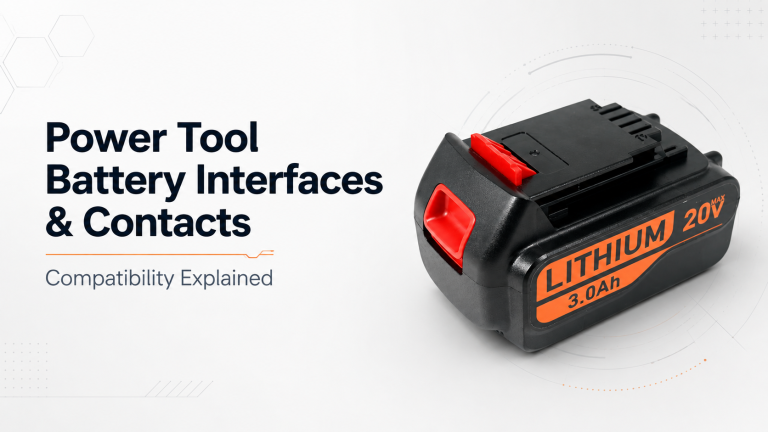
Physical interface — Tool platforms can use different slide-in or snap-in structures, rail geometry, latch mechanisms, contact locations, and terminal layouts. For a deeper explanation, see this guide to power tool battery interfaces and contact compatibility.
Communication requirements — Some newer tool platforms use additional data terminals or electronic communication between the battery, tool, and charger. A mechanically compatible battery may still fail to operate correctly if the required communication is missing.
Electrical characteristics — The tool controller may expect a certain voltage range, internal-resistance profile, current capability, and protection behavior. Different BMS trip points or excessive battery voltage sag can affect tool performance.
This is why fit is not the same as compatibility.
For replacement projects, the original battery model, voltage, capacity, interface, contacts, connectors, tool model, charger model, mechanical fit, discharge load, and protection requirements should all be checked before confirming the appropriate product path.
For OEM/ODM projects, these requirements can be defined together with the tool from the beginning. For aftermarket replacement batteries, compatibility should be verified against the actual target tool and charger rather than inferred from brand name or nominal voltage alone. Buyers dealing with unexpected fit or operating issues may also find this overview of common replacement battery compatibility problems useful.
Safety and Documentation Requirements for Nail Gun Battery Packs
Replacement and custom lithium-ion battery packs for power tools may need to meet different safety, product, and transport requirements depending on the battery configuration and target market.
Examples referenced in power-tool and lithium-battery projects include:
GB/T 38844 — China’s national standard covering lithium-ion battery safety requirements for power tools, including electrical, mechanical, and environmental abuse tests.
UL 2580 — A US battery-system safety standard covering areas such as short circuit, overcharge, mechanical abuse, and thermal stability.
IEC 62133-2 safety requirements for portable lithium-ion cells and batteries — An international safety standard covering portable sealed secondary lithium cells and batteries.
UN 38.3 — A transport-related test requirement for lithium-ion batteries covering altitude simulation, thermal testing, vibration, shock, external short circuit, and other transport conditions. International shipments should also be reviewed against current lithium battery transport and shipping requirements applicable to the selected transport mode.
Documentation should be verified for the exact product configuration before production or shipment.
A frequent procurement mistake is assuming that a document applying to an individual cell automatically covers the finished battery pack. Product scope, test scope, battery configuration, and shipment requirements must be checked separately.
For B2B orders, document availability should be reviewed according to the specific battery model, configuration, transport method, and destination market rather than assumed to apply universally.

How to Test a Cordless Nail Gun Battery Pack Before Production
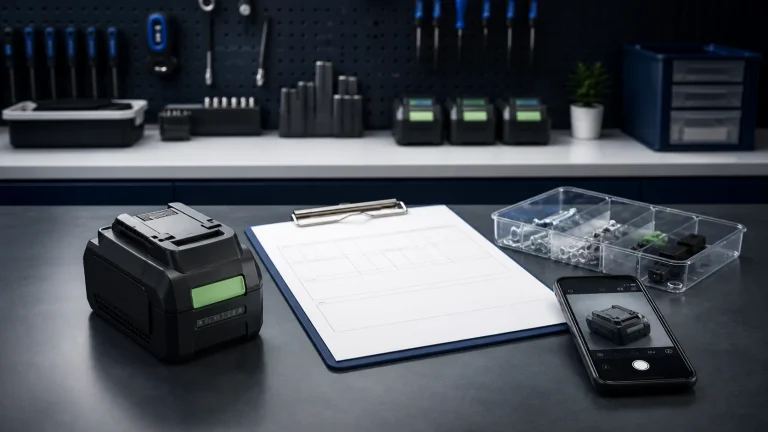
Before approving a battery pack for a cordless nailer—whether it is a replacement battery or a custom OEM/ODM design—the following validation sequence provides a practical starting point.
1. Capture the Peak-Current Waveform
Use a current clamp or shunt resistor with an oscilloscope to capture the actual current waveform during both single-shot and rapid-fire modes.
Verify that the battery pack’s peak-current capability exceeds the measured maximum by at least 50%.
2. Perform a Full-Magazine Firing Test
Load the tool to capacity and fire continuously at the maximum intended rate.
Monitor cell temperature at multiple locations. The battery should complete a full magazine without incomplete drives and without any cell exceeding 60 °C.
3. Run a Cycle-Endurance Test
Repeat the full-magazine test for at least 50 charge-discharge cycles.
Track shots per charge over time. A well-designed pack should show less than 5% runtime degradation over this interval.
4. Measure Voltage Sag Under Peak Load
Capture pack-terminal voltage during the firing event and compare it with the tool’s minimum operating-voltage requirement.
Excessive sag may indicate excessive internal resistance in the cells, welds, busbars, contacts, or interconnections.
5. Verify BMS Protection Behavior
Trigger controlled over-current, over-temperature, and over-voltage conditions to confirm that the BMS responds within the intended thresholds and delays.
Normal firing pulses should not trigger a protection event.
For a B2B battery project, these electrical tests should not be separated from application and compatibility review. GeB Power’s battery engineering and OEM/ODM project support connects application review, pack engineering, sample validation, and production handoff so that tool load, voltage platform, interface, protection, sample acceptance, and production requirements can be reviewed before volume manufacturing.
The practical principle is straightforward: calculate first, validate in the intended tool, then approve the production specification.
Conclusion
The central requirement for a cordless nail gun battery is not simply a large Ah number. Peak current determines whether the pack can reliably support each firing event, while usable battery energy and tool efficiency determine runtime. Cell discharge capability, internal resistance, voltage sag, BMS protection, thermal behavior, and tool compatibility all influence the final result.
For replacement or custom battery projects, the most reliable approach is to start with the actual application and load profile, then validate the selected battery pack in the intended nailer and charger before production.
GeB Power is a Shenzhen-based B2B supplier of compatible replacement power tool batteries and an OEM/ODM battery project partner, supporting application review, compatibility verification, battery pack engineering, sample validation, and structured production handoff. If you are evaluating a cordless nail gun battery project, contact GeB Power to discuss the target tool, voltage platform, load, capacity, interface, protection requirements, quantity, and destination market.
FAQ
What battery specification matters most for a cordless nail gun?
Peak-current capability is critical because the battery must support the short, high-power pulse required during each firing event. Capacity and watt-hours then determine how much total work can be completed between charges.
A suitable cordless nail gun battery therefore needs both adequate peak discharge current and sufficient usable energy.
Does a higher Ah battery make a cordless nail gun more powerful?
Not necessarily.
A higher Ah rating usually means more stored energy and potentially longer runtime within the same tool platform. It does not automatically mean that the battery can deliver a higher peak current.
Cell internal resistance, discharge capability, pack configuration, busbar and weld resistance, and BMS settings all influence power delivery.
Why can a nail gun stop even when the battery still shows remaining charge?
One possible reason is voltage sag.
When the nailer demands a high current pulse, pack voltage can fall temporarily. If it drops below the tool’s operating threshold—or if the BMS interprets the current pulse as an over-current condition—the tool may stop even though the battery still contains stored energy.
Thermal protection can produce similar symptoms during repeated rapid firing.
Are 21700 cells always better than 18650 cells for nail guns?
No.
21700 cells can provide higher capacity and lower internal resistance in some designs, making them attractive for high-power cordless nailers. However, actual performance depends on the specific cell model, discharge rating, thermal behavior, pack configuration, and mechanical space available.
A suitable high-drain 18650 design may still be appropriate for lower-power brad, finish, or pin nailer applications.
How should an OEM/ODM nail gun battery be validated before mass production?
Validation should use the actual target tool and operating conditions.
Engineering teams should measure peak current, voltage sag, temperature rise, shots per charge, repeated-firing behavior, BMS protection response, charger compatibility, and mechanical fit. Sample validation should be completed before the final production specification is released.
For teams still comparing sourcing options, this replacement power tool battery buyer’s guide provides additional checkpoints for model identification, voltage, capacity, compatibility, and procurement review.